How Much Soil Do You Need for a Raised Bed?
A worked calculation for raised bed soil volume in cubic feet, cubic yards and liters, with conversions to bags and to topsoil and compost shares.
At a glance
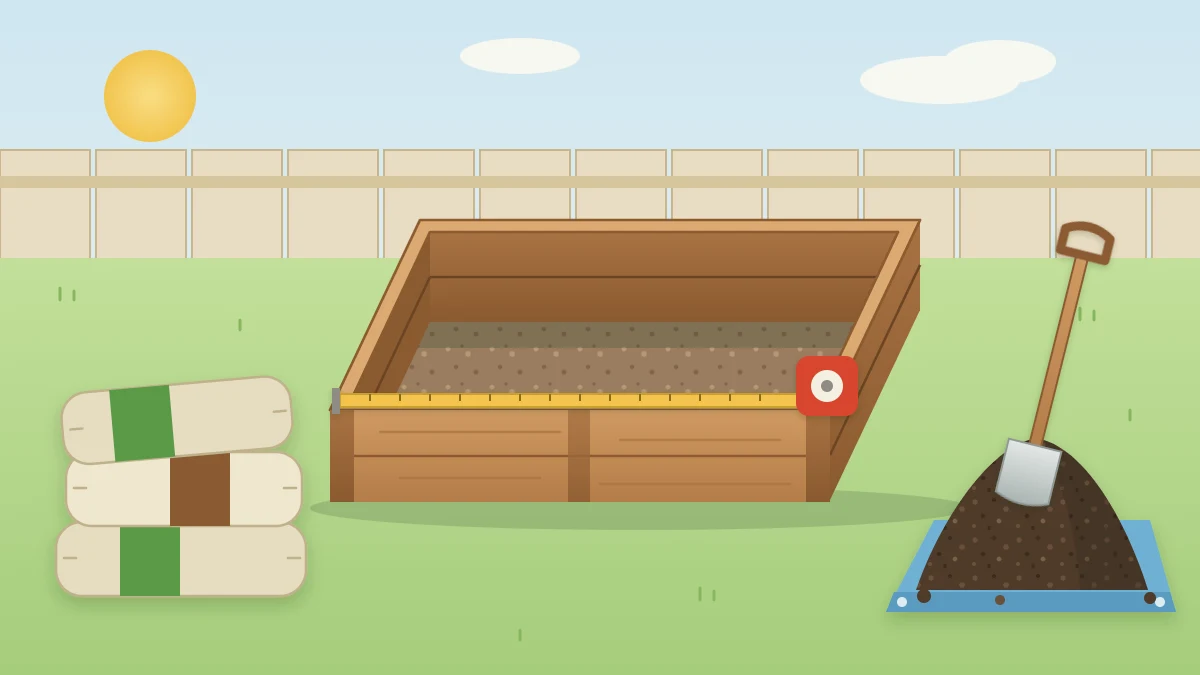
What you need
- Tape measure
- Pencil and paper
- Calculator
- The soil recipe you plan to use
- Bag volume from the label
Ordering fill is the point where a raised bed project meets arithmetic. Order too little and the bed sits half empty while you wait for more; order too much and a heap stays on the driveway. The question of how much soil for a raised bed comes down to one formula and a tape measure.
The steps below work through a full example in US units and another in metric, then show how to turn the total into bags and into topsoil and compost shares.
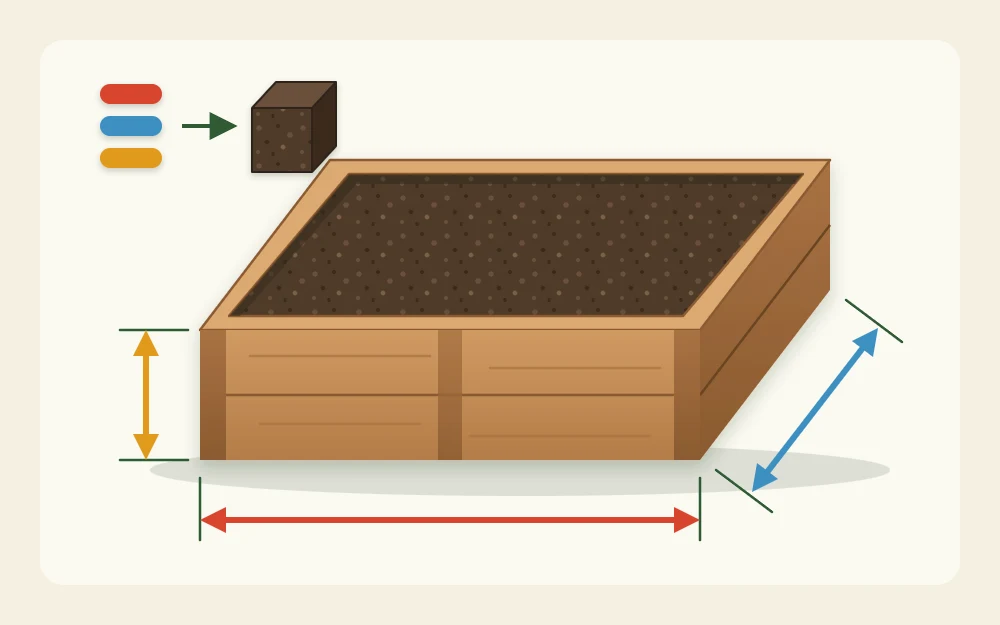
The formula: length x width x depth
A rectangular bed is a box, and the volume of a box is its three sides multiplied together:
Volume = length x width x depth
The one rule is that all three measurements must be in the same unit. Measure everything in feet and the answer is in cubic feet. Bulk soil is commonly sold by the cubic yard, and one cubic yard is 27 cubic feet (a cube 3 ft on each side), so divide cubic feet by 27 to get cubic yards.
Tip
Measure the inside of the frame, not the outside, and measure depth from the ground up to the level you intend to fill to. Thick walls and an empty strip below the rim both reduce the volume.
Worked example: a 4 ft by 8 ft bed
Take a bed 8 ft long and 4 ft wide on the inside (about 2.4 by 1.2 m), to be filled 10 in (25 cm) deep.
- Convert the depth to feet. There are 12 inches in a foot, so 10 divided by 12 is 0.833 ft.
- Multiply length by width. 8 x 4 = 32 square feet of surface.
- Multiply by the depth. 32 x 0.833 = 26.7 cubic feet, rounded to one decimal place.
- Convert to cubic yards. 26.7 divided by 27 = 0.99, so just under 1 cubic yard.
Do not skip the first step. Inches have to become feet before they go into the formula.
The same sum in metric
In metric, measure in meters and the answer is in cubic meters. One cubic meter is 1,000 liters, which is handy because bags are labeled in liters.
For a bed 2.4 m long and 1.2 m wide, filled 25 cm deep:
- Convert the depth to meters. 25 cm is 0.25 m.
- Multiply the three sides. 2.4 x 1.2 = 2.88 square meters, and 2.88 x 0.25 = 0.72 cubic meters.
- Convert to liters. 0.72 x 1,000 = 720 liters.
This is nearly the same bed as the first example; 26.7 cubic feet is about 755 liters, and the small gap comes from rounding the measurements.
Converting the volume to bags
Bagged soil, compost and growing mix state their volume on the bag. Divide your total by that figure and round up to a whole bag.
- With bags of 1.5 cubic feet: 26.7 divided by 1.5 = 17.8, so 18 bags.
- With bags of 2 cubic feet: 26.7 divided by 2 = 13.35, so 14 bags.
- With 50-liter bags for the metric bed: 720 divided by 50 = 14.4, so 15 bags.
Check the unit on the label before you divide. Some bags are sold by weight, which tells you little about volume.
Splitting the total into topsoil and compost
Few beds are filled with one material. Once you know the total, split it by the recipe you have chosen. Published recipes differ, and the guide to raised bed soil mix explains how to pick between them. Using the 26.7 cubic feet from the example:
| Recipe | Topsoil | Compost |
|---|---|---|
| 70% topsoil and 30% compost (University of New Hampshire Extension) | 26.7 x 0.70 = 18.7 cubic feet | 26.7 x 0.30 = 8.0 cubic feet |
| Compost and topsoil at 1:2 (University of Maryland Extension) | Two thirds: 17.8 cubic feet | One third: 8.9 cubic feet |
| Compost and topsoil at 1:1 (University of Maryland Extension) | Half: about 13.3 cubic feet | Half: about 13.3 cubic feet |
The first recipe comes from the University of New Hampshire Extension’s article on raised beds for small spaces. The other two are the ratios that the University of Maryland Extension’s guide to soil for raised beds describes for beds over compacted or clay soil. For a ratio, add the parts together first: 1:2 is three parts in total, so compost is one third and topsoil two thirds.
Allow for settling and the space below the rim
Two adjustments pull in opposite directions.
Fill to a little below the rim. Leaving an inch or two (roughly 3 to 5 cm) of frame above the soil keeps water and mulch from washing over the edge. That is why the example uses the fill depth rather than the full height of the frame. How tall the frame should be in the first place is a separate question, covered in how deep a raised bed should be.
Expect the level to drop. Freshly tipped soil is fluffed up with air. In the first weeks, as it is watered and rained on, it settles and the level sinks.
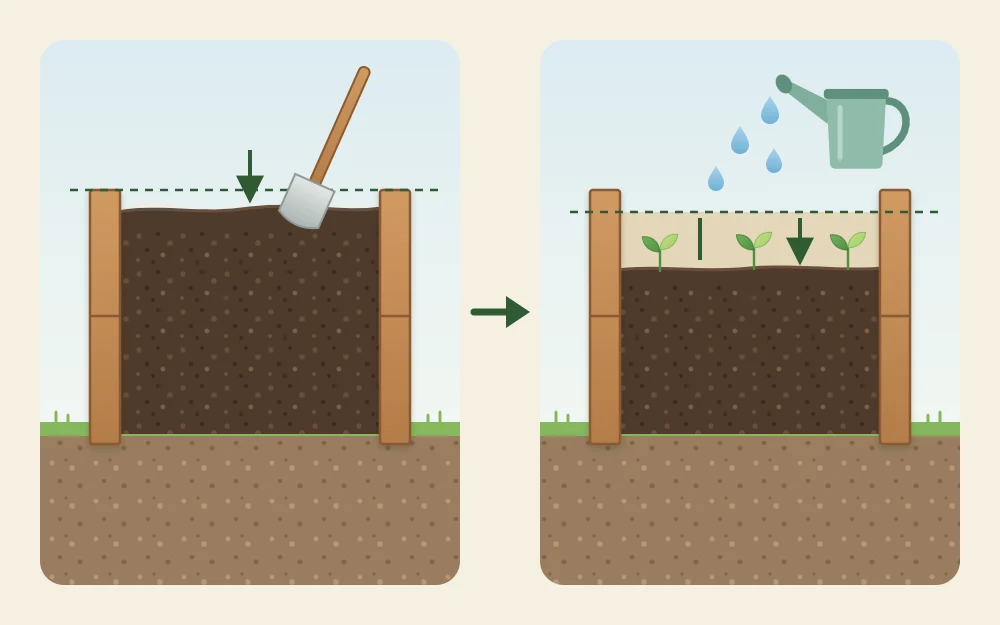
How much it settles depends on the materials, so there is no reliable figure to add. Round your order up rather than down, mound the fill slightly, and keep any surplus covered for topping up. The level keeps falling slowly in later years as organic matter breaks down; the tutorial on refreshing raised bed soil covers the yearly top-up.
Bulk delivery or bags?
Bags suit a single small bed, a top-up, or a yard a truck cannot reach. For several beds, the number of bags and trips climbs quickly.
Bulk delivery suits larger volumes, typically from around a cubic yard upward. Check the supplier’s minimum order, where the load can be tipped, and how far you will have to wheel it. Ask what the blend contains and where the soil comes from, and avoid fill of unknown origin for a food bed.
Round and odd-shaped beds
For a round bed, multiply 3.14 by the radius, by the radius again, and by the depth. The radius is half the width across. A round bed 4 ft across and filled 10 in deep gives 3.14 x 2 x 2 x 0.833 = 10.5 cubic feet. For an L-shaped or U-shaped bed, divide the shape into rectangles, work out each one with the formula above, and add the results.
Frequently asked questions
How many cubic feet of soil does a 4x8 raised bed need?
It depends on the fill depth. Multiply 32 square feet by the depth in feet: about 16 cubic feet at 6 in deep, 21.3 at 8 in, 26.7 at 10 in and 32 at 12 in. Measure the inside of your own frame, because wall thickness changes the result.
How many bags of soil make a cubic yard?
A cubic yard is 27 cubic feet, so divide 27 by the volume printed on the bag. That is 27 bags of 1 cubic foot, 18 bags of 1.5 cubic feet, or 14 bags of 2 cubic feet once you round up. Check that the label gives volume, not weight.
Should I order extra soil to allow for settling?
A little extra is sensible, because fresh fill sinks as it is watered in. The amount varies with the materials, so there is no fixed allowance. Round your order up, mound the bed slightly when filling, and keep any surplus covered for topping up later in the season.