Raised Bed Soil Mix: What to Fill a Raised Bed With
What topsoil, compost and soilless growing mix each do in a raised bed, the blends extension services suggest for different situations, and what to leave out of the fill.
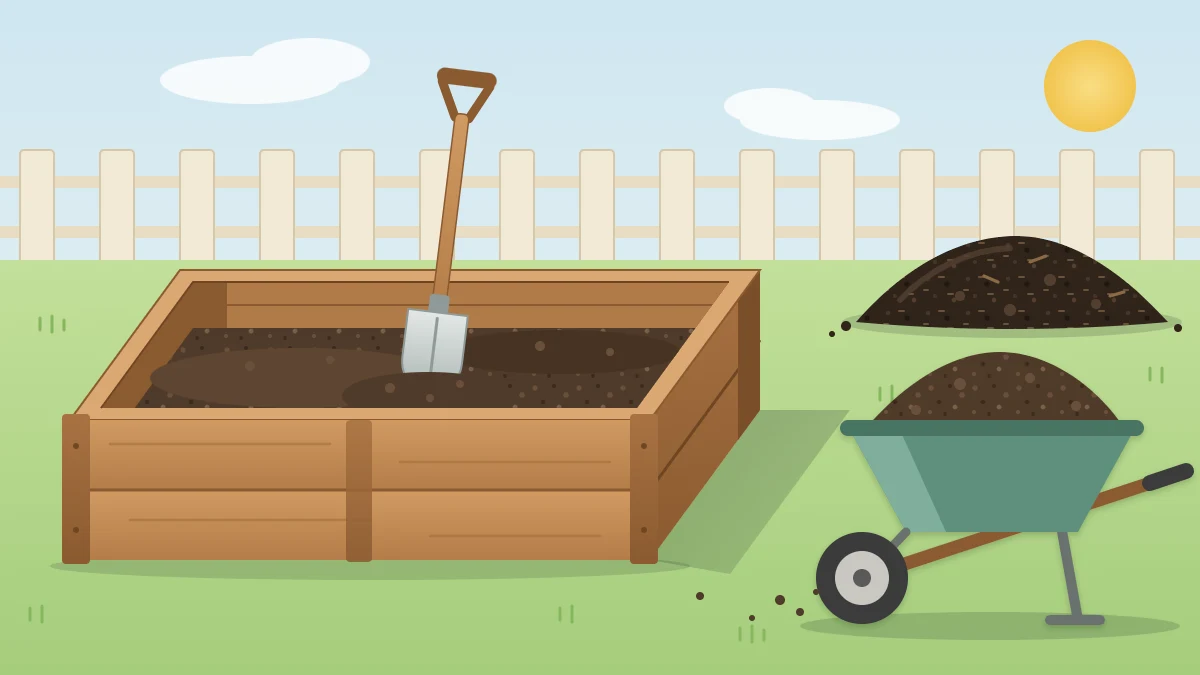
An empty frame raises the obvious question: what goes in it? A good raised bed soil mix is not an exotic product. It is a blend of a few ordinary ingredients, each doing a different job, in proportions that suit where the bed sits.
You will find several published recipes, and they do not agree with each other. That is less of a problem than it sounds. Once you know what each ingredient is for, the recipes read as reasonable variations rather than competing answers.
What the fill has to do
Whatever you put in the bed has four jobs to do at once:
- Hold water long enough for roots to use it.
- Drain the excess, so roots also get air.
- Hold nutrients and release them over the season.
- Stay loose, so roots can push through and the surface does not set hard.
No single material does all four well. Sand drains but holds little. Clay holds plenty but packs tight. That is why the fill is a blend.
The three usual ingredients
Most fills are built from two or three of these.
- Topsoil is the mineral body of the mix: sand, silt and clay particles. It gives weight, holds nutrients and keeps the level from sinking quickly, because minerals do not rot away.
- Compost is decomposed organic matter. It improves both water holding and drainage, feeds the life in the soil and supplies nutrients slowly.
- Soilless growing mix is the light, fluffy material sold for containers. It is useful where there is no ground under the bed, because it stays open and drains freely in a closed space.

Published recipes differ, and that is fine
Extension services give different proportions, mostly because they are describing different situations. The University of Maryland Extension’s guide to filling raised beds sorts its advice by what the bed sits on. The University of New Hampshire Extension’s article on raised beds for small spaces suggests a leaner blend with a lower compost share.
| Situation | Suggested blend | Source |
|---|---|---|
| Bed over compacted or clay soil | Compost and purchased topsoil at 1:2 or 1:1, or compost and soilless growing mix at 1:1 | University of Maryland Extension |
| Bed on a hard surface | Compost and soilless growing mix at 1:1 | University of Maryland Extension |
| Bed over an existing garden bed | 2 to 4 in (5 to 10 cm) of compost mixed into the top 4 in (10 cm) | University of Maryland Extension |
| General raised bed fill | 70% topsoil and 30% compost | University of New Hampshire Extension |
Seen together, the figures fall within a band. The University of Maryland Extension describes organic matter of 25% to 50% by volume in a raised bed, and the blends above mostly land inside it.
Treat any recipe as a starting point
Each of these is a starting point, not a formula to defend. The topsoil you can buy locally may be sandy or heavy, and compost varies from batch to batch, so the same ratio gives different results in different yards.
Lean toward the lower compost share when your topsoil is already dark and crumbly, and toward the higher one when it is pale, sandy or dense. If you want to understand what compost adds and why more is not always better, see the guide to compost for raised beds.
Tip
Blend the ingredients as you fill, a few inches at a time, rather than stacking them in layers. Roots and water move more easily through an even mix.
What to leave out
- Fill of unknown origin. Free soil from a building site or roadside may carry debris, weed seeds or contaminants. Know where your soil comes from.
- Pure compost. It shrinks quickly as it breaks down, can dry into a crust and may supply more of some nutrients and salts than plants need.
- Heavy clay subsoil. The dense, pale material from deep digging packs tight and drains poorly.
- Fresh manure. Only fully composted manure belongs in a food bed.
- A gravel layer at the bottom. It is often added to help water escape, but it tends to do the opposite: water lingers in the finer soil above a coarse layer before it moves down. The guide to raised bed drainage explains why and what helps instead.
Let the fill meet the ground below
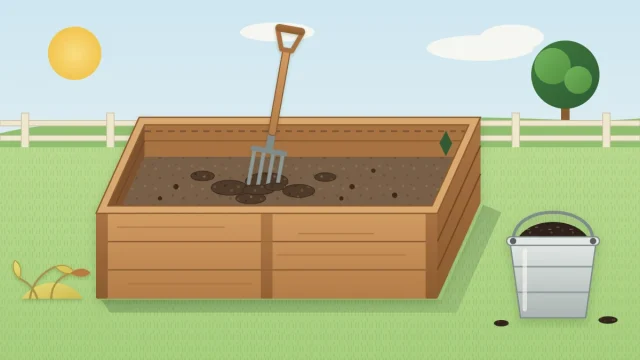
Where the bed sits on soil, loosen that ground with a garden fork before filling. Roots then pass from the fill into the native soil, and water drains through instead of pooling at the boundary.
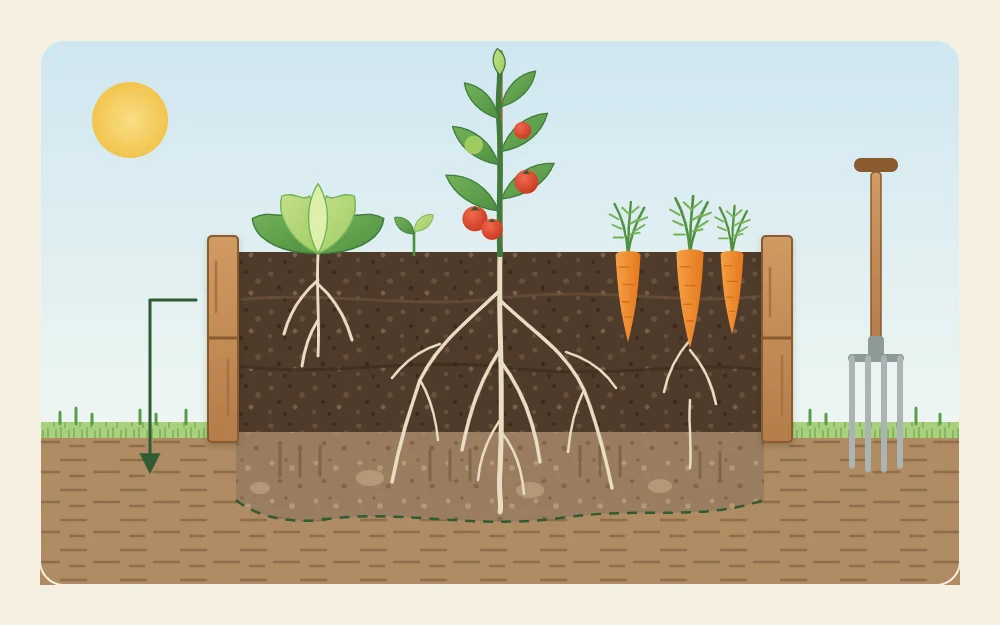
On a patio or other hard surface there is nothing below, which is why the lighter compost and soilless mix blend is suggested there.
Bags or bulk
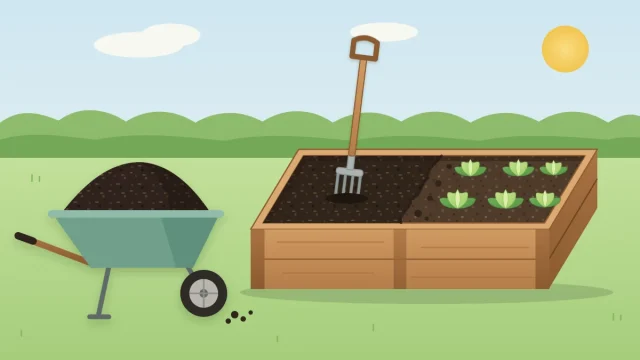
Bagged products are convenient for one small bed: they are easy to carry, the volume is printed on the bag and the contents are listed. For several beds, a bulk delivery of loose material is usually less work per unit and creates far less packaging, but you need somewhere for the pile and a wheelbarrow to move it.
Bulk suppliers often sell a ready-made “garden blend” or “raised bed blend”. The name tells you little, so ask:
- What is in the blend, and in roughly what proportions?
- Where does the topsoil come from?
- What is the compost made from, and is it fully finished?
- Has the blend been tested, and can you see the results?
A supplier who answers these readily is a good sign. Before you order, work out the volume with the guide to how much soil a raised bed needs, and allow a little extra because fresh fill settles.
Test the soil after the first season
A new blend is an unknown. A soil test after the first growing season tells you its pH and nutrient levels, which you cannot judge by eye. The University of Maryland Extension gives a pH of 6.2 to 6.8 as suitable for most vegetables and herbs.
Your local extension office can point you to a testing lab and explain how to take the sample. Add fertilizer or lime only as the soil test report and the product label call for, and repeat the test every few years to see how the bed is changing.
Frequently asked questions
Can I fill a raised bed with bagged potting mix alone?
You can, and on a hard surface a light mix is useful, but extension guidance usually pairs it with compost rather than using it alone. For a bed sitting on soil, a blend of topsoil and compost is the more common choice, because the mineral part keeps the level from sinking as quickly.
Can I use soil dug from the yard in a raised bed?
Often, yes, as the topsoil part of the blend, provided it is reasonable garden soil and not dense subsoil. Near older painted buildings or busy roads, have it tested for lead first. Mixing in compost improves most yard soils for use in a bed.
Why has the soil level in my new raised bed dropped?
Fresh fill settles as it is watered, and the organic part keeps breaking down over time, so some drop in the first weeks and each year after is normal. Top the bed up with compost or a compost and topsoil blend rather than replacing what is there.