Raised Bed Pathways: Width, Surfaces and Layout
How much space to leave between raised beds, how to test a path width for kneeling and a wheelbarrow, and how wood chips, straw, gravel, grass and pavers compare.
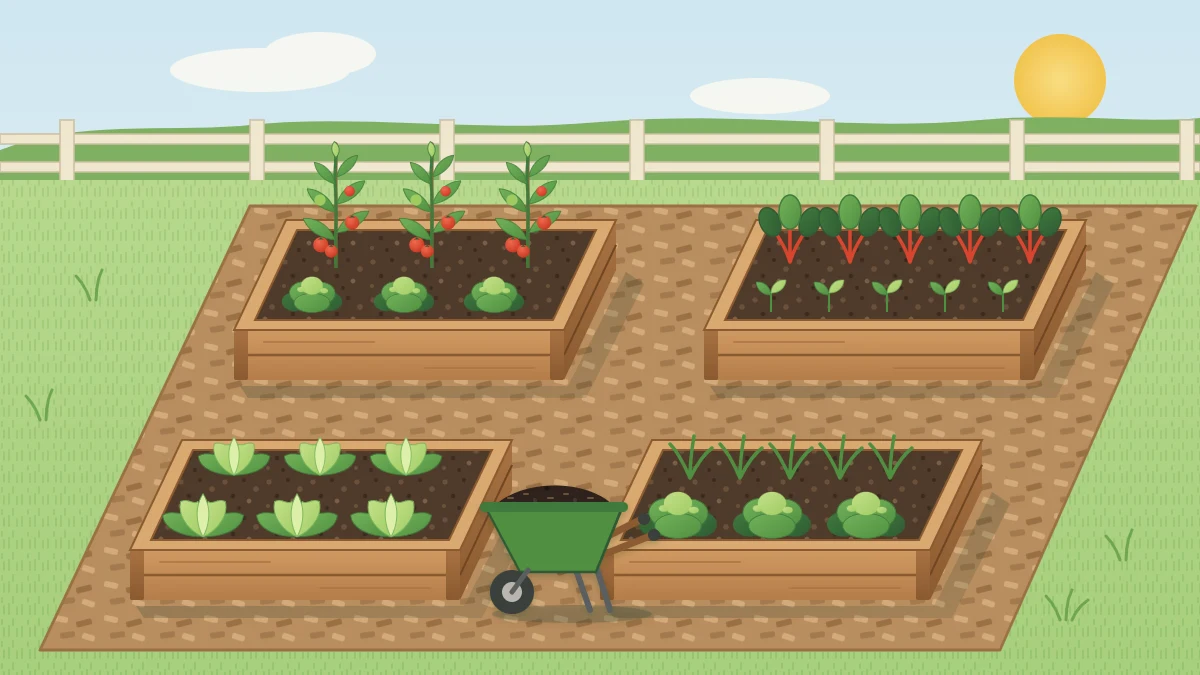
Raised bed pathways tend to get whatever space is left once the beds are drawn. That is backwards. You will walk, kneel, haul compost and drag a hose along those strips many times a week, so they deserve as much thought as the beds themselves.
No single path width suits every yard. The useful question is what has to pass between your beds, and the answer is different for a gardener with a watering can and one with a loaded wheelbarrow.
How wide: what the published figures say
Extension sources give noticeably different numbers. Oregon State University Extension’s raised bed gardening guide mentions walkways of about 14 to 16 in (35 to 40 cm) between beds. The University of Maryland Extension’s page on growing vegetables in raised beds describes paths of about 2 ft (60 cm), covered with wood chips or mulch.
Neither is wrong. The narrow figure gives the most growing area in a small space and is enough to walk through sideways with a trowel. The wider one is easier to kneel and turn in. If a wheelbarrow, a mower or a wheelchair has to get through, you will need more than either.
Measure what has to pass
Work out your own figure from the things you will actually move through the garden.
- A wheelbarrow or cart. Measure it at its widest point, then add room for your hands and for a wobble under load.
- Kneeling. Lay two boards on the lawn at a trial distance and kneel between them. Turn around, reach to both sides and stand up again. Widen the gap until it feels easy.
- A mower. If the paths will be grass, they must take the mower in one pass, with a little to spare beside the frames.
- A wheelchair, walker or garden seat. Check the width of the device and the space it needs to turn, and plan a firm, even surface. Ask the person who will use it to try a mock-up.
- Plants. Squash, tomatoes and other vigorous crops lean out over the frame by midsummer and narrow the path from both sides.

One main path, narrower side paths
Not every path has to be the same width. A layout that works well in many yards has one wide main path that takes the wheelbarrow from the gate or the compost area to the beds, with narrower side paths between individual beds for walking and kneeling.
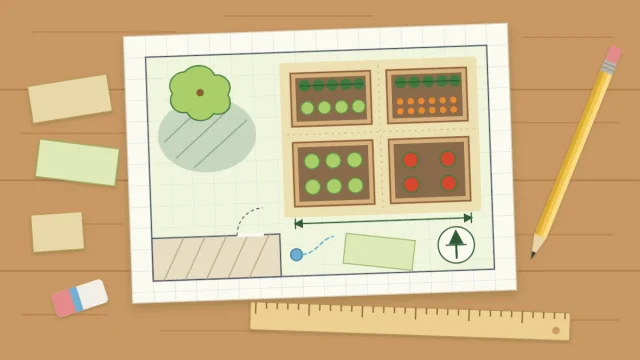
Path width and bed width work together. If each bed is narrow enough to reach the middle from either side, as covered in the guide to raised bed size, the side paths only have to hold you, not your whole stretch. Sketching beds and paths together on paper before building saves a lot of second thoughts, and the tutorial on planning a raised bed garden layout shows how.
Tip
Mark the paths with string before the beds go in, then push the empty wheelbarrow along the whole route, including the corners. Turning needs more room than going straight.
Path surfaces compared
The surface decides how much weeding and mud you live with. Costs vary by region and by what is available locally, so they are compared here only in relative terms.
| Surface | Cost and effort to lay | Weeds and mud | Upkeep |
|---|---|---|---|
| Wood chips | Low, sometimes free from local tree work | Suppress weeds well when laid thickly; drain well | Top up as they break down |
| Straw | Low | Fair weed control; can be slippery when wet | Replace each season |
| Gravel | Higher, and heavy to move | Firm and dry; weeds seed into it over time | Occasional raking and weeding; hard to remove later |
| Mown grass | Lowest if the lawn is already there | Soft underfoot; muddy with heavy use; creeps into beds | Regular mowing and edging |
| Pavers | Highest | Firm, clean and level; weeds in the joints | Little once laid |
| Cardboard under mulch | Low | Smothers existing grass and weeds under the chips or straw | Cardboard breaks down; renew the mulch above |

For cardboard, use plain brown sheets with tape and labels removed, overlap the edges and cover them straight away, because wet bare cardboard is slippery. Wood chips are a path material more than a bed material: the guide to mulching raised beds explains what to use around the crops themselves.
Keep path material out of the beds, and soil out of the paths
Paths and beds stay tidy when each keeps to its side of the frame.
- Fill beds to a little below the rim so that soil and water do not wash over the edge.
- Keep path mulch below the top of the frame, and rake it back when it creeps up against the boards.
- Do not dig path wood chips into the bed soil. Leave them on the surface of the path, where they break down slowly.
- With grass paths, edge along the frames regularly. Grass runners find their way under and over a low frame quickly.
- Pull weeds in the paths before they set seed, or the seed ends up in the beds.
Slopes and running water
On sloping ground, paths can become channels. A path that runs straight downhill gathers rainwater, and the water carries wood chips and straw to the bottom of the garden.
Where you can, run the beds and the main paths across the slope rather than down it. The University of Maryland Extension advises terracing a sloped site for a vegetable garden, so that each bed and its path sit level. Coarse wood chips move less than fine mulch or straw. Watch where water flows in a heavy rain before you settle on a surface, and for a steep site get qualified help with the groundwork.
A quick check before you build
- List what must pass: feet, knees, wheelbarrow, mower, wheels.
- Measure the widest item and test the gap with boards or string.
- Decide on one main path and the narrower side paths.
- Choose a surface you are willing to maintain.
- Walk the whole route once more with full hands.
Space given to a path is not lost growing area. A bed you can reach easily from a path you enjoy walking gets visited more often, and a bed that is visited gets watered, weeded and picked on time.
Frequently asked questions
How much space should I leave between raised beds?
Published figures range from about 14 to 16 in at Oregon State University Extension to about 2 ft at the University of Maryland Extension. Take those as a starting range for walking paths, then widen any path that must take a wheelbarrow, a mower or a wheelchair after measuring the item.
What is the cheapest thing to put between raised beds?
Existing lawn costs nothing to lay but needs mowing and edging. Wood chips over plain cardboard are a low-cost alternative that smothers grass and keeps mud down, and tree services sometimes give chips away. Whichever you choose, plan to top it up or maintain it every year.
Should I put landscape fabric under the paths?
It is optional. Fabric slows weeds coming up from below, but seeds still sprout in the mulch on top and roots can knit into the fabric, which makes later removal a chore. Many gardeners use plain cardboard instead, since it smothers grass and then breaks down.