Raised Bed Size: Choosing Width and Length You Can Reach
How to choose a raised bed width from your own reach, what extension services suggest for freestanding and fence-side beds, and how to decide on length and number of beds.
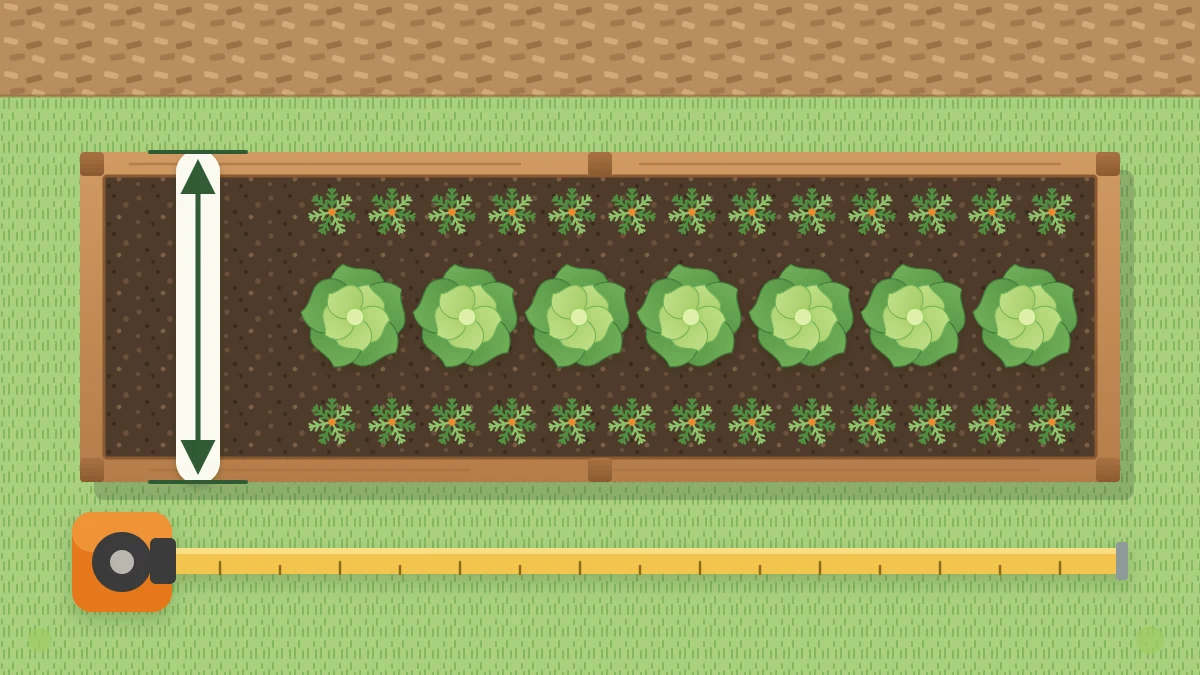
Choosing a raised bed size starts with your own arm, not with a catalog. The width has to let you reach the middle of the bed without stepping on the soil, because soil that is never walked on stays loose, and loose soil is the main thing a raised bed gives you.
Length, height and the number of beds follow from that. Published figures from extension services sit in a narrow band, but they differ a little from one another, and your reach, your yard and your budget decide where you land inside it.
Why width comes first
Every job in a bed happens at arm’s length: sowing, thinning, weeding, tying up and picking. If the center is out of reach, one of two things happens. Either the middle gets neglected, or you put a knee or a foot on the soil to get there, and the soil packs down where you lean.
What extension services suggest
The published figures agree on the idea and vary on the number:
- Oregon State University Extension’s raised bed gardening guide calls a maximum width of 4 ft (1.2 m) a good choice for adult gardeners.
- The University of Maryland Extension describes raised beds as usually 2 to 4 ft (60 cm to 1.2 m) across.
- The University of New Hampshire Extension’s article on raised beds for small spaces gives 3 to 4 ft (90 cm to 1.2 m) as the maximum before you have to step into a bed reached from all sides, and 2 to 2.5 ft (60 to 75 cm) for a bed against a house, shed or fence.
Notice that the upper figures are described as maximums. None of these sources says a bed should be 4 ft wide; they say that beyond about that point most adults can no longer reach the middle. A shorter person, a child or anyone who finds bending difficult will be more comfortable with less.

Measure your own reach
A tape measure answers the question better than any published range. It takes two minutes.
- Kneel or crouch at the edge of a lawn or a rug, the way you would beside a bed.
- Reach forward as if pulling a weed with one hand. Stop where it is still comfortable, not at full stretch.
- Have someone measure from your knees to your fingertips, or mark the spot and measure it yourself.
- For a bed you can work from both sides, double that figure to get your widest comfortable bed. For a bed against a fence or wall, use the single figure.
Repeat the test for anyone else who will garden with you, and build for the shortest reach.
Tip
If you plan a tall bed, test your reach standing and leaning over a table of about the same height. Reaching over a high wall is different from reaching across a low one.
Width by situation
| Situation | Suggested width range | Why |
|---|---|---|
| Freestanding bed, reached from both sides | 3 to 4 ft maximum (University of New Hampshire Extension); 4 ft maximum for adults (Oregon State University Extension) | Each side only has to reach halfway |
| Bed against a house, shed or fence | 2 to 2.5 ft (University of New Hampshire Extension) | All the reaching is done from one side |
| Children’s bed | Narrower than the adult figures; measure the child’s reach | Shorter arms, and the bed should invite them in |
| Seated gardening or limited reach | Measure from the position you will work in | Comfortable reach is shorter when seated or when bending is hard |
Length: free, with a few limits
Length does not affect reach, so in principle a bed can be as long as the space allows. In practice three things hold it back.
- The walk around. A very long bed is tempting to step across in the middle. Two shorter beds with a gap between them save steps and protect the soil.
- The frame. A long side holds back a lot of wet, heavy soil that pushes outward. Keep to the lengths your kit or materials are designed for and follow the kit maker’s instructions. For anything long or tall, get qualified help.
- The yard. A bed needs space on its working sides. The guide to raised bed pathways covers how much room to leave for walking, kneeling and a wheelbarrow.
Many gardeners settle on a rectangle about twice as long as it is wide, such as 4 ft by 8 ft (1.2 by 2.4 m). That is 32 square feet (about 3 square meters), which falls inside the 25 to 50 square feet the University of Maryland Extension suggests for a starter garden. It is a common shape, not a requirement.
Height, in brief
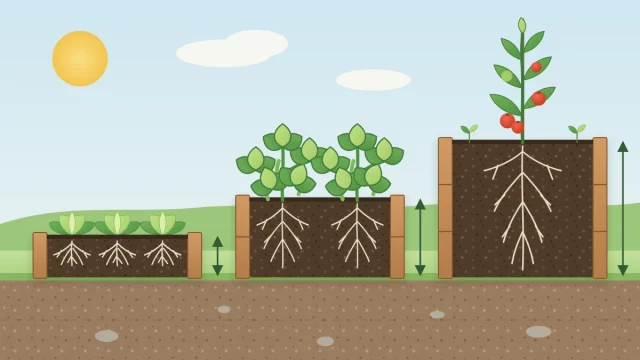
Height is a separate decision from width and length. It depends on the crops you want and on what lies under the bed: over loosened ground, roots carry on below the frame, while on a hard surface the fill is all they get. The guide on how deep a raised bed should be walks through it by crop group.
Keep one link between the two decisions in mind. Every extra inch of height across a wide, long bed adds a surprising volume of fill. Before you commit to a size, run it through the calculation in how much soil you need for a raised bed.
Several small beds or one large one
For the same planting area, several modest beds usually serve better than one big one. They keep every plant within reach, give you separate places to move plant families between from year to year, and let you build in stages as time and budget allow.
The cost is path space and more frame material for each square foot of soil. One long bed is the more economical choice along a fence or in a narrow side yard.
If this is your first season, start with one or two beds. A second year’s bed is easy to add. A bed that proved too wide to reach across is not easy to fix.
Check the size on the ground
Before buying anything, mark the outline with string and stakes or a garden hose. Kneel beside it and reach for the middle. Walk around it with a watering can. Leave it for a few days and see whether it is in the way of the mower, the gate or the path to the compost bin. Adjusting a string costs nothing.
Frequently asked questions
Is a 4 by 8 foot raised bed a good size for a beginner?
It is a common choice and it works for many adults, because the middle is about 2 ft from either long side. Test your own reach first. If stretching 2 ft over the edge is uncomfortable, a bed 3 ft wide will be more pleasant to work in and will get better care.
How wide should a raised bed be against a fence?
Narrower than a freestanding bed, because you can only work from one side. The University of New Hampshire Extension gives 2 to 2.5 ft for a bed against a house, shed or fence. Measure how far you can comfortably reach while kneeling and do not go beyond that figure.
Can a raised bed be too small?
A very small bed still grows food, but it dries out faster and limits what fits, since one sprawling plant can fill it. If space is tight, choose compact crops such as salad greens, radishes and herbs, check the soil moisture often, and add a second bed later if you want more.