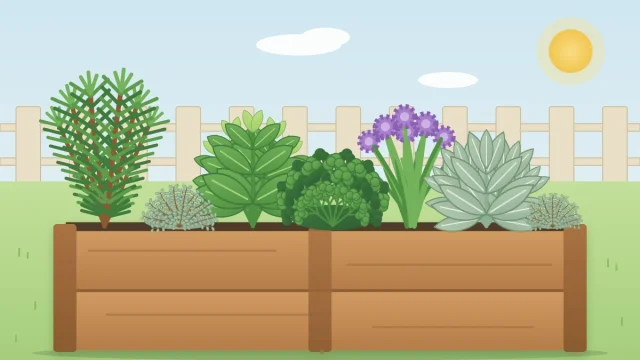
How to Lay Out a Raised Bed Herb Garden
A step-by-step way to arrange a herb bed: sort herbs by moisture, sun, height and life cycle, give each its mature width, set the pots out on the soil, then plant.
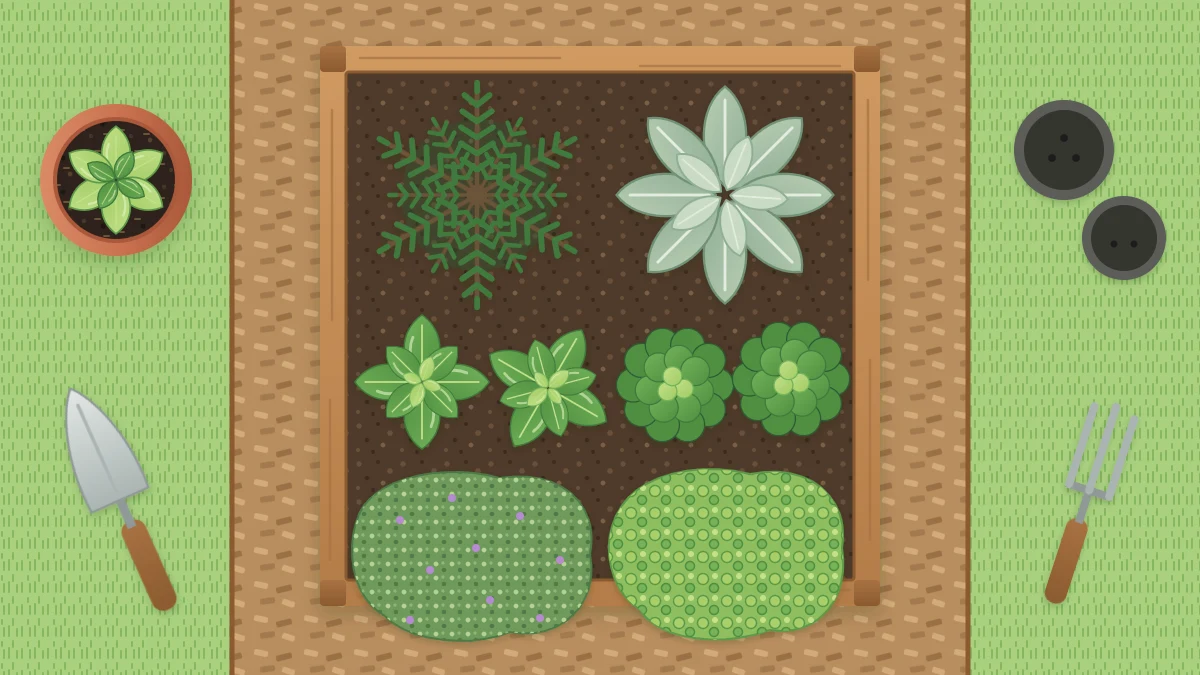
At a glance
What you need
- Herb plants in nursery pots
- Seed for dill and cilantro
- Paper and pencil
- Hand trowel
- Rake
- Watering can
- A pot for mint
A raised bed herb garden is one of the easiest beds to enjoy and one of the easiest to arrange badly. Herbs arrive as small pots that look alike, and a year later the sage has swallowed the thyme while the basil sulks in soil kept too dry for it.
A little sorting before you plant avoids that. The method below takes you from a list of herbs to a planted bed in which each plant has the conditions, the light and the room it needs.
Step 1: List the herbs your kitchen uses
Start with cooking, not with the plant rack. Write down the herbs you buy or wish you had on hand, and be honest about quantity: one sage plant supplies most households, while a family that makes pesto wants several basil plants.
Next to each name, note whether it is a perennial that stays for years or an annual replanted each season. If you are still choosing, the overview of the best herbs for raised beds describes what each one is like.
Step 2: Sort by moisture and sun
Herbs fall into two broad camps, and the bed works best when each camp has its own end.
- The drier, sunnier end is for Mediterranean perennials: rosemary, thyme, sage and oregano. They prefer lean, fast-draining soil that is allowed to dry somewhat.
- The moister end is for basil, parsley, cilantro and chives. They prefer soil with more compost and more even moisture.
If part of the bed is shaded for some of the day, give that part to parsley, cilantro and chives, which tolerate it, and keep the brightest part for the Mediterranean group and basil.
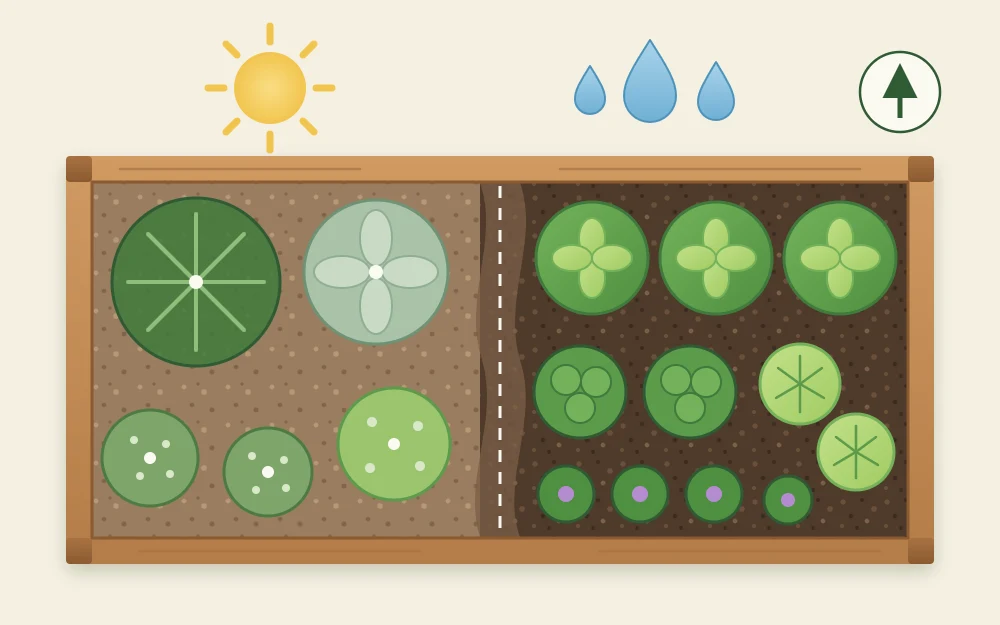
You can make the difference real with small adjustments: add compost to the moist end only, and check each end separately with a finger before you water.
Step 3: Sort by height and habit
Within each zone, arrange plants so the tall ones do not shade the short ones. In the Northern Hemisphere that means tall and bushy herbs toward the north side of the bed, or toward the back if the bed stands against a fence or wall. The University of Maryland Extension gives the same advice for vegetables in its guide to planning a vegetable garden: taller crops on the north and west sides.
- Back or north side: rosemary, sage and dill, which grow tall or wide.
- Middle: basil, parsley, cilantro and chives.
- Edges: thyme and oregano, which stay low and trail over the frame.
A bed you reach from every side can instead have the tall plants down the center line and the low ones around the rim. The article on raised bed planting layouts explains the tall-to-short principle and other patterns in more detail.
Step 4: Give perennials a permanent place
Rosemary, sage, thyme, oregano and chives may occupy their spots for years. Basil, cilantro, dill and usually parsley are cleared and replanted each season, and that patch gets forked over and topped up with compost.
Keep the two kinds apart so the yearly work does not disturb settled roots. Since the perennials mostly belong to the dry group and the annuals to the moist group, the two sorting steps tend to agree: perennials at one end, annuals at the other, with chives as a perennial marker at the boundary or in a corner of the moist end.
Good to know
Keep mint out of the bed. It spreads by runners through loose soil and crowds its neighbors. Grow it in its own pot beside the frame.
Step 5: Give each plant its mature width
This is where herb beds most often go wrong. A sage or rosemary plant in a small nursery pot can become a shrub several times that width, while a thyme plant stays a low cushion. One spacing for the whole bed leaves some plants cramped and others surrounded by bare soil.
Read the mature width or spacing on each plant tag and treat it as the circle that plant will fill. Neighboring circles can touch but should not overlap much. Where the tag is missing, the principles in the guide to raised bed plant spacing show how to find a figure for the variety.
The bed will look sparse at first. Fill the gaps between young perennials for the first season with quick annuals such as cilantro or a few lettuce plants, which are gone before the shrubs need the space.
Step 6: Sketch, then set out the pots
Draw the bed as a rectangle on paper, mark north, shade the dry and moist ends, and draw a circle for each plant at roughly its mature width. A sketch shows quickly if the list is too long for the bed.
Then take the plan outside:
- Rake the bed level.
- Stand every pot on the soil where the sketch puts it.
- Step back and walk around the bed. Check that you can reach every plant from the path without leaning on the soil.
- Imagine each plant at full size and slide pots apart where they would collide.
- Move the herbs you cut most often to the edge nearest the kitchen.
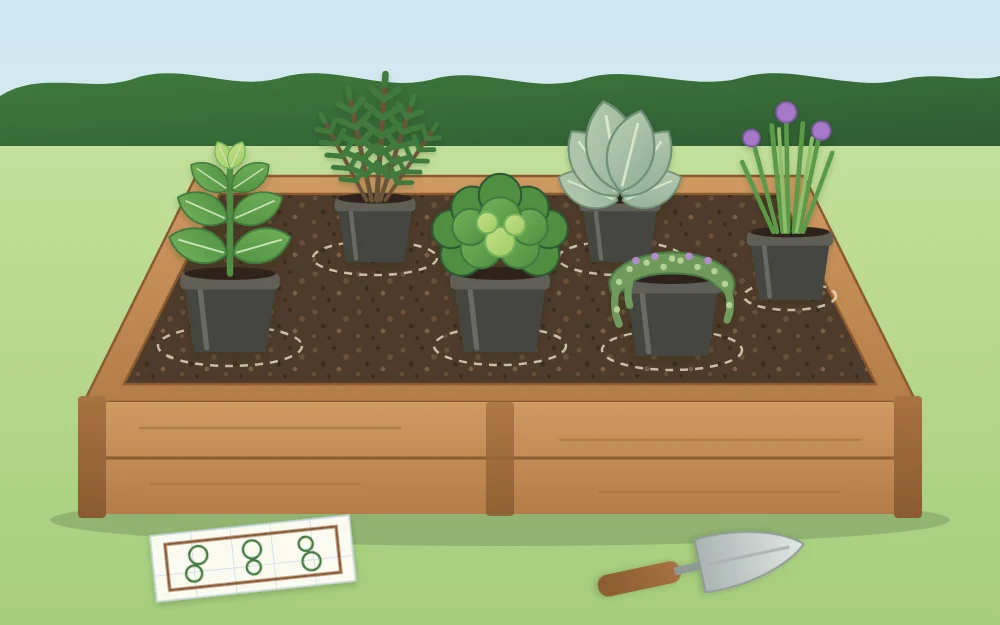
Step 7: Plant and water in
Water the pots an hour or so before planting so the root balls hold together. Work from the back of the bed toward the front so you are not reaching over new plants.
- Dig a hole as deep as the root ball and a little wider.
- Tip the plant out, and gently loosen roots that circle the bottom.
- Set it so the top of the root ball is level with the bed surface, not buried.
- Fill around it, firm lightly with your hands and water at the base until the soil is settled.
Sow dill and cilantro directly where they are to grow, since both resent root disturbance. Tender herbs such as basil go in only after frost danger has passed in your area.
For the first weeks, check the soil near each new plant often, the Mediterranean ones included. “Prefers it dry” applies to established plants, not to transplants still rooting in.
Harvest little and often
Regular light cutting keeps herbs compact and productive. Snip stem tips just above a pair of leaves so the plant branches, and avoid taking more than about a third of a plant at once. Let new perennials put on growth before you cut heavily.
Tip
Keep the sketch. At the end of the season, note which plants outgrew their circles and which ends dried fastest, and adjust the annual end next year.
Frequently asked questions
How many herbs fit in one raised bed?
There is no fixed number, because herbs differ so much in mature size. A sage or rosemary plant can take the room of several thyme or chive plants. Add up the mature widths from the plant tags and compare them with the bed on a sketch. If the circles overlap heavily, shorten the list.
Where should tall herbs go in a raised bed?
Put tall and bushy herbs such as rosemary, sage and dill on the north side in the Northern Hemisphere, or at the back of a bed against a fence, so they do not shade lower plants. In a bed reached from all sides, the tall herbs can run down the center with low ones around the rim.
Can dry-loving and moisture-loving herbs share one bed?
Yes, if each group has its own end. Plant rosemary, thyme, sage and oregano together and let that end dry somewhat once plants are established. Plant basil, parsley, cilantro and chives at the other end, add compost there and check it for water more often. Test each end separately with a finger.