
What Is a Solar Camping Tent and How Does It Work?
A solar camping tent is a tent that captures sunlight and converts it into usable electricity — letting you charge devices, run lights, and power small appliances without a generator or grid connection.
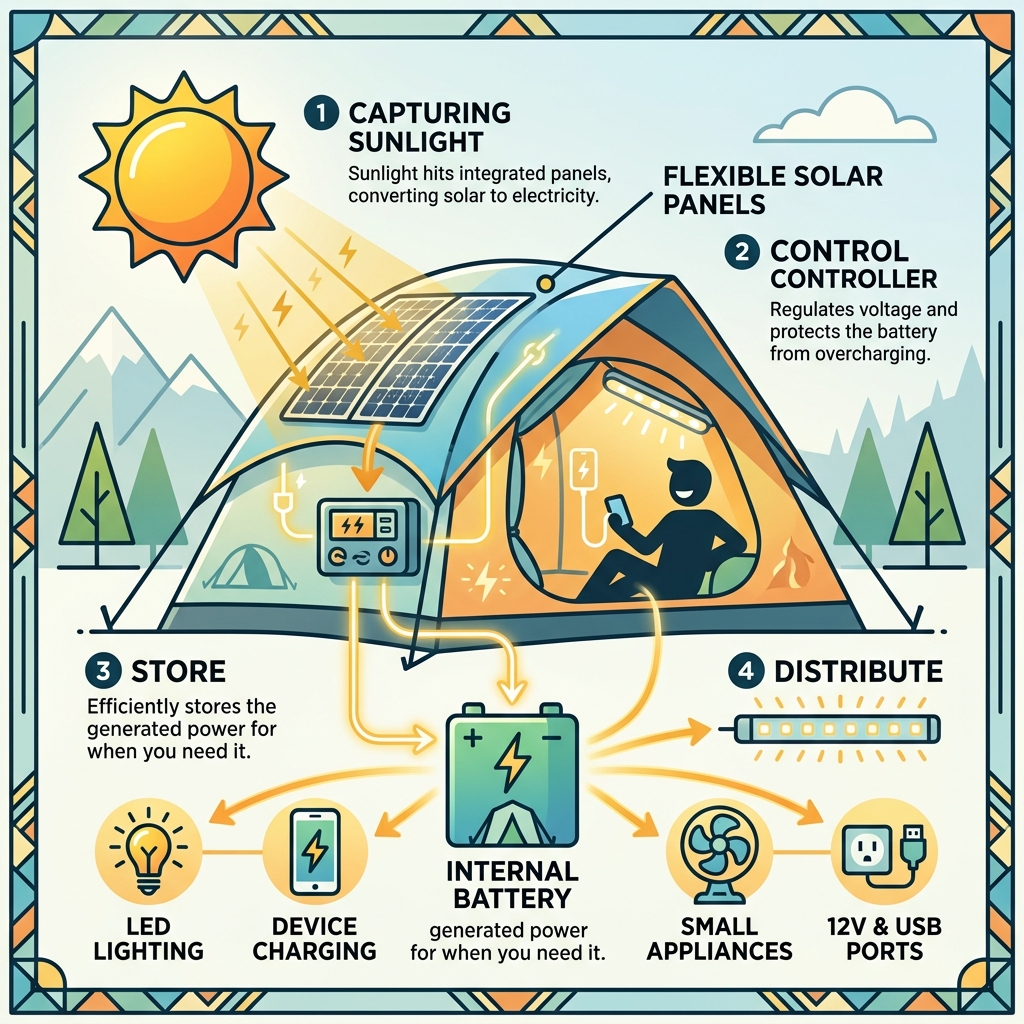
Quick answer: How do solar camping tents work?
- Solar panels (integrated into the tent fabric, roof, or attached on top) absorb sunlight
- A charge controller regulates the power flow
- Energy is stored in a battery or power bank
- Stored power is delivered through USB ports, AC outlets, or DC connections
- You plug in your devices and use them just like at home
Solar tents range from simple rooftop panel add-ons (like a 54W panel that sits on top of a bell tent) to fully off-grid glass dome structures capable of generating up to 10,000W of sustainable power.
If you’ve ever watched your phone die mid-trip — or burned through AA batteries in two days — you already know the problem solar tents solve.
The appeal is simple: the sun is free, it’s reliable in most camping conditions, and it produces zero noise. No generator rumble. No fuel cans. No last-minute battery runs before a weekend trip.
Solar tent technology has matured fast. Today you can find everything from a $385 rooftop panel kit for your existing bell tent to semi-permanent glamping domes with built-in water systems, smart home controls, and photovoltaic glass walls.
This guide breaks down exactly how each type works, what you can realistically power, and how to choose the right setup for your trips.
Understanding the Solar Camping Tent: Types and Applications
When we talk about a solar camping tent, we aren’t just talking about one specific product. The market has evolved into several distinct categories, ranging from lightweight inflatable shelters to massive, semi-permanent glamping domes. Understanding these differences is the first step toward a successful off-grid experience.
The core technology relies on photovoltaic (PV) cells. In some models, these are traditional rigid monocrystalline panels, while others utilize “thin-film” technology where the solar-harvesting material is actually woven into or bonded to the tent fabric. This allows the tent to remain flexible and foldable while still acting as a power plant.
For those interested in a deeper dive into the lifestyle, our guide-to-eco-friendly-solar-camping offers a comprehensive look at how to minimize your footprint while maximizing your comfort.
Comparing Integrated Solar Tents vs. Portable Panels
One of the most common questions we hear is whether it’s better to buy a tent with built-in solar or just use portable panels like a SunJack 25W-60W folding charger.
| Feature | Integrated Solar Tent | Portable Solar Panels |
|---|---|---|
| Setup | Set up once; power is ready inside. | Requires separate positioning and cabling. |
| Efficiency | Optimized for the tent’s surface area. | Can be moved to track the sun manually. |
| Durability | Panels are protected by tent structure/glass. | Exposed to ground-level dirt and tripping. |
| Power Output | Can reach up to 10,000W (Domes). | Typically 20W to 400W. |
| Portability | Varies (Inflatables are light; Domes are not). | Highly portable and modular. |
Integrated Solar Camping Tent Designs
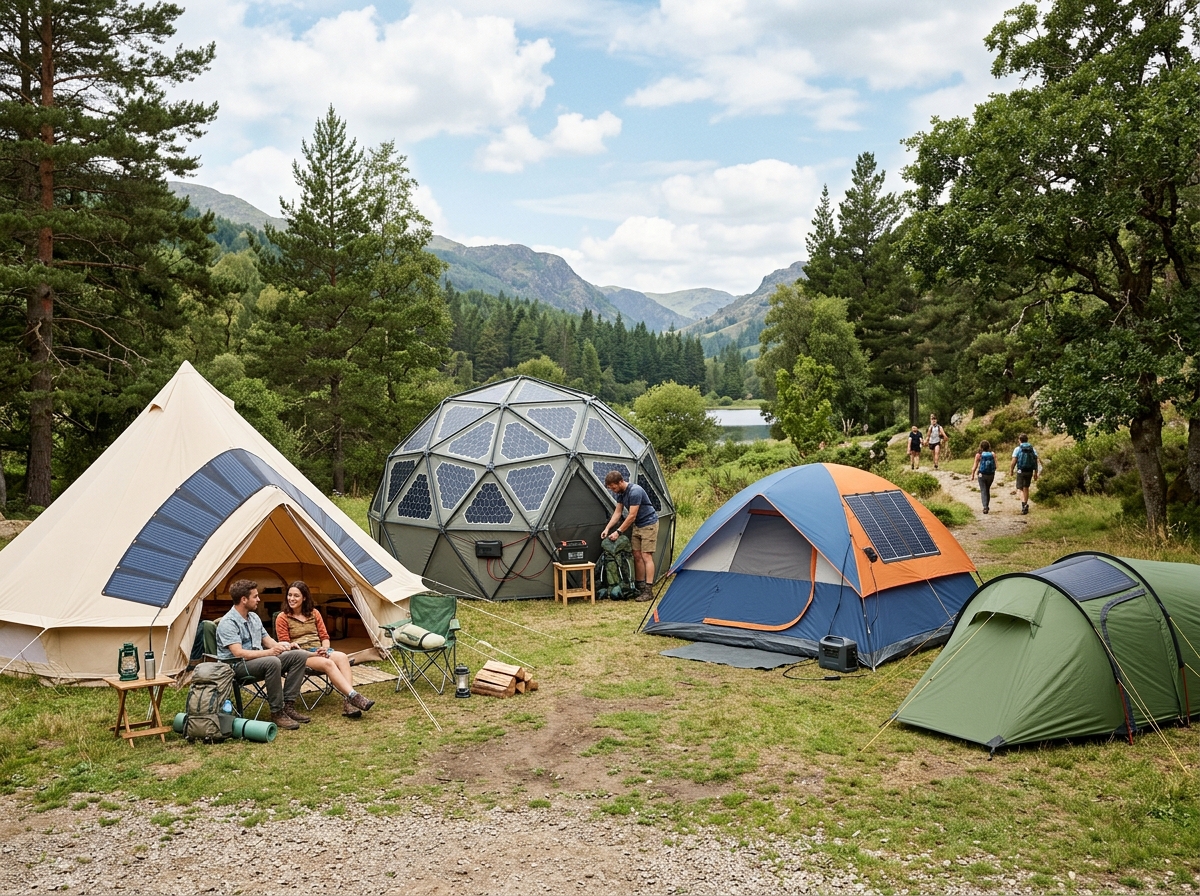
At the high end of the spectrum, we find integrated designs that treat the tent as a permanent or semi-permanent structure. These are often used for luxury glamping or off-grid living.
- Geodesic Domes: These structures, often 6 to 10 meters in diameter, use triangular photovoltaic glass modules. These aren’t just tents; they are architectural feats. A 6m dome can provide roughly 28 square meters of living space, while 8m to 10m versions offer up to 78 square meters.
- Inflatable Structures: For those who want speed, solar inflatable tents use air-beam technology instead of traditional poles. A typical two-person inflatable model might feature 8 integrated panels providing around 52W of power. These are excellent lightweight-tech-gadgets-for-camping because they pack down small (roughly 550x240x200mm) but expand into a full shelter in minutes.
- Advanced Materials: These tents often utilize aviation-grade 6-series aluminum for the framework and 380gsm polycotton canvas. The canvas is frequently treated with specialized coatings to reduce interior light and heat, a feature sometimes referred to as “darkness technology.”
Modular Panels for a Solar Camping Tent
If you already own a beloved bell tent, you don’t need to buy a whole new structure. Modular solar attachments are a popular middle ground. A 54W rated power panel, for instance, can be designed to fit snugly over the roof peak of 13ft (4M) to 19ft (6M) bell tents.
The installation is clever: you pop the panel over the roof peak before sliding up the center pole. The cables hang down the sides, connecting to a USB hub or power bank inside. This setup ensures you never-run-out-of-charge-with-these-solar-powered-camping-tools while maintaining the classic aesthetic of a canvas tent.
Tactical and Emergency Shelters
Solar technology isn’t just for vacationers. Tactical solar tents are used in emergency response and field operations. These rugged shelters can generate massive amounts of power—up to 1,440 watts per 10′ x 20′ section.
Beyond power, these solar coverings provide a massive secondary benefit: insulation. By shading the main shelter, they can reduce the solar heat load by 80% to 90%. This means you need far less energy to keep the interior cool. They are built to MIL-PRF 44103 compliance, ensuring they survive the harshest environments on earth. These are the ultimate eco-conscious-gadgets-for-camping-trips when reliability is a matter of life or death.
Power Generation and Storage Specifications
Understanding the “specs” is vital so you don’t end up with a dead phone and a dark tent. The “engine” of a solar camping tent consists of the solar array, the charge controller, and the battery bank.
Wattage and Energy Harvest
- Small Scale (50W – 150W): Found in rooftop tents and bell tent attachments. This is perfect for charging phones, tablets, cameras, and running LED string lights.
- Medium Scale (150W – 1,000W): Found in tactical shelters and larger inflatable tents. This can support small fans, 12V portable coolers, and laptop charging.
- Large Scale (Up to 10,000W): Found in solar glass domes. This level of power can support air conditioning, water heaters, and full-sized kitchen appliances.
Battery Capacity and Output
Most consumer-grade solar tents come with a power bank. A standard 10,000mAh (37WH) Li-polymer battery is common for smaller setups. It usually features dual USB outputs (e.g., 5V 1A and 5V 2.1A). For larger setups, you might use a dedicated solar generator with AC outlets (110V/220V) and much higher Wh (Watt-hour) ratings.
When choosing solar-powered-gear-for-eco-friendly-trips, always check the “Open Circuit Voltage” and “Short Circuit Current.” For example, a high-quality 54W folding charger might have a short circuit current of 12.0A, ensuring a steady flow even when conditions aren’t perfect.
Installation and Maintenance for Off-Grid Success
Setting up a solar camping tent requires a bit more care than a standard pop-up, but the process is straightforward once you know the steps.
Setup Instructions
- Placement: Always choose a spot with maximum southern exposure (in the northern hemisphere). Avoid placing the tent directly under trees, as even partial shade can drop solar efficiency by 50% or more.
- Bell Tent Attachments: If using a rooftop panel, place it over the peak of the canvas before you raise the center pole. Ensure the A-frame for the door is set before final tensioning so the panel sits flush.
- Rooftop Tents (RTT): Many solar RTTs use gas struts. You simply unlatch the shell, and the struts do the heavy lifting. The solar panel is already integrated into the hard shell, so once the tent is open, the power generation begins.
- Inflatables: Unroll on level ground, connect your manual or electric pump, and inflate. Once the “air poles” are rigid, orient the integrated solar panels toward the sun.
Maintenance and Longevity
To keep your system running for the 10–25 year lifespan these materials can offer, follow these steps:
- Clean the Panels: Dust, bird droppings, and sap can significantly block sunlight. Use a soft rag and glass cleaner or mild soap. Avoid abrasive pads that could scratch the photovoltaic surface.
- Check the Seals: For glass domes and hard-shell tents, inspect the automotive rubber weather seals seasonally.
- Battery Care: Never store your battery completely empty. If you aren’t camping, charge the battery to about 60-80% every few months to maintain cell health.
- Weather Precautions: While most solar tents are waterproof and rated for high winds (some up to 100km/hr), it is a best practice to remove detachable solar panels during extreme storms or hail to prevent impact damage.
These small steps ensure your portable-gadgets-to-improve-camping-comfort remain functional for years to come.
Frequently Asked Questions about Solar Tents
Are solar tents waterproof and wind-resistant?
Yes. Quality solar tents are built to handle the elements. Most use heavy-duty materials like 380gsm polycotton or 210T polyester with a waterhead rating of at least 2000mm to 3000mm. This means they can withstand significant rainfall without leaking.
Wind resistance is also a priority. Geodesic domes are naturally aerodynamic and can handle gusts up to 100km/hr. Even bell tents with solar attachments are quite stable, provided they are staked correctly. Many models feature UV50+ protection to prevent the fabric from degrading under the same sun it’s harvesting for energy. You can even pair these with the best-solar-lights-for-illuminating-your-camping-experience for a fully self-sufficient night setup.
What devices can I actually power with a solar tent?
It depends on the wattage.
- Phones and Tablets: Almost any solar tent can handle these easily.
- LED Lights: Integrated LED strips (often bi-color amber/white) are common in solar tents.
- Fans and Coolers: You’ll need at least a 100W-150W system to run a portable fridge or fan consistently.
- Full Appliances: Only the large glass domes with nearly 10,000W output can handle “home” appliances like AC units or water heaters.
For those planning a trek, knowing which top-outdoor-gadgets-for-backpacking-trips are solar-compatible can save you a lot of weight in spare batteries.
How do solar tents perform on cloudy days?
Solar panels do not need direct, scorching sunlight to work, but their efficiency drops. Monocrystalline cells (the most common type used in these tents) are quite efficient even in “spectral variation” (overcast light). However, you might only get 10-25% of the rated power on a very cloudy day.
This is why the battery bank is so important. You harvest energy during the peak sun hours (usually 10 AM to 4 PM) and store it for use during the evening or on cloudy days. If you’re heading out for a short trip, check out our list of the best-gadgets-for-weekend-camping-trips to see how to balance your power needs.
Conclusion
The solar camping tent represents the perfect marriage of traditional outdoor adventure and modern sustainability. Whether you are a festival-goer looking to keep your phone alive, a glamping site owner aiming for a 30-70% increase in occupancy through “eco-luxury” offerings, or an off-grid enthusiast seeking a self-sufficient home, there is a solar tent design for you.
By choosing renewable energy, we don’t just make our trips more convenient—we make them more responsible. At Rico Compouco, we believe that the future of travel is powered by the sun. From the silent operation of a tactical shelter to the panoramic views of a glass dome, solar technology is changing the way we experience the wild.
Ready to upgrade your outdoor kit? Explore more solar gadgets and start planning your next sun-powered adventure today.
