
A Dead Phone in the Wild Is More Than an Inconvenience
A small solar battery pack is a portable device that combines a solar panel with a rechargeable battery, letting you capture sunlight and store it to charge phones, GPS units, and other USB devices — no outlet needed.
Quick answer: top small solar battery pack categories at a glance
| Category | Best For | Typical Weight | Solar Output (1hr direct sun) |
|---|---|---|---|
| 28W folding panel kit | Best overall performance | ~21 oz | ~2,177 mAh |
| 10W compact panel | Best value | ~12.6 oz | ~1,401 mAh |
| Ultralight 10W mini panel | Ultralight backpacking | ~7.3 oz | ~1,247 mAh |
| 5W compact panel | Compact + reliable | ~12.4 oz | ~789 mAh |
| 30W budget panel | Budget entry-level | — | 30W panel |
You’re miles from the trailhead. Your phone battery hits 5%. Your GPS map is on that phone.
This is exactly the situation a small solar battery pack is built for.
Whether you’re a weekend hiker, a long-distance backpacker, or someone who just wants a reliable backup during power outages, solar battery packs give you a way to stay powered using nothing but sunlight. No gas. No grid. No disposable batteries piling up in your pack.
But not all solar battery packs are created equal. Some generate over 2,000 mAh in a single hour of direct sun. Others barely move the needle. Picking the wrong one means carrying extra weight for almost no payoff.
This guide breaks down exactly what to look for — and which options actually deliver in the real world.

Understanding the Small Solar Battery Pack: Capacity and Performance
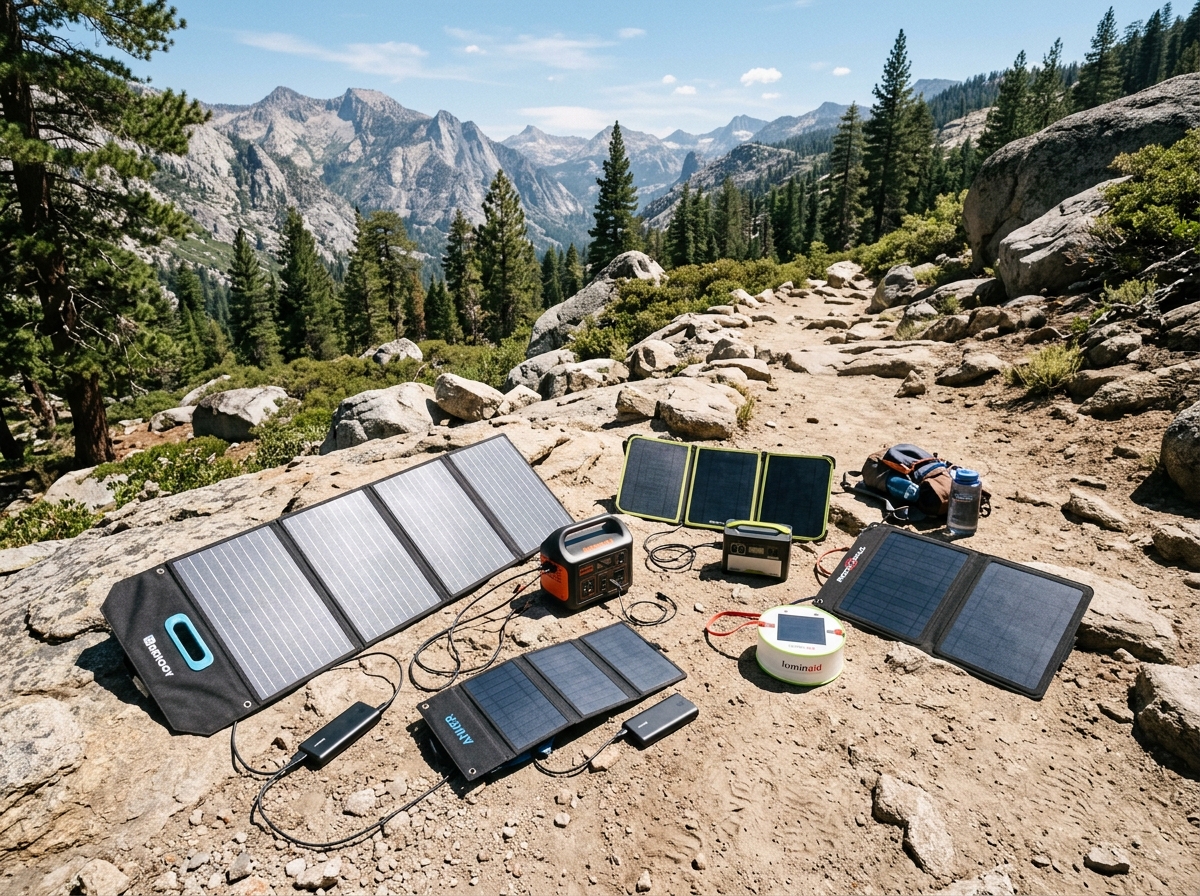
When we talk about a small solar battery pack, we are usually looking at two distinct components: the solar panel (the engine) and the battery (the fuel tank). Understanding how these work together is the difference between having a charged phone and carrying a heavy paperweight.
The Language of Power: mAh and Wh
To choose the right gear, we need to speak the language of energy. You will see two main numbers on every spec sheet:
- Milliamp-hours (mAh): This tells you the total “volume” of energy. For example, a standard smartphone battery is usually between 3,000 and 4,500 mAh.
- Watt-hours (Wh): This is a more accurate measure of energy over time. It is calculated by multiplying the battery’s voltage by its ampere-hours.
For instance, a compact unit rated around 6,400mAh / 23Wh offers enough capacity to charge a modern smartphone about 1.8 times. If you step up to a 10,000mAh / 37Wh pack, you are looking at roughly three full phone charges.
Battery Chemistry: Lithium-Ion vs. LFP
Most small units use Lithium-Ion batteries because they are incredibly light and energy-dense. However, some newer “solar-optimized” packs are moving toward LFP (Lithium Iron Phosphate). LFP batteries are slightly heavier but can last for thousands of charge cycles and are generally safer in high-heat environments – a big plus when you are leaving gear out in the sun all day. You can learn more about the differences between these battery types on the Wikipedia page for Lithium iron phosphate battery.
To learn more about how these technologies are changing the way we explore, check out our guide on Portable Solar Power Banks: The Vanguards of Outdoor Energy.
Calculating Your Runtime
How long will a pack actually last? A simple rule of thumb is to divide the battery’s Watt-hours by your device’s wattage. If you have a 50Wh battery and your device pulls 10W, you have 5 hours of run time.
| Device | Typical Battery Size | Charges from a 10,000mAh Pack |
|---|---|---|
| Smartphone | 3,500 mAh | ~2.2 Charges |
| GPS Unit | 1,500 mAh | ~5.5 Charges |
| Headlamp | 800 mAh | ~10 Charges |
| Tablet (7-inch) | 5,000 mAh | ~1.5 Charges |
How Much Power Does a Small Solar Battery Pack Actually Provide?
The “solar” part of a small solar battery pack is where reality often hits the marketing hype. A panel’s wattage (for example, 5W, 10W, or 28W) represents its peak performance under perfect laboratory conditions. In the real world, performance varies widely.
Direct Sunlight Benchmarks In our research, high-performing 28W-class folding panels were able to generate around 2,177 mAh in just one hour of direct sunlight. That is enough to charge a dead phone to nearly 60% in sixty minutes. More compact 5W-class panels, while reliable and easy to pack, may generate closer to 789 mAh in the same timeframe.
Indirect Light Efficiency Clouds happen. If you are hiking in the Pacific Northwest or under heavy tree cover, you need a panel that does not stop producing the moment a cloud drifts by. High-efficiency panels can still pull about 583 mAh in indirect sunlight, which is often more than low-quality panels pull in full sun.
If you have ever felt like your charger was ignoring you when the sun went behind a cloud, you might want to read Why Your External Battery Solar Charger Might Be Ghosting You.
Trickle Charging vs. Fast Charging Small panels (under 10W) are generally best for “trickle charging” – maintaining a battery’s level or slowly filling a small power bank over a full day. For “fast charging” (getting a phone from 0 to 100% quickly), you really want a panel in the 20W to 30W range.
Choosing Between Integrated Units and Modular Solar Kits
When shopping for a small solar battery pack, you will face a big choice: Do you want an “all-in-one” power bank with a solar panel attached to the top, or a “modular” kit where the panel and battery are separate?
The All-In-One (Integrated) Option
These look convenient – they are roughly the size of a smartphone and have a small solar panel on one side.
- Pros: Extremely portable, no extra cables needed, often waterproof.
- Cons: The solar panels are tiny. It can take 50+ hours of direct sun to fully charge the internal battery.
- Best For: Emergency “just in case” use where you mostly charge it at home via a wall outlet.
The Modular Kit Option
This is what we usually recommend for serious outdoor use. You pair a dedicated folding panel with a separate battery bank.
- Pros: Much larger solar surface area (faster charging), better efficiency, and you can keep the battery in the shade while the panel sits in the sun.
- Cons: More cables to manage, slightly more weight.
A great middle-ground is a 5 Watt Solar Charger Kit. It is lightweight and waterproof, designed to keep a compact battery topped off without the bulk of a massive array.
Efficiency and Ruggedness
Look for monocrystalline solar cells. They are roughly 20-22% efficient, which is the best you can get in a portable format. Also, check the IPX rating. If you are going to be near water or in the rain, you want at least an IPX4 rating (splash-proof) or higher. For more on the top-rated gear for the coming years, see our list of Top Solar Chargers for Outdoor Use 2026.
Portability Factors for Your Small Solar Battery Pack
Weight is everything when it is on your back.
- The Ultralight Category: Some 10W panels weigh as little as 7 to 8 oz, making them ideal for hikers who count every ounce.
- The Middle Ground: Many 10W to 15W panels land around 12 to 13 oz and offer a strong balance of weight, output, and price.
- The High-Output Option: Larger 20W to 30W folding panels often weigh around 1.3 pounds or more, but they can produce nearly double the power of ultralight options.
When traveling with these units, they require a bit of TLC. Heat is the enemy of batteries. For tips on keeping your gear in top shape, check out Maintaining Solar Power Banks for Travel.
Maximizing Efficiency and Real-World Reliability
You can have the best small solar battery pack in the world, but if you just throw it flat on the ground, you are losing up to 50% of your potential energy.
1. The Angle Matters Solar panels work best when the sun hits them at a 90-degree angle. In the morning and evening, you should prop your panel up. Some portable kits even include positioning aids to help you align with the sun’s path.
2. Temperature Protection Batteries hate heat. If you leave your power bank directly behind the solar panel in the scorching sun, the internal safety circuits might shut down the charging process to prevent a fire. Always try to keep the battery in the shade – under a rock, inside your pack, or under the panel itself.
3. Pass-Through Charging This is a “must-have” feature. It allows the solar panel to charge the battery while the battery is simultaneously charging your phone. High-quality packs are often optimized for this, ensuring a steady flow of power to your devices.
4. “Always On” Mode If you are using your battery to power low-draw devices like a GPS tracker or an IoT sensor, many standard power banks will “sleep” because they think nothing is plugged in. Look for batteries with an “Always On” mode to ensure your gear stays powered 24/7.
For a deeper dive into extending the life of your equipment, read our expert tips on How to Maximize Solar Battery Life. If you’re trying to juggle multiple gadgets, we also have a guide on Charging Multiple Devices with Solar Panels.
Safety, Travel, and Essential Accessories
Before you head to the airport with your small solar battery pack, there are a few rules you need to know.
TSA and Airline Regulations
The FAA and TSA have strict rules about lithium batteries.
- The 100Wh Limit: You can generally bring any battery under 100 Watt-hours (Wh) in your carry-on luggage. Most small solar packs are well under this (a 10,000mAh pack is only about 37Wh).
- No Checked Bags: Never put your solar battery pack in a checked bag. The risk of “thermal runaway” (fire) means they must be in the cabin where the crew can respond if something goes wrong.
- The “Cargo Aircraft Only” Label: You might see this on the shipping box when your battery arrives. Don’t panic—it’s a shipping regulation for bulk transport. You are still allowed to carry it on a passenger plane.
Essential Accessories
To get the most out of your kit, consider these additions:
- USB-C PD Cables: USB-C Power Delivery can charge your devices up to 60% faster than old USB-A cables.
- Carabiners: Most panels have “eyelets” on the corners. Use carabiners to clip the panel to the back of your backpack so you can charge while you hike.
- Rechargeable AAs: Some kits, like the Titan Mini, allow you to charge AA batteries directly. This is great for older GPS units or headlamps that don’t have internal batteries.
For more advice on staying powered up when the grid goes down, see our Tips for Charging Gadgets Off Grid.
Frequently Asked Questions about Portable Solar
Can a small solar battery pack power a whole house?
No. A small solar battery pack is designed for small electronics like phones, tablets, and cameras. To power a house, you would need a large “Solar Generator” or “Power Station,” which are much larger, weigh 100+ pounds, and cost thousands of dollars.
How long does it take to charge a phone via solar?
It depends on the panel. With a high-output 28W panel in direct sun, you can charge a phone in about 1.5 to 2 hours. With a small 5W panel, it might take 4 to 6 hours. If you are using an “integrated” power bank (the kind with the tiny panel on top), it could take several days of sun to get a full charge.
Are solar power banks allowed on airplanes?
Yes, as long as they are in your carry-on bag and the capacity is under 100Wh. Almost all portable solar battery packs sold for hiking and camping meet these requirements.
Conclusion
The freedom of the outdoors shouldn’t be limited by a “Low Battery” warning. By choosing a quality small solar battery pack, you’re not just buying a gadget—you’re buying peace of mind. Whether you opt for an ultralight panel for a thru-hike or a high-output folding kit for a basecamp setup, you’re taking a step toward sustainable, independent energy.
At Rico Compouco, we believe that clean power should be accessible to every adventurer. Don’t let your next trip be cut short by a dead screen. Grab a solar kit, aim it at the sky, and keep exploring.
For more off-grid wisdom, check out our Tips for Charging Gadgets Off Grid 2 or browse our full collection of Solar Gadgets.
