
The Best Portable Solar Powered Fan Options for Campers in 2026
If you want a quick answer, here are the top portable solar powered fan picks for campers based on ratings, features, and value:
| Fan Model | Battery | Runtime | Best For | Rating |
|---|---|---|---|---|
| JINLICTE Solar Fan | 20,000mAh | Up to 36 hours | Extended camping trips | 4.6/5 |
| Drchop Solar Fan | 10,800mAh | Up to 20 hours | Budget-friendly all-rounder | 4.4/5 |
| 10400mAh Solar Fan | 10,400mAh | Up to 24 hours | Compact portability | 4.5/5 |
| Panergy SF02 | 10,000mAh | 10-24 hours | Fan + light + power bank combo | N/A |
| GoSun Breeze Pro | 12V direct solar | 8.5 hrs (high) / 6 days (low) | RV and off-grid power users | N/A |
Swapping batteries every other day gets old fast. If you spend time camping, dealing with power outages, or working in a shed without electricity, you already know the frustration.
A portable solar powered fan solves this in a surprisingly elegant way. Instead of burning through AA batteries or hunting for an outlet, it pulls energy straight from the sun — and stores it in a built-in battery for use at night or on cloudy days.
The market has exploded. There are now over 9,000 solar fan results on Amazon alone, ranging from compact tent fans to high-CFM outdoor ventilators. Some double as power banks and LED lanterns. Others are built specifically for sheds, chicken coops, or RVs.
With so many options, picking the right one takes a little guidance. That’s exactly what this list is here for.
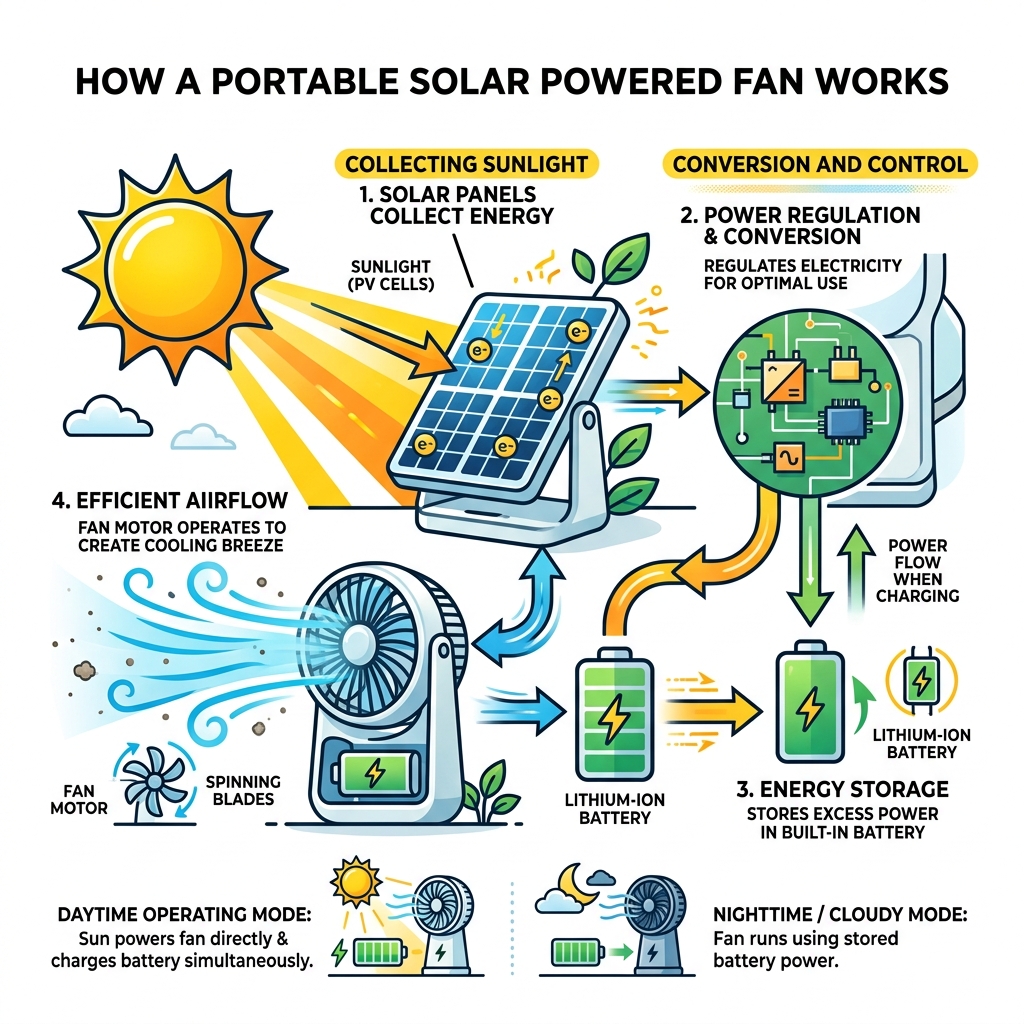
How a Portable Solar Powered Fan Works
At its core, a portable solar powered fan is a marvel of mini-engineering. It combines several technologies to ensure you stay cool even when you are miles away from the nearest power grid.
The process starts with photovoltaic (PV) cells. These are the dark, shimmering panels you see attached to the fan or provided as a separate accessory. When sunlight hits these cells, it creates an electrical current. This current can do one of two things: power the fan motor directly for immediate relief or flow into a lithium-ion battery for storage.
Most modern units are “hybrid” devices. This means they offer hybrid power options—you can charge them via the sun during the day or use a USB-C charging port (or AC adapter) before you leave home. This dual-charging capability is a lifesaver for those rainy camping days when the sun decides to hide.
The magic behind the airflow itself usually involves a brushless DC motor. Unlike older motors, brushless versions are incredibly efficient, which is crucial when you’re relying on a limited battery. They are also much quieter, often operating at levels below 60dB—about the volume of a normal conversation.
When looking at the technical specs, keep an eye on the solar panel wattage. A 4W panel is standard for small personal fans, while more powerful 12V systems might use 15W to 25W panels to move a larger volume of air. This energy conversion efficiency determines how fast your battery tops up while you’re out hiking or relaxing by the lake.
Key Features to Look for in a Portable Solar Powered Fan
Not all fans are created equal. If you’ve ever bought a cheap plastic fan that barely moved a feather, you know that “airflow” is a relative term. Here is what we recommend checking before you click “buy.”

Battery Capacity
This is measured in milliamp-hours (mAh). A 10,000mAh battery is the “sweet spot” for most campers, offering a full night of cooling on medium settings. However, if you are heading out for a week-long trek, upgrading to a 20,000mAh variant ensures you have plenty of backup power for those times when the solar panel isn’t at 100% efficiency.
Airflow Strength and CFM
CFM (Cubic Feet per Minute) tells you how much air the fan actually moves. A small tent fan might offer around 30-50 CFM, while larger outdoor models can move dramatically more air for bigger spaces. If you’re trying to cool a whole RV or a large shed, higher CFM is non-negotiable.
Noise Levels
No one wants to sleep next to a jet engine. Look for fans that utilize brushless motors to keep noise levels low. Many top-rated fans operate between 27dB and 60dB. For context, 27dB is as quiet as a whisper in a library.
Bonus Functions
Modern fans are the Swiss Army knives of the camping world. Many include:
- Integrated Power Bank: Use the fan’s battery to charge your phone via USB-A or Type-C ports.
- LED Lanterns: Built-in lights with multiple brightness levels mean one less piece of gear to pack.
- Multi-angle Rotation: Look for 360-degree vertical tilting or horizontal oscillation to ensure the breeze hits exactly where you need it.
- Timers: Setting a 2, 4, 6, or 8-hour timer helps conserve battery life while you sleep.
Durability and Weather Resistance
Since these are outdoor tools, ABS material construction is standard for impact resistance. Some models also feature water-resistant coatings, though you should always check if the solar panel itself is rated for rain.
Top-Rated Solar Fan Configurations for Every Scenario
Choosing the right configuration depends on your specific needs. Are you backpacking light, or are you “glamping” with an RV?
High-Capacity Powerhouses (20,000mAh+)
Models with 20,000mAh batteries are the heavy hitters. These are designed for longevity and can run for up to 36 hours on a single charge. They often feature stepless speed control, allowing you to dial in the exact amount of breeze you want rather than being stuck with just “low, medium, and high.”
The Multi-Taskers
A good example of a versatile design is a fan with a 10,000mAh battery, three LED brightness levels, and a detachable solar panel. Detachable panels are great because you can place the panel in the scorching sun while keeping the fan and yourself in the shade.
Compact and Budget-Friendly
For those watching their wallet, 10,400mAh variants offer excellent value. These are often USB-battery powered and compact enough to hang from the gear loft of a tent using integrated hanging hook designs.
Professional Off-Grid Systems
If you need serious power, 12V systems are the way to go. These can run directly off a 12V vehicle port, a dedicated power bank, or a solar panel. They are built for durability and high-velocity wind, making them ideal for work sites or beach days.
Benefits and Real-World Use Cases for Solar Ventilation
Why choose a portable solar powered fan over a standard plug-in model? The benefits go far beyond just saving a few cents on your electric bill.
Emergency Preparedness
When a hurricane hits or the grid fails, staying cool isn’t just about comfort—it’s about safety. These fans provide a reliable cooling source and emergency lighting when you need it most. Many users in storm-prone areas like Florida keep several on hand specifically for power outage survival.
Sustainable Camping
We love the “leave no trace” philosophy. Using a portable solar powered fan means zero-carbon operation. You aren’t disposing of alkaline batteries or relying on gas-powered generators that disturb the peace of the woods. It’s clean, quiet, and renewable.
Specialized Ventilation
It’s not just for humans! Solar fans are incredibly popular for:
- Chicken Coops: Preventing heat stress in poultry during the peak of summer.
- Sheds and Workshops: Moving air in small enclosed spaces to protect tools and reduce odors.
- RVs and Vans: Helping circulate air in “dead zones” where the built-in AC doesn’t reach.
Portability vs. Traditional Fans
Traditional fans are tethered to a wall. Even “portable” battery fans eventually die and require a trip back to civilization. A solar fan gives you true independence. Whether you’re on a boat, at a construction site, or deep in a national park, as long as the sun rises, you have a way to stay cool.
Frequently Asked Questions about Solar Cooling
How long does a portable solar powered fan run on a full charge?
Runtime is a bit of a moving target because it depends on your speed settings and battery size. Generally:
- 10,000mAh Fans: Expect 10-24 hours. On the lowest setting, many will last through two full nights of sleep.
- 20,000mAh Fans: These can push 30-36 hours on lower settings.
- Direct Solar: Some fans can run continuously during the day if the solar input matches the motor’s draw.
Can I use a portable solar powered fan indoors during a power outage?
Absolutely. While the fan needs sunlight to charge, it runs off its internal battery, making it perfectly safe for indoor use. For the best results, place the solar panel on a south-facing windowsill during the day. Many models also include LED lanterns and power bank functionality, making them the ultimate indoor emergency tool.
Are these fans durable enough for extreme outdoor weather?
Most quality fans are made from ABS+PC materials, which are designed to handle the bumps and drops of travel. They can usually withstand high temperatures (some up to 160°F). However, most are not fully submersible. While they can handle a bit of dust or a light mist, we recommend bringing them inside during heavy downpours to protect the charging ports.
Conclusion
The shift toward sustainable, off-grid living doesn’t mean you have to suffer through a sweltering summer night. Whether you are looking for a compact companion for your tent or a heavy-duty ventilator for your workshop, there is a portable solar powered fan designed for the job.
By investing in a high-quality solar fan, you’re not just buying a breeze—you’re buying independence, emergency readiness, and a more sustainable way to enjoy the great outdoors. If you’re ready to upgrade your off-grid setup, Explore more solar gadgets to see how else you can harness the power of the sun for your next adventure.
