
When the Power Goes Out, Are You Ready?
An emergency solar generator kit is one of the smartest investments you can make for your home’s energy security. Here’s a quick look at the top options to match common needs:
| Use Case | Recommended Capacity | Key Feature |
|---|---|---|
| Small devices & lights | 300-1,000Wh | Lightweight, portable |
| Refrigerator + essentials | 1,000-3,000Wh | Fast recharge, UPS function |
| Whole-home backup | 4,000Wh+ | Expandable, transfer switch ready |
| Off-grid or extended outages | 10,000Wh+ | Scalable battery stacks |
Power outages are getting longer and more common. Whether it’s a hurricane, ice storm, or grid failure, most households are completely unprepared. According to FEMA, having a backup power source is a critical part of any emergency plan.
Traditional gas generators are loud, produce fumes, need fuel, and require regular maintenance. A solar-powered kit sidesteps all of that.
Modern solar generator kits combine a battery station, solar panels, and all the cables you need into one plug-and-play package. You set it up once, keep it charged, and it’s ready when you need it most.
The best kits use LiFePO4 (LFP) batteries, which last through 2,500-6,500 charge cycles – that’s up to 10 years of daily use. That’s roughly seven times longer than older battery chemistries.
Capacity ranges are wide. Entry-level kits start around $300 and handle phones, lights, and small devices. High-end whole-home systems can exceed $40,000 and power every appliance in your house.
In this guide, we break down the best emergency solar generator kits available in 2025 – so you can find the right fit for your home, budget, and power needs.

Understanding How an Emergency Solar Generator Kit Works
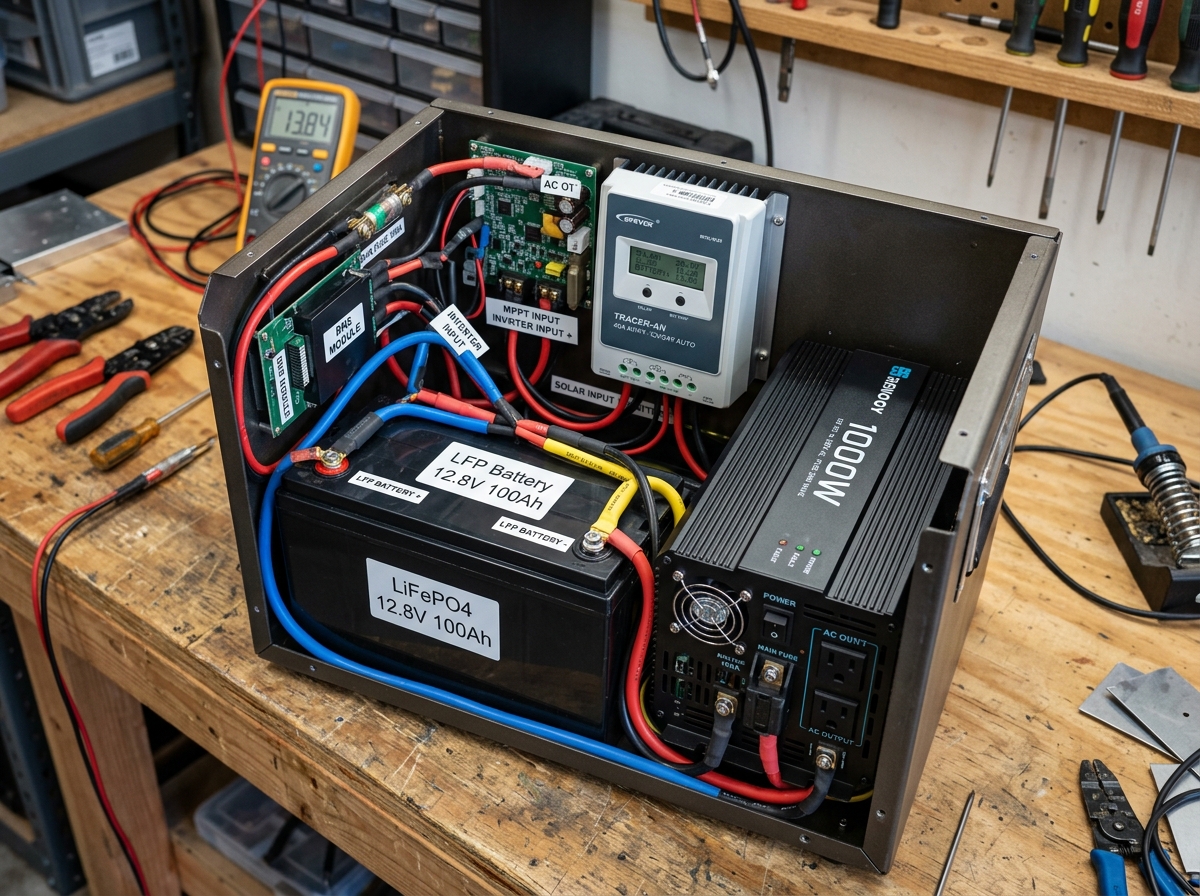
At its core, an emergency solar generator kit is a sophisticated energy management system. It doesn’t actually “generate” energy in the mechanical sense like a gas engine; instead, it captures, stores, and converts energy from the sun. To understand why these are so reliable during a blackout, we need to look under the hood at the four main components.
1. Photovoltaic (PV) Panels
These are the “collectors.” Most modern kits come with monocrystalline solar panels, which currently boast conversion efficiencies of up to 23-25%. They take photons from sunlight and turn them into Direct Current (DC) electricity. Even in low-light conditions, high-quality panels can still trickle-charge your system, ensuring you aren’t left entirely in the dark.
2. LiFePO4 Batteries
The battery is the heart of the kit. In 2025, the industry standard has shifted almost entirely to Lithium Iron Phosphate (LiFePO4). Why? Because they are incredibly safe—virtually eliminating the risk of thermal runaway—and they last a long time. While older lithium-ion batteries might degrade after 500 cycles, LFP cells often handle 3,000 to 6,000 cycles before dropping to 80% capacity. This means your emergency kit will likely still be functional a decade from now.
3. MPPT Charge Controller
Think of this as the “brain” that sits between the panels and the battery. Maximum Power Point Tracking (MPPT) technology ensures that the battery is charged as efficiently as possible. It adjusts the voltage and current coming from the panels to match what the battery needs at that exact moment, maximizing energy harvest even when clouds pass over.
4. Pure Sine Wave Inverter
Your home appliances run on Alternating Current (AC). The battery stores DC. The inverter performs the “DC to AC conversion.” It’s crucial to use a pure sine wave inverter rather than a modified one, as sensitive electronics like CPAP machines, laptops, and modern refrigerators can be damaged by “dirty” power.
For those looking into smaller-scale solutions for grab-and-go scenarios, portable solar power banks offer a glimpse into how this technology works on a micro-scale.
Choosing the Right emergency solar generator kit for Your Home
Selecting the right kit isn’t just about picking the most expensive model; it’s about matching the “math” of the generator to the “math” of your life. There are three main numbers you need to watch:
- Battery Capacity (Wh): This tells you how much total energy is stored. If you have a 1,000Wh (Watt-hour) battery, it can theoretically run a 100W device for 10 hours.
- Continuous Output (W): This is the maximum amount of power the generator can pull at once. If your fridge needs 800W to run and your microwave needs 1,200W, you need an inverter that can handle at least 2,000W of continuous output to run both simultaneously.
- Surge Power (W): Many appliances, like refrigerators or sump pumps, need a “kick” of extra power to start their motors. This surge can be 2-3 times the running wattage. A good emergency solar generator kit will offer a surge rating (often double the continuous rating) to handle these brief spikes.
Determining Your Needs
To size your system correctly, list the “must-have” items you’ll need during an outage. For a deeper dive into sizing for larger setups, check out our guide on large off-grid solar systems.
| Appliance | Average Running Watts | Estimated Runtime (2000Wh Kit) |
|---|---|---|
| LED Light Bulb | 10W | 200 Hours |
| Smartphone Charge | 5W | 400 Charges |
| CPAP Machine | 40W | 50 Hours |
| Full-Size Refrigerator | 150W | 13-15 Hours |
| Coffee Maker | 1,000W | 2 Hours |
| 50″ LED TV | 150W | 13 Hours |
Note: Runtimes are estimates. Real-world performance depends on battery depth of discharge and inverter efficiency.
Solar Input Rate
Don’t overlook how fast the kit can recharge. If you have a massive 4,000Wh battery but only 100W of solar panels, it will take days of perfect sunlight to refill. Look for kits that support high solar input (e.g., 400W to 1,600W) so you can get back to full strength before the sun goes down.
Top-Rated Categories for Emergency Power in 2025
The market for an emergency solar generator kit has expanded rapidly. In 2025, we see a clear divide between kits designed for “survival portability” and those designed for “home residency.”
The Best Portable emergency solar generator kit for Essentials
If your goal is to keep the lights on, keep your phones charged, and perhaps run a small fan or a CPAP machine, a portable kit is your best friend. These typically weigh between 10 and 30 pounds and offer capacities between 300Wh and 1,000Wh.
The beauty of these smaller kits is their versatility. They often feature folding solar panels that can be deployed in seconds. Because they are quiet and fume-free, you can keep them right on your nightstand or kitchen counter. We’ve found that for most people, a 1,000Wh unit is the “sweet spot” for short-term outages. It’s enough to keep a phone charged for a month or run a small 12V portable fridge for nearly two days.
When you’re out in the elements, setting up solar chargers in the outdoors requires a bit of strategy to maximize sun exposure, but these kits make it as simple as possible with plug-and-play MC4 or XT60 connectors.
The Best High-Capacity emergency solar generator kit for Whole-Home Backup
For those who want to maintain a “normal” life during a multi-day blackout, high-capacity kits are the answer. These systems start at 3,000Wh and can scale up to a staggering 90kWh or more through expandable battery modules.
Key Features of High-Capacity Kits:
- Dual-Voltage Support (120V/240V): This is essential if you want to run heavy-duty appliances like well pumps, clothes dryers, or central air conditioning.
- Transfer Switch Integration: Many of these kits are designed to plug directly into a manual transfer switch or a smart home panel. This allows the generator to power specific circuits in your home (like the kitchen and living room) through your existing wall outlets.
- Fast Recharging: Leading models in 2025 can charge from 0% to 80% in under 90 minutes when plugged into a wall outlet, or in a few hours with a large solar array.
- Tax Credit Eligibility: In the United States, many high-capacity systems (typically those over 3kWh) may qualify for the 30% Residential Clean Energy Credit, which can save you thousands of dollars on the total kit price.
The longevity of these systems is anchored by EV-grade LFP cells. Some premium models even feature IP65-rated battery packs, meaning they are resistant to dust and water, making them rugged enough for garage storage or even outdoor use in protected areas.
Frequently Asked Questions about Emergency Solar Power
How long can a solar generator power a refrigerator?
This is the most common question we get! A standard modern ENERGY STAR refrigerator uses about 100W to 150W while the compressor is running. However, it doesn’t run 24/7. On average, a 2,000Wh emergency solar generator kit can keep a full-sized fridge running for about 18 to 24 hours. If you have solar panels connected during the day, you can effectively run the fridge indefinitely, as the panels will replenish the battery faster than the fridge consumes it.
Can I charge a solar generator while using it?
Yes! This is known as “pass-through charging.” Most high-quality kits from reputable manufacturers support this. It is incredibly useful during an emergency; your solar panels can be “feeding” the battery while the battery is “feeding” your microwave or lights. Just keep in mind that if you are pulling more power out than the sun is putting in, the battery level will still drop – just more slowly.
What is the lifespan of a LiFePO4 solar battery?
LiFePO4 (LFP) batteries are remarkably durable. Most are rated for 3,000 to 6,500 full charge cycles. Even after that point, the battery isn’t “dead” – it just holds about 80% of its original capacity. For the average user who might use the kit for occasional emergencies and camping trips, an LFP battery can easily last 10 to 15 years. This is a massive upgrade over traditional lead-acid batteries, which often fail after just 2-3 years if not maintained perfectly.
Conclusion
Investing in an emergency solar generator kit is about more than just buying a battery; it’s about buying peace of mind. As our weather becomes more unpredictable and our power grid faces increasing strain, the ability to generate your own clean, silent power is invaluable.
From small, portable units that keep your communication lines open to massive, expandable systems that can power a 5-ton AC unit, there is a solution for every home. By choosing a kit with LiFePO4 technology and high solar input, you are ensuring that your family stays safe, warm, and connected when the rest of the neighborhood goes dark.
At Rico Compouco, we believe in energy independence that is both sustainable and reliable. Don’t wait for the next storm to realize you need a backup plan. Explore your options, do the math on your home’s energy needs, and take the first step toward a more resilient future.
