
When the Power Goes Out, Will You Still Be Connected?
Solar powered radios are portable radios that use built-in solar panels — plus backup options like hand cranks and USB — to keep you informed even when the grid goes dark.
Here are the top reasons people buy them:
- Stay updated with NOAA weather alerts during hurricanes, tornadoes, and snowstorms
- Charge your phone when wall outlets are unavailable
- Get real-time emergency broadcasts when cell towers fail
- Use built-in flashlights and SOS signals during power outages
- Never worry about dead batteries on camping or hiking trips
The appeal is simple: one compact device replaces several emergency tools — and it runs on free energy from the sun.
Over 450 solar-powered radio models are available today, with top sellers earning 4.5-star ratings and thousands of units purchased every month. Battery capacities range from 4,000mAh all the way to 37,000mWh, meaning some models can charge your smartphone multiple times on a single charge.
Whether you’re building an emergency kit or just tired of swapping batteries on outdoor trips, there’s a solar radio built for your situation.

Why Solar Powered Radios are Essential for Emergency Preparedness
When we think about survival, we often think about food and water first. But information is just as vital. In a crisis, knowing where a storm is heading or where to find help can be the difference between safety and disaster. We believe that solar powered radios are the backbone of any serious emergency kit because they offer grid independence.
Traditional radios rely on alkaline batteries that eventually leak or die. Cell phones rely on towers that can be knocked over by high winds or overwhelmed during a mass emergency. Solar powered radios, however, harvest energy directly from the sun. Even if the sun isn’t shining, most of these devices include a hand crank, ensuring you are never truly without power.
The statistics speak for themselves regarding how much we value these tools. On major online marketplaces, there are over 450 different products listed under this category. Some of the most popular emergency models have seen over 7,000 purchases in a single month. This isn’t just a niche hobby for “preppers”; it’s a mainstream safety essential.
These devices provide access to the NOAA (National Oceanic and Atmospheric Administration) weather network. This network broadcasts 24/7 weather information directly from the nearest National Weather Service office. During hurricane season or wildfire outbreaks, having a dedicated outdoor-tech-to-improve-adventure-safety tool like a weather radio allows you to receive automated alerts even while you sleep. You can learn more about NOAA Weather Radio directly from the National Weather Service.
Key Features of a High-Performance Solar-Powered Emergency Radio
Not all solar powered radios are created equal. When we look at the sea of options available for sale, we look for a balance of power, durability, and reception.
Battery Capacity and Power Output
The heart of the radio is its internal battery. We’ve seen capacities ranging from a modest 1,200mAh to a robust 20,000mAh. For context, a standard modern smartphone usually has a battery between 3,000mAh and 4,500mAh. If you want your radio to act as a reliable power bank, you should aim for a model with at least 4,000mAh.
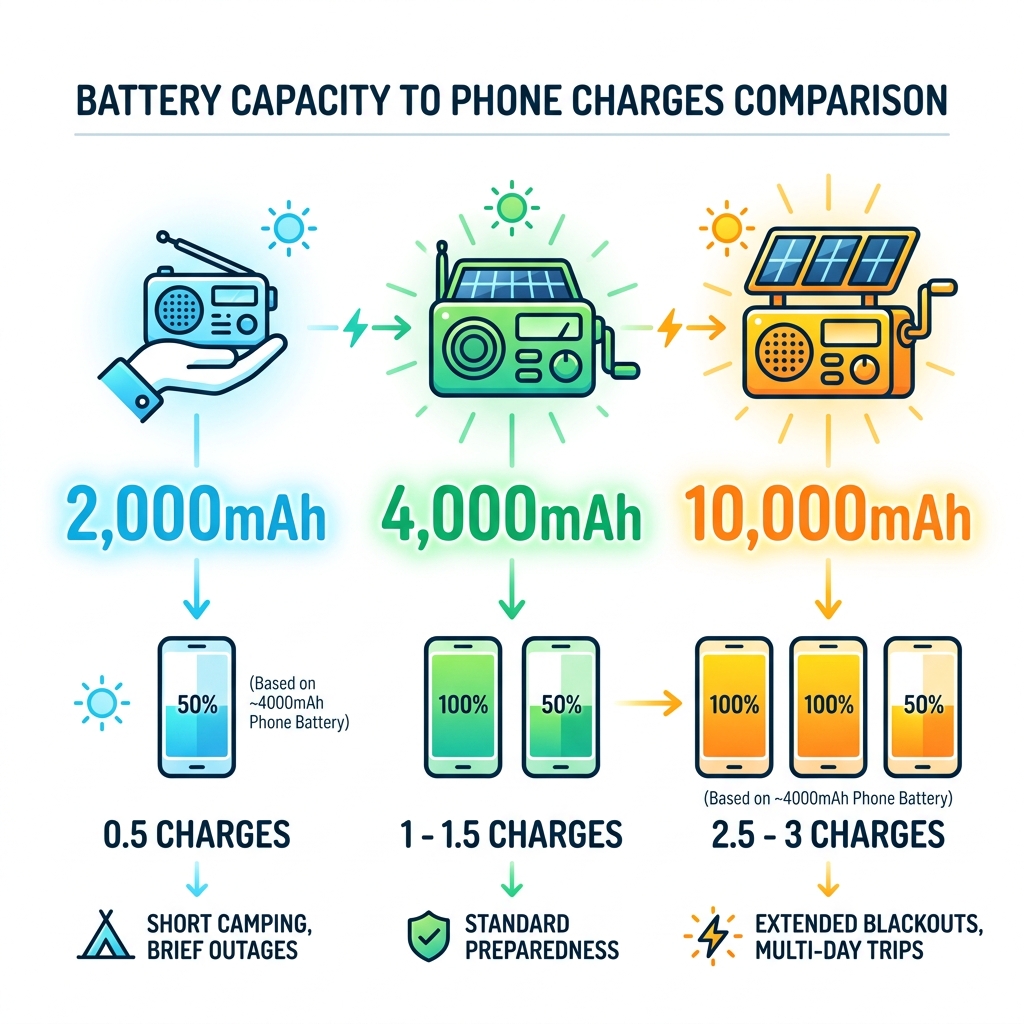
| Battery Capacity | Estimated Smartphone Charges | Best Use Case |
|---|---|---|
| 2,000mAh | 0.5 Charges | Lightweight hiking, short outages |
| 4,000mAh | 1 – 1.5 Charges | Standard emergency preparedness |
| 10,000mAh | 2.5 – 3 Charges | Multi-day camping, extended blackouts |
| 20,000mAh | 5+ Charges | Off-grid living, base camp |
Radio Bands: AM, FM, and Shortwave
A good radio should offer more than just your local FM music stations.
- AM/FM: Good for local news and entertainment.
- NOAA Weather Band: Critical for localized emergency alerts.
- Shortwave (SW): This allows you to pick up broadcasts from hundreds or even thousands of miles away. In a total local grid failure, shortwave might be your only link to the outside world.
Durability and Weatherproofing
Since these gadgets are often used in the “great outdoors” or during literal storms, they need to be tough. Look for an Ingress Protection (IP) rating. An IP64 rating is a great benchmark; it means the device is dust-tight and protected against water splashes from any direction. Many models feature rubberized housings to survive drops, which is a must-have for lightweight-tech-gadgets-for-camping.
Display and Controls
In a dark, stressful situation, you don’t want to struggle with tiny, confusing buttons. We prefer radios with backlit LCD displays that clearly show the frequency, battery level, and time. Digital tuning is generally more precise than old-school analog dials, making it easier to lock onto a weak signal when it matters most.
Integrated Survival Tools in Solar Powered Radios
Modern solar powered radios have evolved into “survival Swiss Army knives.” Manufacturers often pack them with extra features to save space in your go-bag.
- LED Flashlights: Most include at least a 1W LED. Some advanced models offer multiple modes, such as a focused beam for searching and a wide-angle floodlight for walking.
- SOS Beacons: This is usually a loud siren accompanied by a flashing red light to help search-and-rescue teams find you.
- Reading Lamps: Often hidden under the solar panel, these provide soft, ambient light for inside a tent or room without blinding everyone.
- Motion Sensors: Some higher-end models include a motion-activated light, which is incredibly handy if you need to find the radio on your nightstand during a sudden midnight power outage.
- Ultrasonic Dog Whistles: A rare but useful feature in some survival-specific models to help deter aggressive animals or signal for help.
Having these outdoor-tech-gadgets-for-survival-trips integrated into one unit reduces the weight of your pack and ensures you always have a light source attached to your communication device.
Top-Rated Solar Powered Radios for Sale: A Comparison Guide
When you’re looking for solar powered radios for sale, you’ll find everything from pocket-sized units to rugged base stations. Here are some of the most respected types of models currently on the market, based on our research into their performance and user feedback.
The Versatile All-Rounder
One highly-regarded model is a legend in the survival community. What makes it unique is its 180-degree adjustable solar panel. Most radios have a fixed panel on top, but this design allows you to tilt the panel to follow the sun’s path, maximizing charging efficiency. It features AM, FM, Shortwave, and 7 NOAA weather channels. Plus, its internal battery is often replaceable, which is a huge plus for long-term maintenance.
The Audio Enthusiast’s Choice
If you plan on using your radio daily—not just during emergencies—look for a digital model that is “voice-tuned.” This means the speaker is specifically designed to make human speech clear and easy to understand. Some top contenders also feature Bluetooth receiving, so you can use it as a high-quality speaker for your phone when the sun is out.
The Humanitarian Workhorse
Designed for the toughest conditions on earth, some radios are built for group listening in off-grid communities. These are incredibly rugged and feature a fail-safe winding mechanism. While they may lack some of the “bells and whistles” of consumer models (like Bluetooth), their audio volume and clarity are superior, making them a great choice for large families or community centers.
The Budget-Friendly Survivalist
Certain models have become staples on major marketplaces, often cited for their high-capacity 4000mAh batteries and compact design. These are popular choices for those building their first emergency kit because they offer a bright flashlight, a motion-sensor reading lamp, and reliable NOAA alerts at a very accessible price point.
The Ultra-Portable Option
For those who need something “shower-proof” and pocketable, there are options offering a 2000mAh battery and an IP64 rating. These are simple, effective tools for keeping updated with the news while camping or traveling.
Choosing the Right Solar Powered Radios for Your Needs
With so many solar powered radios for sale, how do you pick just one? We suggest evaluating your choice based on three main factors:
1. Portability vs. Power
If you are a backpacker, every ounce counts. You’ll want a lightweight, compact model like those found in our guide to top-outdoor-gadgets-for-backpacking-trips. However, if the radio is for a “home stay” emergency kit, weight is less important than battery capacity and speaker volume. A larger radio often has a larger solar panel, which will charge the battery faster.
2. Audio Quality and Reception
Reception is king. Look for radios with long, telescopic antennas. Some models, like the Kaito, even allow you to attach an external “reel antenna” to boost shortwave reception. If you have trouble hearing, prioritize models that mention “voice clarity” or “voice-tuned” speakers.
3. Ease of Use
In an emergency, your fine motor skills might be impaired by cold or stress. Large, tactile knobs for volume and tuning are often better than tiny buttons. Also, consider if the radio has a “lock” switch to prevent the battery from being drained if a button is accidentally pressed in your bag.
Maximizing Power with Multi-Powered Charging Methods
The true strength of an emergency radio isn’t just the solar panel—it’s the redundancy. Most of the solar powered radios we recommend feature at least four ways to stay powered.
- Solar Charging: This is the “set it and forget it” method. While it’s the slowest (taking anywhere from 8 to 42 hours for a full charge), it’s perfect for maintaining the battery while you’re out during the day. Some high-end panels can generate up to 5.5W of electricity in direct sunlight.
- Hand Crank (Dynamo): This is your fail-safe. On most quality models, cranking for one minute will give you about 15 to 30 minutes of radio play or a few minutes of flashlight use. It’s hard work, but it works when everything else fails.
- USB Charging: This is the fastest method. Before a storm hits, plug your radio into the wall. It usually takes about 9 hours to fully charge via USB.
- Replaceable Batteries: Many radios allow you to use standard AA alkaline batteries or replaceable 18650 lithium-ion cells. This is a great backup if you have a stockpile of batteries.
Using the Radio as a Power Bank
One of the most valuable features of these devices is the “USB Out” port. This allows you to use the radio’s large internal battery to charge your cell phone. While the solar panel isn’t powerful enough to charge a modern smartphone directly in a few hours, it can slowly “drip feed” the radio’s battery, which you then transfer to your phone. In a long-term outage, this could be your only way to send a “we are safe” text message to loved ones.
Frequently Asked Questions about Solar Radios
How long does it take to charge a radio using only sunlight?
It varies wildly by model and sun intensity. A small, efficient radio might take 8 hours of full sun. A larger, high-capacity unit can take up to 42 hours to reach a full charge from the solar panel alone. Solar is best viewed as a “maintenance” charge rather than a primary one.
Can a solar-powered radio charge a modern smartphone?
Yes, most can! However, don’t expect it to be as fast as your wall charger. Most radios will charge a phone from 50% to 100% on a full internal battery. If you are using the hand crank to charge a phone, be prepared for a workout—you’ll need to crank for a long time to get even a 5% boost.
What is the difference between a weather band and a weather alert radio?
A weather band radio requires you to manually tune to the station to hear the report. A weather alert radio (like those with S.A.M.E. technology) stays in a low-power “standby” mode and automatically loud-broadcasts an alert if the National Weather Service issues a warning for your specific area. For sleeping through a storm, a “weather alert” function is a lifesaver.
Conclusion
At Rico Compouco, we believe that preparedness is the key to peace of mind. Solar powered radios are one of the few gadgets that truly offer a “triple threat” of utility: they provide vital information, essential light, and emergency power for your other devices.
Whether you are an avid hiker looking for essential-tech-for-hiking-trips or a homeowner wanting to protect your family during hurricane season, investing in a high-quality solar radio is a smart move. Don’t wait for the lights to go out to realize you’re disconnected. Pick a model that fits your lifestyle, keep it in a sunny window, and stay ready for whatever Mother Nature throws your way.
