
Stop Hauling Ice: The Best Solar Powered Coolers for Off-Grid Adventures
Solar powered coolers are electric fridges and freezers that run on 12V/24V DC power — which can come directly from a solar panel, a portable power station, or a built-in battery. No ice required.
Here are the top solar powered coolers worth buying right now:
| Cooler | Capacity | Cooling Speed | Best For |
|---|---|---|---|
| Anker SOLIX EverFrost 2 | 40L / 58L | 77°F to 32°F in 15 min | Long trips, van life |
| ACOPower LiONCooler Pro | 30L / 40L / 50L | 32°F in 20 min | Off-grid, removable battery |
| GoSun Chill | 40L | Fast, -4°F to 68°F | Solar bundles, device charging |
| BougeRV 23 Quart | 23L | Solid performance | Budget buyers, beach trips |
| Dometic CFX5 45 | ~45L | 30 min to target temp | Serious campers, durability |
If you’ve ever lugged a 40-pound bag of ice to a campsite — only to find soggy sandwiches by noon — you already understand the problem.
Traditional coolers fight a losing battle. Ice melts. Food gets wet. You spend half your trip hunting for more ice at the nearest gas station.
Solar powered coolers flip that entire experience.
They use compressor or thermoelectric technology to actively refrigerate — the same way your fridge at home does — except they run off solar energy, a car’s 12V outlet, or a rechargeable battery pack. The best compressor models can hit temperatures as low as -4°F, even in hot weather. That means frozen food stays frozen, regardless of how blazing the sun gets outside.
And the numbers are getting hard to ignore. The Anker EverFrost, for example, draws as little as 5.8 watts per hour in steady state — meaning a single 299Wh battery can keep it running for roughly 48 hours without any sun at all.
For outdoor enthusiasts tired of replacing batteries, hauling ice, and compromising on food safety in the backcountry, this category of gear has genuinely matured into something reliable.
How Solar Cooling Technology Works
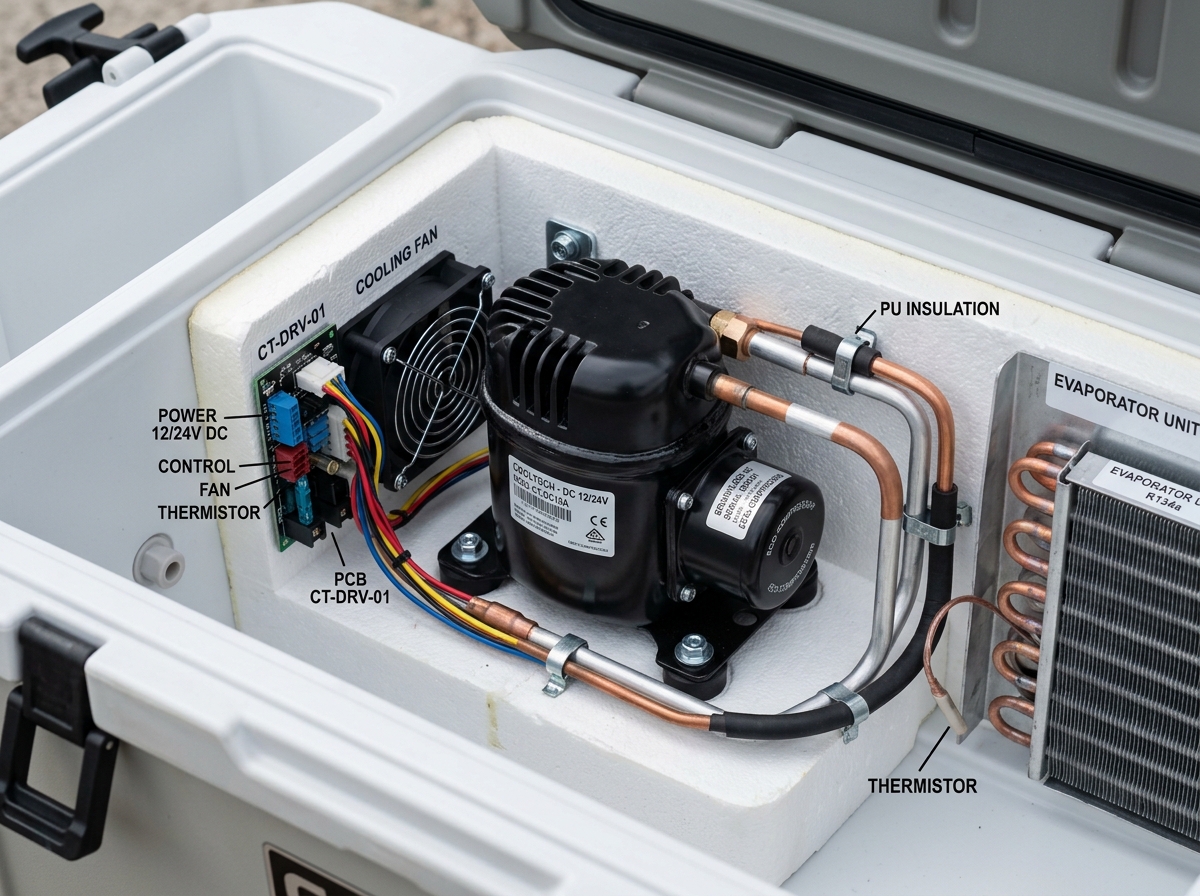
To understand why solar powered coolers are such a game-changer, we need to look under the hood. Not all “electric” coolers are created equal. In portable refrigeration, there are two main technologies: compressors and thermoelectrics.
Compressor vs. Thermoelectric
If you want your drinks frozen, you need a compressor. High-efficiency DC compressors are essentially miniature versions of the one in your kitchen refrigerator. They are powerful enough to reach sub-zero temperatures (as low as -4°F) regardless of the ambient temperature outside. For example, the Engel MT45 can cool down to 38°F in just 20 minutes, while the Dometic CFX5 45 reaches its target temp in about half an hour.
Thermoelectric coolers, on the other hand, usually only cool about 35-40°F below the surrounding air temperature. If it’s 90°F at the beach, a thermoelectric cooler might struggle to keep your milk below the food-safety threshold of 40°F. This is why we almost always recommend compressor-based models for serious off-grid use. If you’re new to this world, check out our Beginner Guide to Solar-Powered Gear for a deeper dive into how these systems integrate.
Energy Draw and Insulation
The “solar” part of the equation comes down to efficiency. These units are designed to sip power. A top-tier unit like the Anker EverFrost 40 has a steady-state DC power draw of just 5.8 Watts per hour. This efficiency is supported by thick insulation—often R-10 closed-cell polyurethane foam—which keeps the cold in and the heat out, even when the compressor isn’t running.
Top Features to Look for in Solar Powered Coolers
When shopping for solar powered coolers, it’s easy to get distracted by flashy colors. However, the features that actually matter are the ones that keep your food safe and your battery alive.
- Dual-Zone Cooling: Some larger models, like the Renogy 53 Quart or the Anker EverFrost 50L, offer two separate compartments. You can set one to 32°F for drinks and the other to -4°F for ice cream.
- Battery Protection: This is a vital safety feature. Most modern coolers have Low, Medium, and High voltage protection settings. This ensures the cooler shuts off before it completely drains your vehicle’s starter battery, leaving you stranded.
- App Control: Many brands, including BougeRV and ACOPower, now offer Bluetooth app integration. You can check the internal temperature or adjust settings from your phone without getting out of your sleeping bag.
- Rugged Portability: Look for heavy-duty wheels and telescopic handles. A 50-liter cooler full of food is heavy; the “EasyTow” suitcase design found on some models makes a massive difference on gravel paths.
For more ways to level up your outdoor setup, see our guide on Portable Gadgets to Improve Camping Comfort.
Maximizing Efficiency with Solar Powered Coolers
To get the most out of your setup, you should treat your cooler like a battery. Here are a few expert tips:
- Pre-chill everything: Plug your cooler into a wall outlet at home the night before your trip. Loading it with already-cold food and drinks means the compressor doesn’t have to work overtime using your precious solar power.
- Thermal Mass: A full cooler stays cold better than an empty one. If you have extra space, fill it with jugs of water.
- Placement Matters: Keep the cooler out of direct sunlight. Even the best insulation struggles against 100-degree direct sun on a black lid. Check out our tips on Solar Gadget Placement for Best Efficiency to optimize your charging and cooling.
Essential Accessories for Solar Powered Coolers
A cooler is only “solar” if you have a way to catch the rays. While some models have built-in batteries, most require an external power source for long-term off-grid use.
- Solar Panels: A 100W foldable solar panel is the “sweet spot” for most medium-sized coolers. It provides enough juice to run the compressor and recharge a battery simultaneously.
- Removable Batteries: Models like the ACOPower LiONCooler Pro offer removable 193Wh lithium batteries. You can swap them out or charge them separately via USB-C.
- Protective Covers: These add an extra layer of insulation and protect the unit from scratches during transit.
Setting up these systems can be intimidating, but our guide on Setting Up Solar Chargers in the Outdoors makes it simple.
Top-Rated Off-Grid Cooling Solutions
We have analyzed the data from various lab tests and real-world reviews to bring you the top performers in the market. For readers who want a broader technical overview of portable refrigeration, the Wikipedia article on portable refrigerators is a useful external reference.
| Feature | Anker EverFrost 40 | ACOPower LiONCooler Pro | GoSun Chill |
|---|---|---|---|
| Capacity | 40L (42QT) | 40L (Available 30-50L) | 40L |
| Power Draw | 5.8W (Steady State) | < 60W (Max) | 35-45W (Draw) |
| Cooling Speed | 15 min (to 32°F) | 20 min (to 32°F) | Rapid |
| Battery Life | 42-52 Hours | Up to 10 Hours | 14+ Hours |
| Unique Feature | EasyTow Suitcase Design | Removable Battery | Solar Table Bundles |
GoSun Chill Electric Cooler
The GoSun Chill is a standout for those who want a complete ecosystem. It doesn’t just keep things cold; it can actually make ice using solar power. With a temperature range of -4°F to 68°F and R-10 insulation, it’s a powerhouse. It also features a built-in PowerBank+ that can charge your phone or laptop while it runs the compressor.
ACOPower LiONCooler Pro Portable Solar Fridge Freezer
If you want true cordless freedom, the LiONCooler Pro is the way to go. It features a removable lithium battery that can run the unit for up to 10 hours on a single charge. It’s rugged, has large wheels for off-road terrain, and can be charged directly via solar panels without needing a separate power station.
Anker EverFrost Portable Cooler
The Anker EverFrost series is currently the king of efficiency. With the lowest steady-state power draw we’ve seen (5.8W), it is perfect for long-term van life. The 299Wh battery is substantial, and the “FrostFlow” technology allows it to drop from room temperature to freezing in just 15 minutes. It’s essentially a fridge on wheels.
Frequently Asked Questions
How long can solar powered coolers run without sun?
The runtime depends entirely on the battery capacity and the ambient temperature. A 14+ hour runtime is standard for units like the GoSun Chill using a 144Wh battery. However, larger batteries like the 299Wh pack in the Anker EverFrost can keep the unit running for up to 48-52 hours in “Eco Mode” if the lid stays closed. To extend this, you can learn How to Maximize Solar Battery Life through smart temperature management.
Can these coolers maintain freezing temperatures in high heat?
Yes, provided they use compressor technology. Unlike thermoelectric coolers, compressor models are rated to maintain sub-zero temperatures (down to -4°F) even when the outside air is 90°F or higher. The combination of a brushless DC motor and thick insulation allows them to dissipate heat efficiently and maintain a steady internal climate.
What size solar panel is required for continuous operation?
For most 40L to 50L solar powered coolers, a 100W solar panel is recommended. While a 30W panel can “trickle charge” or slow down the battery drain, a 100W panel usually provides enough power to run the compressor (which draws 35-60W when active) and still have enough leftover energy to top up the internal battery for night-time use. Always check your cooler’s maximum solar input voltage; for instance, the EverFrost supports up to 100W solar input.
Conclusion
At Rico Compouco, we believe that the best gear is the gear that lets you stay outside longer. Switching to solar powered coolers isn’t just about cold beer—it’s about energy independence and reducing waste. No more plastic bags of melting ice, no more spoiled food, and no more reliance on noisy gas generators.
Whether you’re building out a van, prepping for an emergency, or just heading to the beach for a long weekend, these coolers represent the pinnacle of eco-conscious camping. By pairing a high-efficiency compressor cooler with portable solar panels, you can enjoy “home-quality” refrigeration anywhere the sun shines.
For more tips on maintaining your sustainable setup, explore our Category: Solar Gadgets for the latest in off-grid tech. Stay cool out there!
