
Why Solar Panel Kits for Camping Are a Game-Changer for Off-Grid Adventures
Solar panel kits for camping are complete, portable power systems that let you charge devices, run small appliances, and stay powered up — all without a generator or hookup.
Here’s a quick look at what to expect from the most common options:
| Kit Size | Best For | Typical Price | Can Power |
|---|---|---|---|
| 50-100W | Backpacking, day trips | $80-$300 | Phone, tablet, small lights |
| 200W | Car camping, weekend trips | $250-$450 | Laptop, fan, portable fridge |
| 400W | RV, extended off-grid stays | $400-$600+ | Fridge, TV, power station |
| 600W+ | Full RV / van life | $700-$2,100+ | Multiple large appliances |
Most kits include at least a solar panel, a charge controller, and connection cables. Some add a battery or power station — making them true plug-and-play solutions.
If you’ve ever watched your phone die in the middle of nowhere — or burned through a bag of AA batteries by day two — you already know the frustration. Frequent battery replacements and dead devices are one of the biggest headaches for serious outdoor enthusiasts.
The good news? Portable solar has come a long way. Today’s camping solar kits are lighter, more efficient, and more affordable than ever. High-quality monocrystalline panels now hit 23-25% cell efficiency, and most kits fold down to the size of a briefcase. With thousands of portable solar panel options available on the market today, there’s something for every trip style and budget.
This guide cuts through the noise so you can find the right kit — fast.
Choosing the Right Solar Panel Kits for Camping
When we head into the wild, the last thing we want is a power system that weighs us down or fails to keep the lights on. Choosing the right solar panel kits for camping starts with understanding your specific energy appetite. Are you a minimalist hiker or a “glamper” with a portable fridge and a laptop?
Wattage Options: Finding Your Sweet Spot
The wattage of a solar panel tells you how much power it can generate under ideal conditions (Standard Test Conditions).
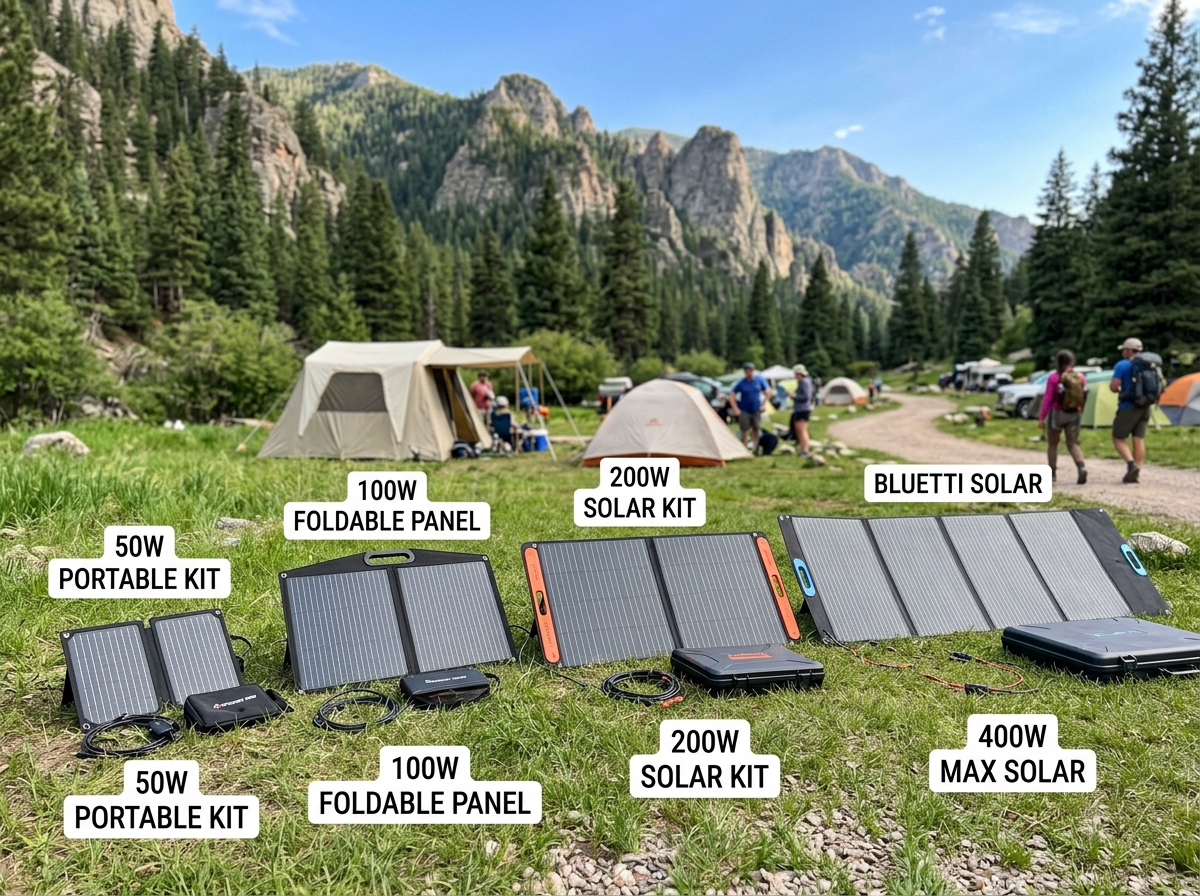
- 50W to 100W Kits: These are the entry-level champions. A 100W panel is the “gold standard” for most campers. It is typically enough to keep your phone, camera, and a few LED lights running indefinitely. Many reputable manufacturers offer 100W options that are highly rated for their balance of price and performance.
- 200W Kits: This is where things get serious. A high-quality 200W kit can generate about 1kWh of power per day. This is enough to run a small 12V portable refrigerator or a CPAP machine through the night, provided you have a battery to store that energy.
- 400W and Above: These kits are designed for RVs, vans, or basecamps. A 400W setup can produce up to 2,000Wh (2kWh) per day. That’s enough to handle a TV, multiple laptops, and kitchen gadgets.
Portability vs. Power Output
There is always a trade-off. A rigid 400W panel might offer massive power, but it’s heavy and hard to move. On the flip side, a compact 28W solar charger is incredibly light but won’t do much more than trickle-charge a smartphone. For most of us, foldable kits offer the best of both worlds. They use “suitcase” or “blanket” designs that protect the cells during transport but unfold into a large surface area once you reach camp.
To help you decide, check out our guide on how to choose the best solar gadgets for outdoors.
| Feature | 100W Portable | 200W Suitcase | 400W RV Kit |
|---|---|---|---|
| Weight | 6-9 lbs | 30-35 lbs | 60+ lbs (Total) |
| Setup Time | 2 minutes | 5 minutes | Permanent/DIY |
| Best Use | Car Camping | Overlanding | Van Life |
Essential Features of Portable Solar Kits
Not all solar panels are created equal. When you’re shopping for solar panel kits for camping, you’ll see a lot of technical jargon. Let’s break down what actually matters when you’re standing in a field trying to catch some rays.
Monocrystalline vs. N-Type Technology
Most modern portable panels use monocrystalline cells because they are more efficient than the older, blue-tinted polycrystalline cells. However, the latest “N-Type” technology (found in premium high-efficiency kits) takes it further. N-Type cells can reach up to 25% efficiency and perform better in hot temperatures and dim lighting. This is a huge win for campers who don’t always have perfect, cloudless skies.
Durability and Weatherproofing
Since these kits live outdoors, they need to be tough. Look for an IP67 waterproof rating, which means the panel can handle a sudden downpour or even temporary immersion in water. Many high-quality panels also feature an ETFE coating. This isn’t just a fancy acronym; ETFE is a durable, scratch-resistant material that allows more light to reach the solar cells compared to cheaper PET laminations. It also resists the “yellowing” effect that can happen after years of sun exposure.
Shading Tolerance and Design
In the past, if a single leaf fell on your solar panel, the whole system’s output would tank. Modern kits often include bypass diodes or parallel wiring. This ensures that if one part of the panel is in the shade, the rest of the panel continues to produce power. This is essential for camping in wooded areas where shadows move throughout the day.
For a deeper dive into the basics, our beginner guide to solar powered gear is a great place to start.
Top-Rated Solar Panel Kits for Camping Performance
We’ve looked at the data and customer reviews to see which kits actually deliver when the sun is out. Here are the top performers across different categories.
High-Wattage Solar Panel Kits for Camping
If you are running an off-grid office or a fully equipped RV, you need high-output solar panel kits for camping.
- 400W Heavy-Duty Suitcase: This is a powerhouse. It uses a parallel wiring design that ensures “uninterrupted brilliance” even in partial shade. It’s built with fiberglass reinforcement and a heavy-duty frame, making it one of the most durable options for long-term use.
- 300W Lightweight Foldable Kit: This kit is surprisingly manageable for its power level. It weighs about 15.2 lbs and folds down to a compact size. Users have reported charging a 100Ah battery in just six hours under good sun.
- Professional RV Solar Kits: Some manufacturers specialize in complete DIY kits that range from 100W to a massive 1600W. Their kits often include high-end MPPT controllers, which are about 30% more efficient than standard PWM controllers.
When using these high-power kits, it’s helpful to know some tips for charging gadgets off-grid to ensure you aren’t wasting any of that precious energy.
Compact Solar Panel Kits for Camping and Backpacking
For those who prefer to travel light, smaller kits are the way to go.
- Premium 100W Portable Panel: Frequently cited by experts as a top-tier camping panel, this design is known for its incredible ease of use. It often features built-in kickstands and a simple plug-and-play interface that works perfectly with portable power stations.
- Ultra-Portable 25W Foldable: This is a favorite for backpackers. It’s small enough to hang on the back of your pack while you hike, charging a power bank via USB as you move.
- Multi-Port 28W Solar Charger: With high user ratings and proven reliability, this is a budget-friendly staple. It features multiple USB ports and often includes a digital ammeter so you can see exactly how much power your devices are pulling.
To see how these fit into your overall gear list, check out how to navigate your first camping trip with these solar enabled essentials.
Compatibility and Components: What’s in the Box?
When you buy a “kit,” you aren’t just getting a panel. You’re getting an ecosystem. Understanding the components is the difference between a smooth trip and a frustrating afternoon of “why won’t this plug in?”
The Brain: MPPT vs. PWM Controllers
A charge controller sits between your panel and your battery. It prevents the panel from overcharging and damaging the battery.
- PWM (Pulse Width Modulation): Simpler and cheaper. These are often found in 50W-100W budget kits. They work well but aren’t the most efficient.
- MPPT (Maximum Power Point Tracking): These are the “smart” controllers. They constantly adjust to find the optimal voltage, squeezing every bit of energy out of the sun. If you’re camping in variable weather, an MPPT controller is worth the extra investment.
The Connectors: MC4, Anderson, and DC Adapters
Most professional-grade panels use MC4 connectors. These are round, waterproof plugs that click together. However, many portable power stations might use Anderson Powerpoles or 8mm DC inputs.
The best solar panel kits for camping include a variety of adapter cables. For example, a high-quality 300W kit often comes pre-wired with a controller and multiple adapters to ensure it can talk to almost any battery or power station on the market.
Accessories to Look For
- Adjustable Kickstands: These allow you to angle the panel directly at the sun. A panel laid flat on the ground can lose up to 25% of its potential output.
- Extension Cables: Sometimes the best sun is 20 feet away from your shaded tent. Long, high-gauge extension cables are a lifesaver.
- Protective Cases: Portable panels are made of glass or thin silicon. A padded case is essential for keeping them safe in the trunk of your car.
According to industry standards for portable solar performance, testing for functionality includes how easy these cables are to store and deploy. For more on the physical setup, read our guide on setting up solar chargers in the outdoors.
Frequently Asked Questions about Camping Solar
We get a lot of questions about the “real world” limits of solar. Here is the straight talk on what these kits can and can’t do.
Can solar panels charge my devices at night?
The short answer is: No. Solar panels require photons from sunlight to create an electrical current. Even a full moon provides less than 0.3% of the energy of direct sunlight—not enough to charge a phone.
To have power at night, you need battery storage. This is why many people buy “solar generators” (a bundle of a solar panel and a portable power station). You spend the day “harvesting” energy into the battery so you can run your lights and charge your laptop after the sun goes down. Learn more about this cycle in our guide to eco friendly solar camping.
How do I connect my solar kit to a power station?
Most modern power stations are “plug-and-play.” You simply plug the cable from the solar panel into the “Solar Input” or “DC Input” on the power station.
However, you must check voltage matching. If your panel puts out 40V but your power station only accepts 30V, you could fry the electronics. Always read the specs on the back of your devices. Most 100W and 200W kits are designed to be compatible with most popular power station brands. For more tips, see our article on charging multiple devices with solar panels.
Are portable solar panels waterproof?
Most are water-resistant, but very few are truly “waterproof” in the sense that they should stay out in a week-long storm.
- IP65: Protected against water jets (light rain and splashes).
- IP67: Can handle being dropped in a puddle or heavy rain for a short time.
The panels themselves are usually fine, but the charge controllers and USB ports are the weak points. If it starts to pour, it’s always best to bring your gear inside or cover the electronic components. This is a key part of being an eco conscious gadget user on camping trips.
Conclusion
At Rico Compouco, we believe that the best camping trips are the ones where you feel completely free, but still have the tools you need to stay safe and connected. Solar panel kits for camping provide that bridge. They offer a silent, sustainable, and reliable way to power your adventures without the smell or noise of a gas generator.
Whether you’re looking for a tiny 25W panel for a weekend hike or a massive 400W suitcase for your dream RV build, the technology is ready for you. By choosing a kit with high-efficiency monocrystalline cells, a solid waterproof rating, and the right controller, you’re investing in years of off-grid independence.
Ready to power up your next trip? Explore our full range of solar gadgets and find the perfect kit for your style of travel. Happy camping!
