
Why Solar Powered Water Purifiers Are a Game-Changer for Off-Grid Living
Solar powered water purifiers use energy from the sun to filter, disinfect, or desalinate water — giving you clean drinking water anywhere, without batteries you have to keep replacing or a grid connection you have to rely on.
Quick answer: What are solar powered water purifiers?
- What they do: Convert sunlight into power to run pumps, UV lamps, or filtration membranes that remove harmful contaminants from water
- Who they’re for: Campers, hikers, off-grid homesteaders, emergency preppers, and remote communities
- What they remove: Bacteria, viruses, protozoa, heavy metals, microplastics, sediment, and in some systems — salt
- How effective: UV systems can inactivate up to 99.99% of pathogens; reverse osmosis removes salts and dissolved solids
- Cost to run: As low as $0.005 per liter depending on the system
- Popular options: Range from compact $179 portable units to community-scale systems producing thousands of liters per day
Here’s a sobering fact: over two billion people worldwide lack reliable access to clean water, yet less than 2% of Earth’s surface water is fresh and uncontaminated. For outdoor enthusiasts, that number hits differently when you’re staring at a lake or stream and wondering what’s actually in it.
Solar water purification isn’t a niche concept anymore. It’s a fast-growing category of technology that ranges from backpack-sized portable units to village-scale systems. The MIT-engineered system deployed in La Mancalona, a remote Mexican village, produces around 1,000 liters of purified water daily for 450 residents — powered entirely by the sun.
Whether you’re planning a backcountry trip, building an off-grid homestead, or just want a reliable emergency backup, understanding your options can make the difference between clean water and a serious health risk.
How Solar Water Purification Technology Works
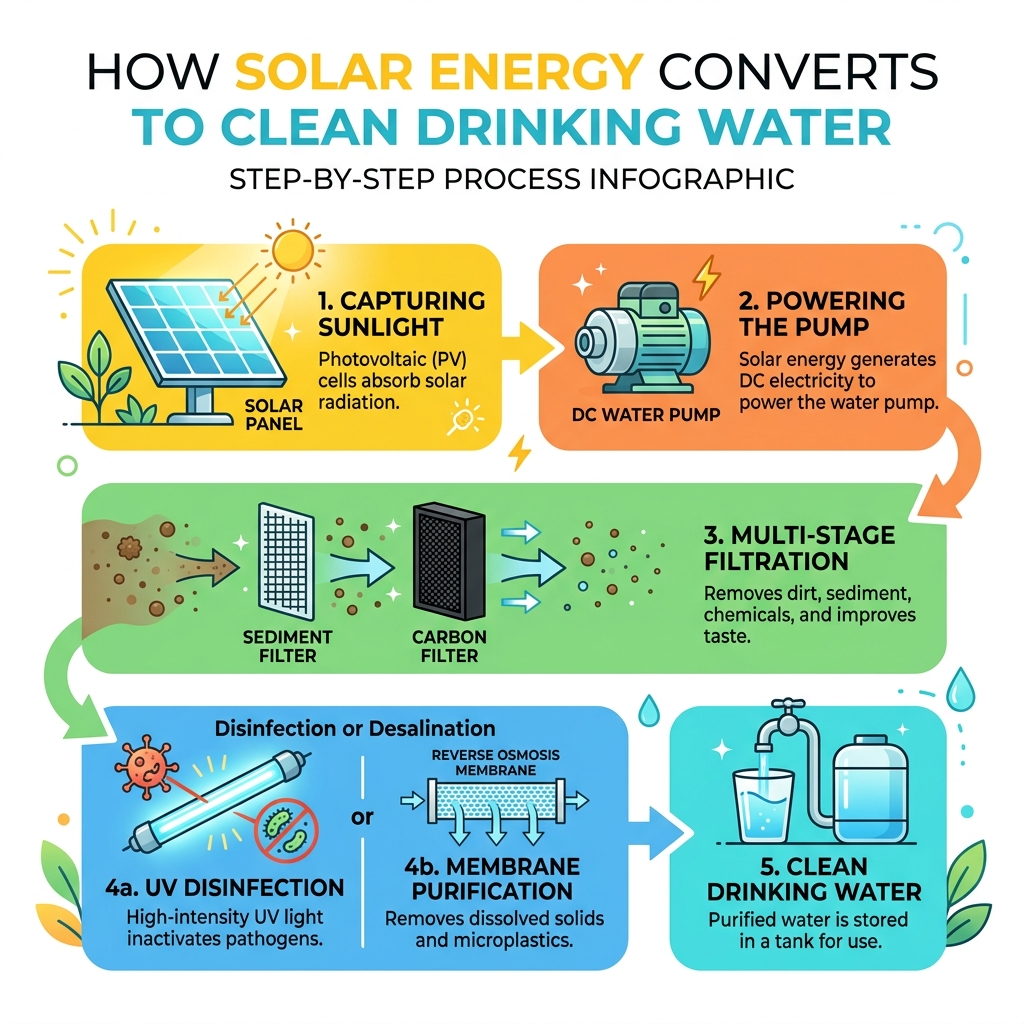
When we talk about solar powered water purifiers, we are looking at a marriage of two distinct fields: renewable energy and advanced filtration. At the most basic level, these systems use photovoltaic (PV) panels to capture photons from the sun and convert them into DC electricity. This electricity then powers the “heavy lifting” components of the purification process, such as pumps or specialized lamps.
For many off-grid setups, setting-up-solar-chargers-in-the-outdoors/ is the first step toward creating a self-sustaining water station. Once the power is flowing, it typically drives a DC pump that moves raw water through a multi-stage filtration sequence. This sequence often begins with sediment filters to catch dirt and sand, followed by carbon filters to improve taste and remove chemicals. However, the real magic happens in the disinfection or desalination stages, which are the primary reasons why solar-powered water purifiers are becoming a staple for homesteaders.
Ultraviolet (UV) Disinfection Systems
UV systems are a favorite for freshwater sources like lakes and rivers. Instead of using chemicals like chlorine, these systems pass water through a chamber containing a UV lamp. The ultraviolet light penetrates the cells of microorganisms, damaging their DNA and rendering them unable to reproduce.
This process is incredibly efficient, often boasting a 99.99% success rate in inactivating pathogens such as E. coli, Giardia, and Cryptosporidium. For example, the Wyckomar UV-250 can process up to 2.6 gallons per minute (10 LPM) from freshwater sources, making it a robust choice for cabins or small groups. Similarly, the WaterQuip SOLAR-2 utilizes UV technology to meet World Health Organization standards for potable water in rural areas without a power grid.
Solar Powered Reverse Osmosis (RO)
If your water source is brackish (salty) or contains heavy metals, UV light won’t be enough. This is where Photovoltaic Powered Reverse Osmosis (PVRO) comes in. RO systems use high-pressure pumps to force water through a semi-permeable membrane. This membrane is so fine that it blocks almost everything except pure H2O molecules, effectively reducing Total Dissolved Solids (TDS) and removing salts.
While RO is energy-intensive, modern innovations like the “Clark Pump” energy recovery device used in the Spectra Aquifer 200 allow these systems to run on as little as 110 watts. This makes it possible to purify seawater or brackish well water using just a few folding solar panels and a deep-cycle battery.
Advanced Solar Absorber Gels
One of the most exciting emerging technologies isn’t a mechanical pump at all, but a “solar absorber gel.” Researchers at Princeton University have developed a second-generation hydrogel that acts like a sponge. Under 33°C (91°F), the gel absorbs water while leaving contaminants like microplastics and heavy metals behind. When the sun hits the gel and warms it above that threshold, the gel structure collapses and “sweats” out the purified water.
This passive technology can produce over a gallon of clean water in just 10 minutes from a single square meter of material. It requires no electricity, no moving parts, and is virtually maintenance-free, representing a massive leap forward for emergency on-demand water access.
Benefits and Real-World Impact of Solar Systems
The shift toward solar-powered purification isn’t just about convenience; it’s about survival and community resilience. In many parts of the world, traditional water purification relies on boiling water (which requires fuel/wood) or using diesel-powered pumps. Solar systems eliminate the need for fuel, reduce noise, and lower the carbon footprint of clean water production.

A prime example of this impact is the MIT project in La Mancalona, Mexico. By using a PVRO system, the village transformed brackish well water into high-quality drinking water. This didn’t just improve health; it created a local economy. The community sells 20-liter bottles for about one-tenth the price of commercial bottled water, generating a yearly profit of roughly $3,600 for community reinvestment. This proves that with the right guide-to-eco-friendly-solar-camping/ mindset and technology, even the most remote locations can become self-sufficient.
Effectiveness Against Contaminants
Different technologies excel at removing different “nasties.” To help you decide which system fits your needs, we’ve broken down the effectiveness of the primary solar technologies below:
| Contaminant | UV Disinfection | Reverse Osmosis (RO) | Ultrafiltration (UF) |
|---|---|---|---|
| Bacteria & Viruses | 99.99% (Inactivated) | >99.9% (Removed) | >99.9% (Removed) |
| Protozoa (Giardia) | Excellent | Excellent | Excellent |
| Heavy Metals | No Effect | Excellent | Poor |
| Salts (Desalination) | No Effect | Excellent | No Effect |
| Microplastics | No Effect | Excellent | Excellent |
| Sediment | Requires Pre-filter | Excellent | Excellent |
For many humanitarian efforts, Solar Powered Water Pumps for Filtration are paired with five-step filtration processes including ultrafiltration and activated carbon to ensure the water tastes as good as it looks.
Economic and Environmental Sustainability
The economics of solar water are hard to beat. While the upfront cost of a system like the WaterQuip SOLAR-2 might be over $5,000, the operational costs drop significantly over time. Some large-scale desalination units can produce clean water for as little as 0.30 € to 1.00 € per cubic meter.
On a smaller scale, systems like the Healing Waters Solar Pure can produce water at a cost of just $0.005 per liter. When you consider that using-solar-devices-in-different-weather-conditions/ allows these systems to function even on cloudy days (using battery backups), the reliability and long-term savings compared to buying bottled water are staggering.
Choosing the Right Solar Powered Water Purifiers
Selecting the right system depends on three main factors: how much water you need, what your water source looks like, and how portable you need the system to be.
If you are a solo traveler or a couple on a weekend trip, a heavy-duty desalination unit is overkill. Conversely, if you are providing for a remote homestead with a brackish well, a small portable filter won’t keep up with your daily volume.
Comparing Portable Solar Powered Water Purifiers
For the “mobile” crowd—campers, van-lifers, and emergency preppers—portability is king.
- GoSun Flow Pro: This is essentially a “kitchen sink in a backpack.” It uses an 18Wh battery (charged by solar) to pump water at 1 LPM. It doubles as a handwashing station and shower. It’s priced around $179 and can pump 100 gallons on a single charge.
- Fulling Way Portable System: This unit adds a layer of security with a hand-crank backup. If the sun isn’t shining and your battery is dead, three minutes of cranking provides a day’s worth of water. It also features a USB-C port to charge your phone.
- Spectra Aquifer 200: For those who need serious output in a portable “tough-tote” box, this unit produces 8 gallons per hour and can handle seawater. It’s a military-grade solution for expeditions.
Stationary and Community-Scale Solutions
When portability isn’t the priority, we look for modular designs and high-capacity output. These systems, like the Wyckomar UV-250, are often housed in weather-resistant enclosures and can be integrated into existing plumbing.
The best stationary systems offer “Solar Direct” options, meaning they can run directly off the panels during the day to fill a large storage tank, eliminating the need for expensive battery banks. For 24/7 operation, these systems can be “Grid-Tied” or use a battery backup to ensure clean water is available even after sunset.
Maintenance and Troubleshooting for Longevity
Like any piece of high-tech gear, solar powered water purifiers require a bit of TLC to stay in peak condition. Neglecting maintenance doesn’t just shorten the lifespan of the device; it can lead to contaminated water passing through the system unnoticed.
Maintenance for Solar Powered Water Purifiers
The most critical maintenance task is managing the filters and membranes.
- Sediment Filters: These should be checked frequently. If your water source is “chunky” or turbid, these will clog fast.
- Backwashing: Systems like the GoSun Flow or Fulling Way allow for backwashing—reversing the flow of clean water through the membrane to flush out trapped bacteria and silt.
- UV Lamps: A UV lamp might still “glow” after a year, but it loses its germicidal effectiveness over time. Most manufacturers recommend replacing the lamp every 12 months.
- Solar Panels: Keep them clean! A layer of dust or bird droppings can significantly reduce power output. We recommend checking our guide on how-to-maintain-outdoor-solar-gadgets/ for specific cleaning tips.
If your pump sounds strained or the flow rate drops, it’s usually a sign of a clogged filter or a low battery. For electrical issues, you can refer to our guide on troubleshooting-solar-powered-devices/.
DIY vs. Commercial Systems
Can you build your own? Absolutely. A basic DIY solar purifier can be as simple as a 12V RV pump, a few inline filters, and a small solar panel with a charge controller. This is a cost-effective route for those on a budget.
However, commercial systems offer “fail-safes” that are hard to replicate at home. For instance, the WaterQuip SOLAR-2 includes a safety interlock that automatically closes the water outlet if the UV lamp malfunctions. When your health is on the line, that built-in peace of mind is often worth the extra investment.
Frequently Asked Questions about Solar Water Purification
Can solar purifiers work at night or in cloudy weather?
Yes, most modern solar powered water purifiers include internal lithium-ion or AGM batteries. The solar panels charge the battery during the day, and the battery runs the pump or UV lamp at night. For example, the GoSun Flow Pro can pump over 100 gallons on a single charge of its 18Wh battery.
Do these systems remove salt from seawater?
Only if they use Reverse Osmosis (RO) or distillation technology. Standard UV and carbon filters will not remove salt. If you are near the ocean, look specifically for “desalination” or “seawater” rated units like the Spectra Aquifer series.
How often do filters and UV lamps need replacement?
It depends on the model. Portable filters like the GoSun Flow generally last for 1,000 liters. UV lamps typically need replacement once a year (approx. 9,000 hours of use). Pre-filters may need changing every 3-6 months depending on how “dirty” your source water is.
Conclusion
The future of water is decentralized. As groundwater tables drop and infrastructure becomes less reliable, the ability to generate your own clean water using nothing but sunlight is the ultimate form of self-reliance. From the jungles of the Yucatan to the mountains of the Pacific Northwest, solar powered water purifiers are proving that clean water doesn’t have to depend on a grid or a fuel tank.
At Rico Compouco, we believe in empowering you with the best solar-integrated solutions. Whether you’re looking for a “personal water factory” for your backpack or a community-scale setup for your homestead, the technology is ready.
Stay hydrated, stay sustainable, and if you want to dive deeper into renewable tech, check out More info about solar gadgets.
