
The Best Solar Showers That Actually Get Hot (2026 Picks)
The best solar showers on the market right now are:
- Advanced Elements 5-Gallon Summer Shower – Best for car camping; heats to 110°F in 3 hours, 7-minute runtime
- Sea to Summit Pocket Shower (10L) – Best for backpacking; weighs just 5.25 oz, 8.5-minute runtime
- Nemo Helio LX Pressure Shower (22L) – Best for pressure and runtime; 7-10 minutes, no hanging needed
After a long day on the trail, nothing sounds better than a hot shower. But when you’re miles from the nearest facility, that feels like a fantasy.
It doesn’t have to be.
Solar showers use the sun to heat your water for free. No batteries. No propane. No hookups. Just fill, set in the sun for a few hours, and you’re ready to rinse off.
The catch? Not all solar showers actually get hot. Some barely warm up. Some leak. Some give you 90 seconds of water before running dry.
We dug into real-world testing data across multiple models and conditions – from the Sierra Nevada to Montana fly fishing trips – to find out which ones genuinely deliver.
Whether you’re a backpacker counting every ounce or a car camper who wants a full warm shower at base camp, there’s a solar shower that fits your setup. Here’s what you need to know before you buy.
How Solar Showers Work: Gravity vs. Pressure Systems
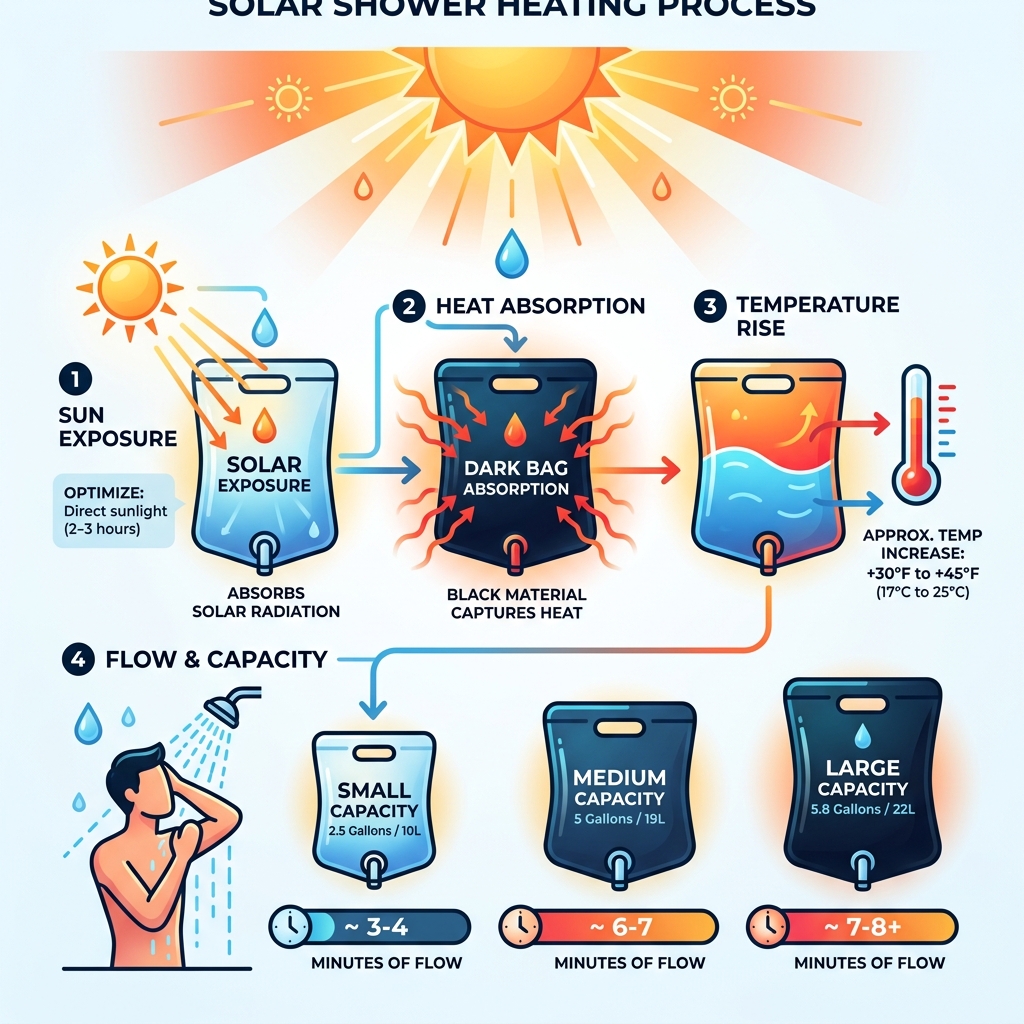
Before we dive into the specific models, we need to talk about the “how.” At its core, a solar shower is a lesson in thermodynamics. Most of these systems use a black or dark-colored reservoir to absorb UV rays. When you place that reservoir in direct sunlight, the water inside absorbs the heat.
However, how that water gets from the bag to your skin varies wildly. Understanding this is the first step in our beginner-guide-to-solar-powered-gear/ for staying clean off-grid.
The Gravity-Fed System
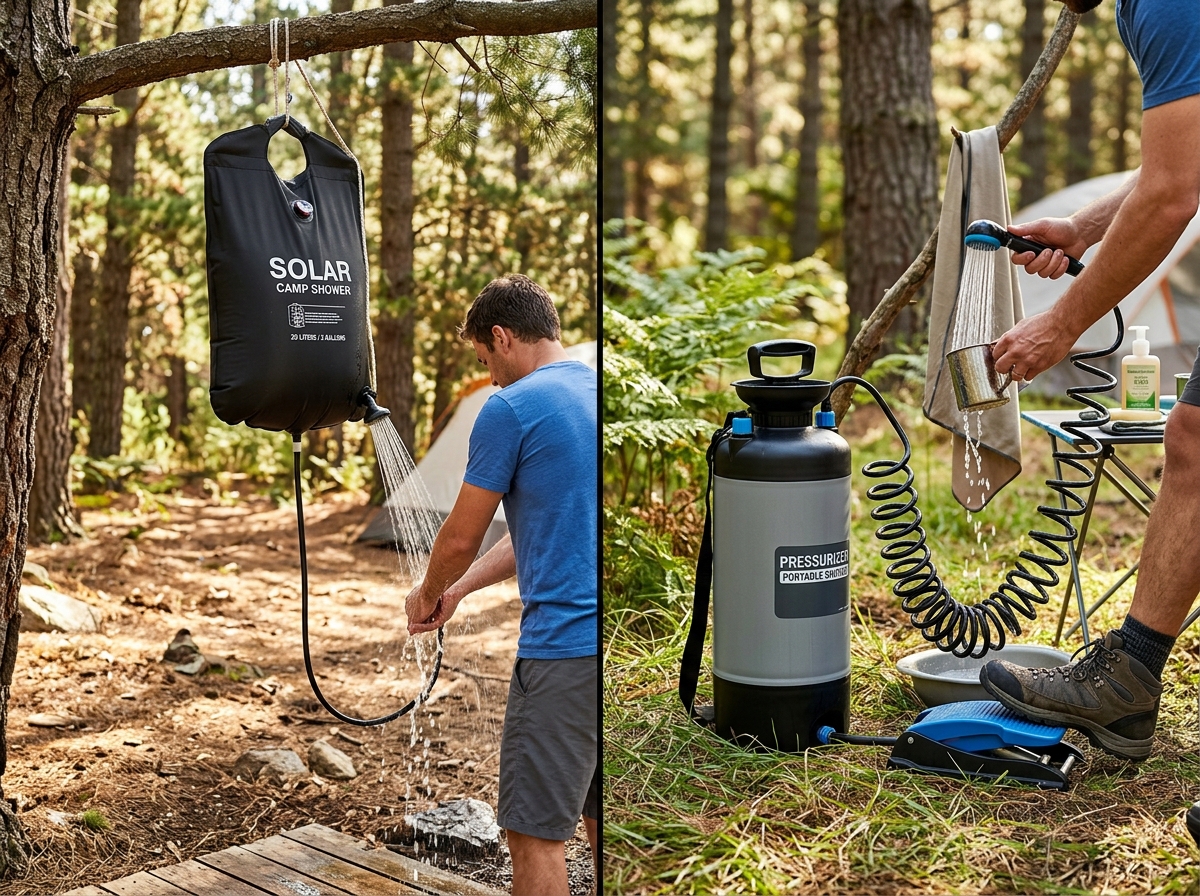
The classic solar shower is a gravity bag. These are essentially heavy-duty dry bags with a hose and a nozzle at the bottom.
- The Pros: They are inexpensive, have zero moving parts to break, and are incredibly packable.
- The Cons: You have to hang them. And water is heavy. One gallon of water weighs approximately 8 pounds. If you have a 5-gallon bag, you are trying to hoist 40 pounds of sloshing weight six feet into the air.
- Expert Tip: To get decent water pressure, the bag needs to be at least a foot above your head. In places like Wyoming, finding a sturdy branch at the right height in a lodgepole pine forest can be a genuine challenge!
The Pressurized System
If you don’t want to play “find the perfect tree,” a pressurized system is your best friend. These usually sit on the ground and use a foot pump or a hand pump to create air pressure inside the tank.
- The Pros: Consistent flow rates, no heavy lifting, and you can use them anywhere—even in a desert with no trees in sight.
- The Cons: They are bulkier, heavier, and significantly more expensive than gravity bags.
Top Rated Models: The Best Solar Showers for Every Camper
Choosing the best solar showers depends entirely on your style of travel. Are you hauling everything on your back, or do you have a trunk full of gear? We’ve compared the top performers based on capacity, weight, and how long they actually stay hot.
| Model | Capacity | Weight (Empty) | Heating Time | Pressure Type |
|---|---|---|---|---|
| Advanced Elements Summer Shower | 5 Gallons | 1.4 lbs | 3 Hours | Gravity |
| Sea to Summit Pocket Shower | 10 Liters | 5.25 oz | 3-4 Hours | Gravity |
| Nemo Helio LX | 22 Liters | 2 lbs | 3.5 Hours | Foot Pump |
| Stearns Sun Shower 4 | 5 Gallons | 1.2 lbs | 4 Hours | Gravity |
Investing in these tools is a major part of solar-powered-gear-for-eco-friendly-trips/ because they eliminate the need for disposable wipes or propane-heavy heating systems.
Best Solar Showers for Backpacking: The Ultralight Gravity Option
For the ounce-counters among us, the Sea to Summit Pocket Shower is a marvel of engineering. Weighing in at just 5.25 oz, it’s about the size of a deck of cards when folded up.
Despite its tiny footprint, it holds 10 liters (about 2.6 gallons) of water. In our experience, that’s enough for a solid 8.5-minute shower if you’re conservative with the nozzle. The roll-top seal is incredibly secure, meaning you can also use it as a dry bag for your clothes when you aren’t showering.
While it doesn’t have the fancy insulation of larger models, its thin material actually helps it heat up relatively quickly. It’s a staple for eco-friendly-solar-gadgets-for-backpackers-2026/ because it delivers luxury without the weight penalty.
Best Solar Showers for Car Camping: The High-Capacity Gravity Bag
If weight isn’t your primary concern, the Advanced Elements Summer Shower is arguably the best value on the market. We’ve seen this bag hit 110°F in just 3 hours on a 100°F day in Southern California.
What sets it apart is the 4-layer construction. It has a clear side to let the sun in and a black side to absorb the heat, backed by an insulator to keep that heat from escaping. It even features a built-in temperature gauge, so you don’t accidentally scald yourself.
The wide handle with a Velcro strap makes it easier to hang than the flimsy plastic tubes found on budget $15 bags. It’s a perfect example of green-energy-on-your-camping-trip-the-best-solar-gadgets/ because it’s durable enough to last for years of rugged use.
Best High-Pressure Option: The Portable Foot-Pump System
The Nemo Helio LX is the gold standard for those who want a “real” shower experience in the woods. Instead of hanging a heavy bag, you fill the tank, set it on the ground, and use a foot pump to pressurize it.
The 22L (5.8 gallon) capacity provides a steady 7-10 minute stream of water. Because it’s pressurized, you can even use it to spray down your gear, wash the dog, or rinse off a muddy mountain bike. It’s one of the solar-powered-gadgets-that-are-raising-the-camping-game-in-2026/ because it solves the biggest pain point of solar showers: the lack of pressure.
Heating Performance: What Determines Water Temperature?
We’ve all seen the claims: “Heats water to 120 degrees!” But in the real world, your results will vary based on a few key factors.
- Ambient Temperature: A solar shower typically heats water to about 30°F above the surrounding air temperature. If it’s a 70°F day, don’t expect a 110°F shower.
- Surface Area to Volume Ratio: Smaller bags (like 2.5-gallon models) actually heat up faster than 10-gallon bags because there is more surface area exposed to the sun relative to the amount of water inside.
- Sun Angle: For the best solar showers to work efficiently, they need direct, perpendicular sunlight. Laying the bag on the ground (clear side up) often works better than hanging it while it’s heating because it captures more direct rays.
- The “Boiling Water Hack”: If the sun isn’t cooperating, you can speed things up by adding a liter of boiling water from your camp stove to the bag. Just be sure to test the temperature before you jump in!
Expert testing has shown that most high-quality black-backed bags will reach 100-105°F in about 3 to 4 hours on an 80°F day. However, once the sun goes down, they lose heat fast—dropping about 5 degrees every hour they spend in the shade. Timing is everything! You can learn more about managing these variables in our guide-to-eco-friendly-solar-camping/.
Setup, Maintenance, and Leave No Trace Principles
Staying clean shouldn’t mean making the wilderness dirty. When using the best solar showers, we have a responsibility to protect the environment by following Leave No Trace principles.
The 200-Foot Rule
Always set up your shower at least 200 feet away from lakes, streams, or rivers. Even “biodegradable” soap can harm aquatic life and disrupt the pH of natural water sources.
Greywater Disposal
The best way to handle soapy runoff is to dig a 6-inch “cathole” in a sunny spot. This allows the soil microbes to break down the soap efficiently. If you’re in a high-traffic campground, consider using a privacy tent with a floor that drains into a specific area to minimize your footprint.
Maintenance and Mold Prevention
The biggest enemy of a solar shower isn’t a sharp rock—it’s mold. Because these bags are made of plastic or TPU, they take a long time to dry.
- The Dry Time: Expect it to take up to 2 full days to completely air out a bag.
- Sanitization: After every trip, rinse your bag with a solution of one tablespoon of bleach per gallon of water. Flush it through the hose and nozzle, then hang it upside down with the cap off to dry.
- Storage: Never store your bag while it’s still damp. This is a one-way ticket to a funky-smelling shower next spring.
For more tips on keeping your gear in top shape, check out our guide on solar-gadgets-for-sustainable-travel-2026/.
Frequently Asked Questions about Solar Showers
How long does it take for a solar shower to heat up?
In optimal conditions (full sun, 80°F ambient temperature), most 5-gallon bags take 3 to 4 hours to reach a comfortable 100-105°F. To speed this up, lay the bag on a dark surface like a car hood or a black tarp to catch reflected heat. Shaking the bag every 30 minutes also helps distribute the warm water that rises to the top.
How much shower time do you get from 5 gallons?
You can expect between 4 and 7 minutes of continuous flow from a 5-gallon bag. However, we recommend the “wet-lather-rinse” method:
- Turn on the water to get wet (30 seconds).
- Turn off the water and lather up with soap.
- Turn the water back on to rinse (2 minutes). Using this method, a single 5-gallon bag can easily provide showers for 3 to 4 people.
Can I use a solar shower in freezing weather?
It’s possible, but difficult. The main issue isn’t the bag—it’s the hose. The small amount of water in the hose will freeze almost instantly in sub-freezing temps. To combat this, you can fill the bag with pre-heated water and wrap it in a black garbage bag or an insulated jacket. However, for true winter camping, a propane-heated system is usually a more reliable choice.
Conclusion
At Rico Compouco, we believe that sustainable travel doesn’t have to mean sacrificing the simple joys of life—like a warm shower after a dusty hike. The best solar showers are more than just gear; they are a bridge to a more comfortable, eco-friendly outdoor experience.
Whether you choose the ultralight Sea to Summit for your next thru-hike or the high-pressure Nemo Helio for your van-life adventures, you’re making a choice that respects both your comfort and the planet.
Ready to level up your off-grid game? More info about solar gadgets can be found on our main hub, where we break down everything from solar chargers to portable power stations. Stay clean, stay warm, and we’ll see you on the trail!
