
Why Every Serious Hunter Needs a Trail Solar Battery Pack
Trail solar battery packs are the smartest way to keep your trail cameras running indefinitely without repeated trips into the field to swap batteries.
Here are the top types of options to consider in 2025:
| Category | Typical Capacity | Solar Panel | Best For |
|---|---|---|---|
| High-Capacity Pro | 25,000 mAh | 10W monocrystalline | Long-term cellular cams |
| Integrated Stealth | 5,000 mAh | Amorphous panel | Discreet setups |
| Universal 12V | 5,000 mAh | Integrated panel | Standard 12V cameras |
| Compact SD | 2,000 mAh | 1W panel | Light-duty use |
| High-Output Foldable | External battery | 28W panel | General outdoor charging |
If you run trail cameras, you already know the frustration. You hike into your best spot, check the camera, and realize it’s been dead for two weeks. Every photo opportunity — gone.
The fix is simple. A good trail solar battery pack keeps your camera powered around the clock, rain or shine. No more dead batteries. No more wasted trips. No more scent contamination in your prime hunting areas.
These packs pair a solar panel with a rechargeable lithium battery. The panel tops up the battery during the day, and the battery powers your camera day and night — even through cloudy stretches.
Whether you run a cellular camera 250 miles from home or just want fewer maintenance headaches, the right solar pack can mean the difference between catching that trophy buck on camera and missing it entirely.
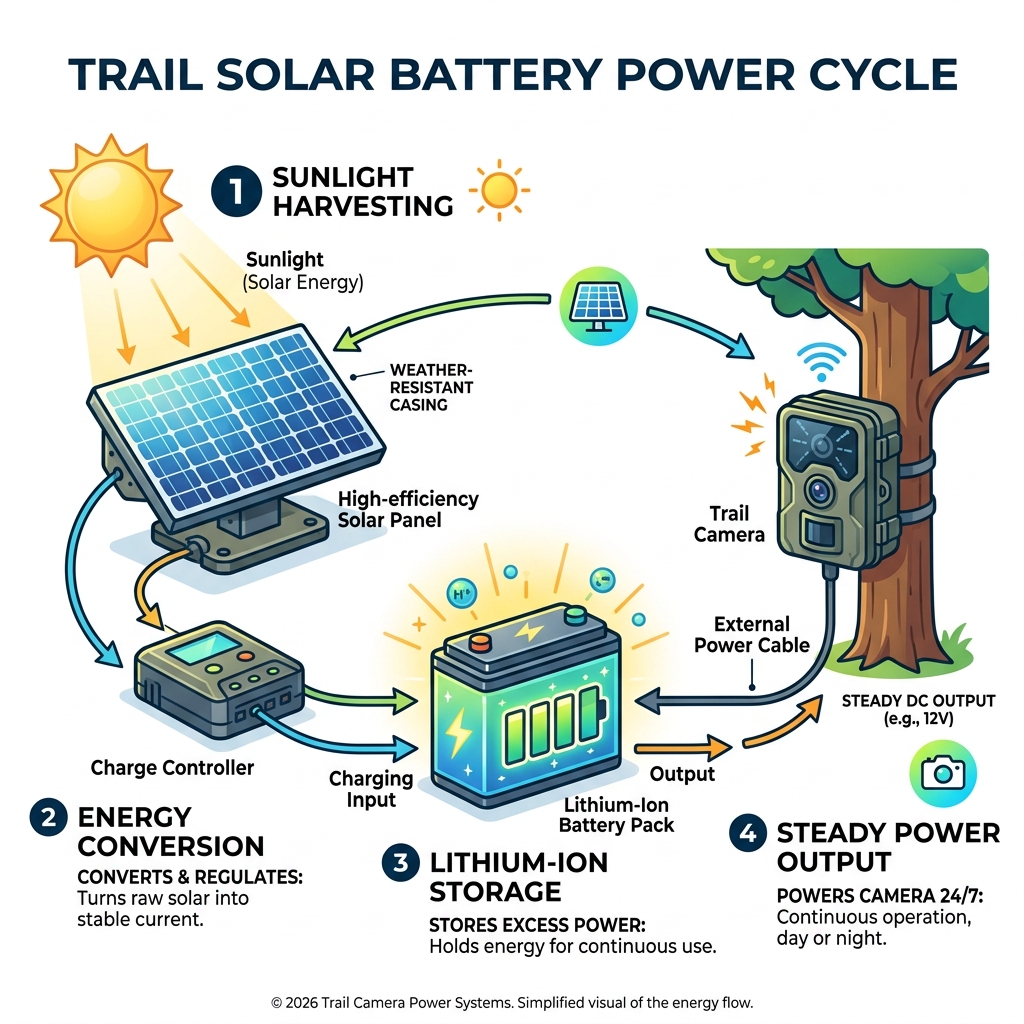
How a Trail Solar Battery Pack Works for Remote Monitoring
At its core, a trail solar battery pack is a mini power grid for your scout camera. It uses photovoltaic cells to capture sunlight and convert it into electrical energy. This energy isn’t sent directly to the camera in a raw “live” stream; instead, it is funneled into a lithium-ion storage unit. This internal battery acts as a buffer, ensuring your camera receives a steady 12V DC output (or 6V/9V depending on the model) regardless of whether the sun is currently shining.
When setting up solar chargers in the outdoors, the housing is just as important as the electronics. These units are encased in weather-resistant materials, often ABS plastic with IP66 ratings, to withstand the “fun” parts of nature like driving rain, snow, and curious squirrels.
The type of panel matters significantly. You will generally see two types:
- Monocrystalline Panels: These are the gold standard. They are made from a single crystal structure, making them highly efficient (often around 20-25% conversion rates). They perform better in smaller footprints, which is ideal for a discreet trail setup.
- Amorphous Panels: Often found on entry-level or “stealth” models, these are “thin-film” panels. While less efficient than monocrystalline, they have a unique advantage: they can sometimes perform better in low-light or partially shaded conditions.
To keep these units running for years, maintaining solar power banks for travel and field use involves keeping the panel face clear of debris and checking the cable seals once a season.
Key Features of a High-Performance Trail Solar Battery Pack
When you are shopping for a trail solar battery pack, don’t just look at the price tag. Look at the “gas tank” and the “refill rate.”
- mAh Capacity: This is your storage. A 3,000mAh battery might last a few days of heavy cellular transmission during a storm, but a 25,000mAh beast can keep a camera running for weeks even if the sun disappears entirely.
- Solar Wattage: This is how fast you can recharge. A 1W panel is fine for a standard SD-card camera that only triggers occasionally. However, for a high-traffic cellular camera, you really want a 5W to 10W panel to ensure you aren’t running a deficit.
- Durability and Mounting: Look for IP66 waterproof ratings and rugged mounting brackets. T-swivel brackets are excellent because they allow you to tilt the panel toward the sun while keeping the camera pointed at the trail.
- Voltage Compatibility: Most modern cellular trail cams run on 12V external power, but some older models or specific brands use 6V or 9V. Ensure your pack matches your camera’s requirements to avoid frying the circuits. Knowing how to maximize solar battery life often starts with choosing the correct voltage to prevent energy loss through conversion.
Choosing the Right Trail Solar Battery Pack for Your Camera
Compatibility is the biggest hurdle for most hunters. Not all “universal” packs are truly universal. You need to consider the brand and the barrel plug size.
Popular camera manufacturers often use different plug dimensions. For example, one popular cellular model might require a 4.0×1.7mm plug, while a different brand might use a 5.5×2.1mm “standard” barrel.
Before buying, check your camera’s external power jack. Some high-end solar packs come with a variety of adapters or specific “chewproof” cables designed for specific brands. If you are running a 12V system, ensure the battery pack doesn’t drop below the required voltage when the internal battery is at 50% capacity, as some cellular cameras are very picky about voltage drops.
Top-Rated Solar Power Solutions for 2025
The market for trail solar battery pack technology has exploded recently. We’ve moved past the days of flimsy 1W panels that barely kept up with self-discharge. Today’s units are serious pieces of hardware.
| Feature | High-Capacity Pro | Standard Solar | Value Pack | Compact SD |
|---|---|---|---|---|
| Capacity | 25,000 mAh | 5,000 mAh | 5,000 mAh | 2,000 mAh |
| Wattage | 10W | High Efficiency | Integrated | 1W |
| Voltage | 6V/9V/12V | 12V | 12V | 6V/12V |
| Specialty | Long-term Cellular | Integrated Stealth | Value/Bulk Buy | Compact SD Cams |
For those who need even more power—perhaps for a base camp setup or a “master” cellular hub—high-capacity portable power stations offer significant storage in a shockproof housing. While overkill for a single camera, it’s a game-changer for remote research stations.
Best High-Capacity Trail Solar Battery Pack Features
If you want the “set it and forget it” experience, you need to look at high-capacity units. A standout configuration includes a massive 25,000mAh lithium battery and a 10W monocrystalline solar panel, designed to provide 24/7/365 runtime.
One of the best features of high-end packs is the inclusion of “chewproof” cables. If you’ve ever had a bear or a squirrel decide your power cable looked like a snack, you know why this matters. These steel-braided cables ensure that your power stays connected even in “varmint-heavy” areas. Furthermore, these packs often feature integrated charge meters, so you can see exactly how much juice you have left without needing a multimeter.
Real-World Performance: Direct Sun vs. Cloudy Conditions

In a perfect world, every trail solar battery pack would sit in an open field facing south. In the real world, we put them in thick timber, north-facing hollows, and cedar swamps.
Performance varies wildly based on light quality. For instance, a high-output 28W panel can generate about 2,177 mAh in just one hour of direct sun. However, in indirect sun (cloudy days or under a heavy canopy), that drops to 583 mAh per hour. While that’s a significant drop, a high-wattage panel still generates enough to keep a camera “in the green.”
Smaller panels struggle more. A standard 10W panel generates about 1,401 mAh in direct sun but only 295 mAh in indirect light. If your camera transmits 50 photos a day via cellular, it might consume 100-200 mAh. On a cloudy day, a small panel might barely break even.
To get the best results, solar gadget placement for best efficiency is key. Even in heavy timber, try to find a “window” in the canopy. Sometimes moving the panel just three feet up the tree or angling it slightly can double your daily intake. If you find your levels dropping, check our guide on troubleshooting solar powered devices.
Winter brings its own challenges. Lithium batteries don’t love the cold, but high-quality packs use insulated housings or LiFePO4 chemistry to maintain resilience in sub-zero temperatures. In fact, real-world tests of high-capacity 25,000mah packs show them performing excellently even in deep freezes.
Installation and Maintenance for All-Season Use
Installing a trail solar battery pack shouldn’t require a degree in engineering. Most modern units use a tool-free setup.
- Mount the Bracket: Use the included adjustable nylon strap or a lag bolt to secure the T-swivel bracket to the tree.
- Angle for the Sun: Aim the panel south (if you’re in the Northern Hemisphere). Tilt it at roughly a 45-degree angle to shed snow and rain while catching the most sun.
- Connect the Cable: Plug the barrel connector into the camera’s external power port. Ensure the connection is snug and the weather seal is seated.
- Secure the Slack: Don’t leave loose wires hanging! Use zip ties or the tree strap to tuck the cable against the bark. This prevents “wind-whipping” and discourages animals from tugging on it.
For maintenance, simply wipe the panel face with a damp cloth once or twice a year. Pollen, dust, and bird droppings can act like a “dimmer switch” for your solar cells. Since these are portable solar power banks: the vanguards of outdoor energy, they are built to be tough, but a little cleaning goes a long way.
Frequently Asked Questions about Trail Solar Power
Can these packs charge other devices like phones?
Yes! Many modern trail solar battery packs feature dual-purpose ports. In addition to the 12V DC output for your camera, premium units often include USB or USB-C ports.
This field versatility is a lifesaver. If you are out checking cameras and your phone dies, you can plug right into the solar pack for a quick boost. We have a full guide on charging multiple devices with solar panels if you want to expand your off-grid charging setup.
What is the expected lifespan of a solar battery pack?
Most high-quality packs are designed to last 3 to 5 years of continuous outdoor use. The limiting factor is usually the lithium battery’s cycle life. Units using LiFePO4 (Lithium Iron Phosphate) technology are particularly durable, often rated for thousands of charge cycles.
To see what’s coming next in this space, check out the top solar chargers for outdoor use 2026. Generally, as long as you keep the seals intact and don’t let the battery sit at 0% charge for months at a time, you’ll get several seasons of reliable service.
Do I need extra accessories for specific camera brands?
Sometimes. While many packs are “universal,” the “universal” label usually refers to the 12V output, not the plug size.
- Compact Cellular Models: Often need a 4.0×1.7mm plug.
- Standard 12V Units: Usually use a 5.5×2.1mm plug.
- Dual-Voltage Systems: Often require a specific adapter for their 6V/12V systems.
Many retailers offer brand-specific kits that include the correct adapters. Always double-check your manual before buying, and keep some tips for charging gadgets off-grid in mind when organizing your gear bag.
Conclusion
At Rico Compouco, we believe that technology should make your outdoor experience more productive and less stressful. Investing in a quality trail solar battery pack is more than just a convenience—it’s a commitment to sustainable scouting. By eliminating the need for dozens of disposable AA batteries every year, you’re saving money and keeping heavy metals out of the woods.
Whether you choose a compact unit or a high-capacity powerhouse, the peace of mind that comes with a “full battery” icon on your cellular app is worth every penny.
Ready to take your off-grid setup to the next level? Check out our tips for charging gadgets off-grid 2 or explore more outdoor tech solutions on our main site. Happy scouting!
