
The Coolest Way to Beat the Heat Without a Power Outlet
A solar powered fan is exactly what it sounds like — a fan that runs on energy from the sun instead of grid electricity. No outlet needed. No batteries to swap out. Just sunlight and airflow.
Here’s the quick version of what you need to know:
- What it is: A fan powered by a built-in or attached solar panel, often with a rechargeable battery for cloudy days or nighttime use
- How it works: Photovoltaic cells convert sunlight into DC electricity, which drives a motor and spins the fan blades
- Best uses: Camping, sheds, chicken coops, greenhouses, RVs, and off-grid spaces
- Key specs to compare: CFM airflow rating, solar panel wattage, and battery capacity (mAh)
- Typical cost: Portable models range from around $8 to $42, while fixed ventilation fans for sheds or attics can cost more
- Limitations: Most basic models need direct sunlight to run — though battery-equipped versions can keep going through the night
If you’re tired of hunting for power outlets or swapping out AA batteries every few days, solar fans offer a genuinely practical alternative. Models like the GoSun Breeze push out 1,200 CFM of airflow at full power, while compact exhaust fans like the QuietCool UTF-SLR-03 quietly ventilate small spaces at just 28 dBA — all without touching the grid.
The catch? Performance varies a lot depending on how much sun you get, what size space you’re cooling, and which model you pick. That’s exactly what this guide walks you through.

How Solar Technology Keeps You Cool
At its heart, a solar powered fan is a masterpiece of energy conversion. It starts with photovoltaic cells—those sleek, dark panels you see on top of the unit. These cells capture photons from sunlight and knock electrons loose, creating a flow of Direct Current (DC) electricity.
Most modern solar fans utilize brushless DC motors. We love these because they are significantly more efficient than older brushed versions. They generate less friction and heat, which means they last longer and run much quieter. This is why a high-quality utility fan can operate at a whisper-quiet 28 dBA, which is barely louder than a person breathing.
When it comes to light sensitivity, these fans are surprisingly resilient. While they perform best in direct, bright sunlight, many high-efficiency models can operate continuously between 10,000 and 40,000+ lux. To put that in perspective, 10,000 lux is roughly the amount of light you get on a bright overcast day. However, for maximum RPM and airflow, you really want that direct “high noon” sun exposure. If you are planning to take one of these on a trip, check out our guide on using solar gadgets efficiently for hiking to ensure you’re getting the most out of the sun.
Benefits Over Traditional Electric Fans
Why go solar when you could just plug a fan into the wall? For us, it comes down to four main pillars:
- Zero Operating Costs: Once you buy the fan, the wind is free. You aren’t adding a single cent to your monthly utility bill.
- Unmatched Portability: You can take a solar powered fan to the middle of a desert, a remote beach, or a deep-woods campsite. As long as the sun rises, you have a cooling system.
- Reduced Carbon Footprint: By using renewable energy, you’re cutting down on the demand for fossil-fuel-generated grid power.
- Noise Reduction: Because solar fans often use DC brushless motors, they lack the heavy “hum” associated with large AC industrial fans.
Operating a Solar Powered Fan at Night
A common myth is that solar fans stop the moment a cloud passes or the sun sets. While that’s true for “direct-drive” models (like basic exhaust kits), many modern units come with integrated battery storage.
When looking at these models, pay attention to the mAh (milliamp-hour) capacity. A fan with a 10,000mAh to 20,000mAh battery can often run for 8 to 15 hours on a single charge. Some high-end portable fans can even last up to 6 days on a low-speed setting! Many of these fans also feature hybrid charging, meaning they have a USB backup port. This allows you to charge the fan via a wall outlet before you leave home, using the solar panel merely to “top off” the battery during the day. For more tips on keeping your gear running after dark, see our article on how to maximize solar battery life.
Key Specifications to Consider When Buying a Solar Powered Fan
Not all fans are created equal. If you buy a tiny desk fan and expect it to cool a 200-square-foot shed, you’re going to be disappointed. Here are the specs we always check:
- CFM Rating: This stands for Cubic Feet per Minute. It measures the volume of air the fan moves. A small utility fan might only have 33 CFM (great for a chicken coop), while a powerful portable fan can reach 1,200 CFM (perfect for a large tent or RV).
- Solar Panel Wattage: This determines how fast the battery charges and how much power the motor can pull. A 2.5W panel is standard for small vents, while 15W to 25W panels are common for high-performance standing fans.
- Panel Type: Monocrystalline panels are generally more efficient and perform better in low light compared to Polycrystalline panels, though the latter are often more budget-friendly.
| Feature | Portable Camping Fan | Fixed Exhaust Kit |
|---|---|---|
| Primary Goal | Personal cooling/Airflow | Heat & odor extraction |
| Installation | None (Stand/Hook) | Permanent mounting |
| CFM Range | 200 – 1,200 CFM | 30 – 500 CFM |
| Power Source | Internal Battery + Solar | Direct Solar (usually) |
| Best For | Tents, RVs, Beaches | Sheds, Coops, Attics |
Before you make a purchase, it’s worth weighing the solar vs battery powered outdoor gadgets debate to see which power profile fits your lifestyle best.
Choosing the Right Solar Powered Fan for Enclosed Spaces
When we talk about “enclosed spaces,” we’re usually referring to sheds, greenhouses, or dog houses. In these environments, the goal isn’t just to blow air on you—it’s to prevent heat stress.
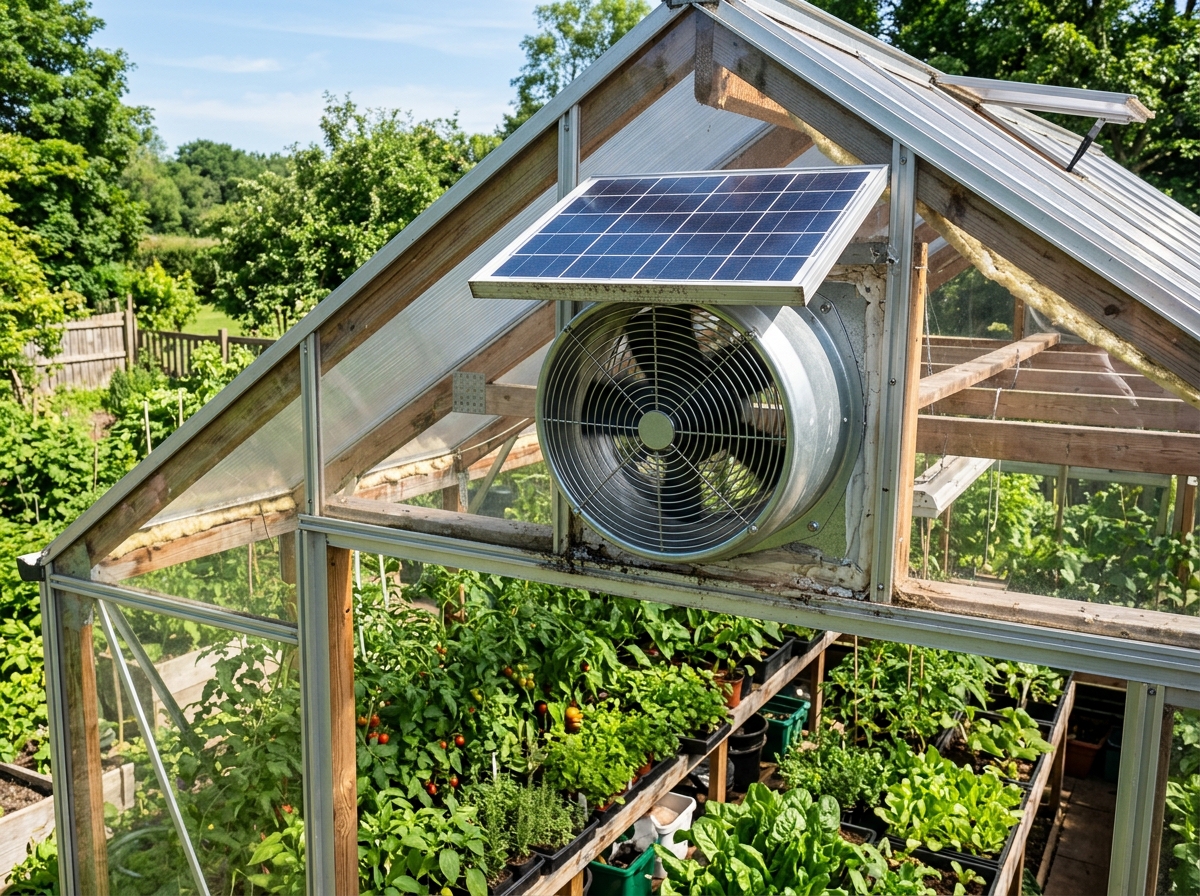
In a greenhouse, a solar powered fan is vital for preventing your plants from wilting in the afternoon sun. For these applications, you want a fan that activates automatically when the sun is at its hottest. Some models are designed to kick on once the light reaches a certain intensity, providing constant ventilation exactly when the heat starts to build up. If you’re setting up a more complex system, you might find our guide on setting up solar chargers in the outdoors helpful for positioning your panels.
Understanding Durability and Weatherproofing
Since these fans live outdoors, they need to be tough. Look for an IPX7 rating if you plan on using the fan near water or in rainy conditions. This means the device can handle immersion or heavy splashes.
Material matters, too. ABS plastic is the gold standard for portable solar fans because it is lightweight yet incredibly impact-resistant. Additionally, check for UV resistance on the solar panel casing; otherwise, the plastic can become brittle and crack after a single summer in the sun. Most high-quality units can withstand temperatures up to 160°F, ensuring they don’t melt while sitting on a hot roof. To learn more about how different environments affect your gear, read about using solar devices in different weather conditions.
Best Use Cases for Solar Ventilation
We’ve found that solar fans aren’t just “nice to have”—in some cases, they are essential.
- Chicken Coops: Chickens are very susceptible to heat stroke. A small solar exhaust fan can pull out ammonia fumes and hot air, keeping your flock healthy without the fire risk of running extension cords through straw.
- Greenhouses: Constant air circulation prevents mold and regulates humidity.
- Sheds: If you store gas-powered tools or paint in a shed, heat buildup can be dangerous. A solar vent keeps the air moving and the temperatures stable.
- Portable Restrooms: Solar fans are the #1 way to reduce odors in off-grid toilets or “outhouse” setups.
Intake and Exhaust Capabilities
Can a solar powered fan do both? Most basic models are designed for exhaust only—meaning they pull air out of a space. This is because pushing hot air out is generally more effective for cooling a structure than trying to blow outside air in.
However, “dual fan kits” are becoming popular. These feature two fans mounted side-by-side: one set to intake and one to exhaust. This creates cross-ventilation, which is the “holy grail” of air circulation. If your fan isn’t behaving as expected, our troubleshooting solar powered devices guide can help you identify if it’s a wiring issue or a placement problem.
Portable Cooling for Camping and Travel
For those of us who love the outdoors, a portable solar powered fan is a game-changer. Many camping models feature stepless speed control, allowing you to dial in the exact amount of breeze you need—from a gentle puff to a 1,200 CFM gale.
Look for models with a 360-degree tilting head or a built-in hanging hook. This allows you to hang the fan from the ceiling of your tent or the “grab handle” in your SUV. Some even include LED lanterns, making them a multi-purpose tool for your campsite.
How to Properly Install a Solar Powered Fan for Optimal Performance
If you’re installing a fixed fan, placement is everything. You want the solar panel to have West-facing exposure if possible. Why? Because the hottest part of the day is the afternoon, and a west-facing panel will capture that peak afternoon sun to keep the fan spinning at maximum RPM when you need it most.
For a standard utility fan, you’ll typically need a 3.25-inch hole saw to cut through the wall of your shed or coop. Most kits come with a screw-on holding plate that makes the process fairly straightforward. For more detailed tips on where to put your gear, check out our article on solar gadget placement for best efficiency.
DIY Options for a Custom Solar Powered Fan
If you’re a tinkerer, you can build your own setup. You’ll need:
- A 12V DC fan (computer fans work for very small spaces, but look for high-static pressure fans for better results).
- A 10W to 20W solar panel.
- A small charge controller (if you want to include a battery).
Wiring is usually a simple positive-to-positive and negative-to-negative connection. We recommend housing your DIY fan in a custom wooden or plastic enclosure to protect the wiring from the elements. If you’ve never set up solar gear before, our step-by-step guide for solar lantern setup covers the basics of handling panels and connectors safely.
Preventing Leaks and Ensuring Stability
The biggest mistake people make with fixed solar fans is poor sealing. Whenever you cut a hole in a building, you risk letting rain in. We always recommend using a high-quality silicone sealant around the edges of the fan housing.
Ensure the screw-on plates are tightened evenly to prevent vibration. A vibrating fan is not only noisy but can eventually loosen its own mounting hardware. For a smoother experience, follow our tips on the easy setup of solar outdoor tech.
Maintenance and Longevity of Solar Devices
Solar fans are remarkably low-maintenance, but they aren’t “set it and forget it.”
- Panel Cleaning: Dust, pollen, and bird droppings can significantly reduce the efficiency of your solar panel. A quick wipe with a damp cloth every few months makes a huge difference.
- Dust Removal: Use compressed air to blow dust out of the fan blades and motor housing. Accumulated dust can unbalance the blades, leading to noise and wear.
- Bearing Lubrication: While many brushless motors have sealed bearings, some larger fans may require a drop of light machine oil once a year to keep things spinning smoothly.
For a deeper dive into keeping your equipment in top shape, see our guide on how to maintain outdoor solar gadgets. Most quality solar fans come with a 1-year warranty, but a well-maintained brushless motor can easily last 10,000 to 40,000 hours of operation.
Common Pros and Cons Based on User Reviews
Before you buy, it’s helpful to look at the general consensus from other users:
Pros:
- Easy Installation: Most people find they can set up a portable or small exhaust fan in under 15 minutes.
- Quiet Operation: Users love that they can sleep near these fans without the loud “whirring” of traditional motors.
- Reliability: In off-grid scenarios, having a fan that doesn’t rely on a generator is a huge relief.
Cons:
- Sunlight Dependency: Without a battery, the fan will slow down or stop when a cloud passes.
- Airflow Limitations: Small, cheap models often don’t move enough air for larger rooms. You get what you pay for when it comes to CFM.
Frequently Asked Questions about Solar Fans
Do solar powered fans work on cloudy days?
Yes, but at a reduced capacity. High-quality fans can still spin in overcast conditions (around 10,000 lux), but the airflow will be significantly lower than in direct sunlight. If you need consistent power regardless of clouds, choose a model with a built-in battery.
Can I add a thermostat to my solar fan?
Some high-end attic fans come with integrated thermostats (set to turn on at 88°F and off at 77°F, for example). However, for most basic DC fans, adding a thermostat requires some DIY wiring knowledge and a 12V thermostat switch.
How do I turn off my solar fan during the winter?
Many solar utility fans do not have an “on/off” switch because they are designed to run whenever there is sun. In the winter, if you don’t want the fan pulling cold air into your shed, the easiest solution is to simply disconnect the power cable between the panel and the fan.
Conclusion
At Rico Compouco, we believe that sustainable living shouldn’t mean sacrificing comfort. Whether you’re trying to keep your chickens cool, ventilate a stuffy shed, or stay breezy at a summer music festival, a solar powered fan is one of the most cost-effective and eco-friendly investments you can make.
By choosing a model with the right CFM for your space and ensuring proper installation, you can achieve true energy independence and beat the heat for years to come. Ready to upgrade your off-grid setup? Explore more solar gadget solutions on our site today!
