
Why a Solar Powered Camping Fridge Is a Game-Changer for Off-Grid Adventures
A solar powered camping fridge is one of the smartest upgrades you can make for off-grid trips — no ice runs, no soggy food, no warm drinks.
Here’s a quick overview of what you need to know:
| Topic | Quick Answer |
|---|---|
| Best type | Compressor fridges (DC) — faster, colder, more efficient |
| Typical capacity | 15L to 55L (suits solo to group camping) |
| Runtime on battery | 10–43 hours depending on battery size |
| Solar panel needed | 60W–120W for most portable models |
| Temperature range | As low as -4°F (-20°C) — fridge and freezer |
| Top brands | BougeRV, EcoFlow, ACOPOWER, Dometic, GoSun |
| Best for | Car camping, RVs, overlanding, emergency backup |
If you’ve ever dealt with melted ice, soggy sandwiches, or a cooler that’s mostly water by day two — you already know the problem. Traditional ice coolers are messy, limited, and require constant restocking.
Solar powered fridges solve all of that.
Modern units cool to freezing in as little as 15–20 minutes, run for 10+ hours on a removable battery, and recharge directly from a foldable solar panel. Some models even let you control the temperature from your phone via Bluetooth.
Power outages and off-grid reliability are becoming bigger concerns too. Research shows that 83% of blackouts in the US are weather-related, and outages have doubled over the past 20 years. A solar fridge isn’t just a camping luxury — for many people, it’s becoming a practical backup tool.
This guide breaks down everything you need to choose the right one: fridge types, power calculations, top models, and tips to get the most out of your setup.
Understanding the Solar Powered Camping Fridge: Types and Technology
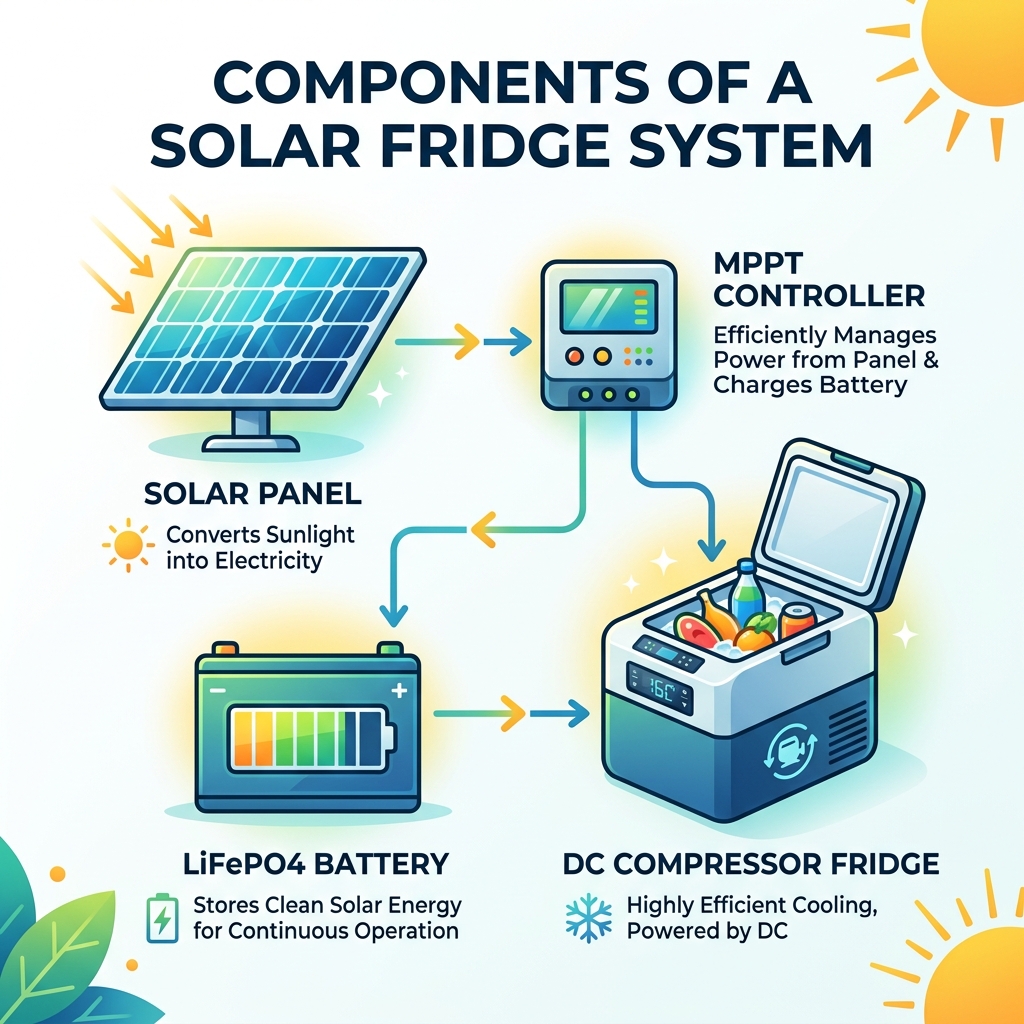
When we talk about a solar powered camping fridge, we aren’t usually talking about a fridge with solar panels glued to the lid. Instead, we are looking at highly efficient cooling units designed to run on DC power (12V/24V) that can be seamlessly paired with solar panels and batteries.
The heart of these machines is the cooling mechanism. There are two main technologies you’ll encounter: compressor and thermoelectric.
Compressor vs. Thermoelectric
For serious camping, the compressor-based solar powered camping fridge is the undisputed heavyweight champion.
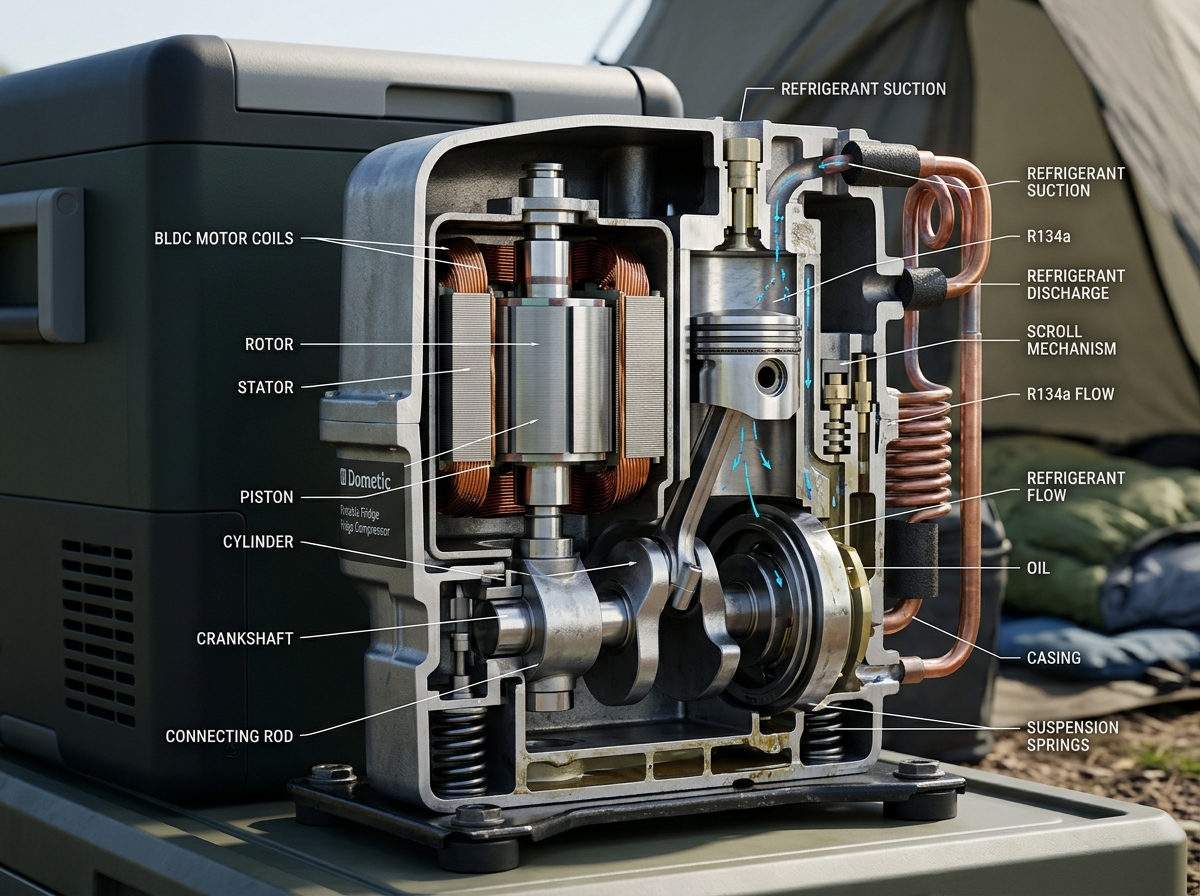
- Compressor Fridges: These work exactly like your fridge at home but are optimized for 12V DC power. They use a high-efficiency DC compressor to pump liquid refrigerant through a closed system. They are incredibly powerful, often reaching 32°F (0°C) in as little as 15 to 20 minutes. Because they are thermostatically controlled, the compressor only runs when needed, making them highly energy-efficient.
- Thermoelectric Coolers: These use the Peltier effect to transfer heat. While they are cheaper and have no moving parts, they are significantly less efficient. They can usually only cool about 40°F below the ambient temperature. If it’s 90°F outside, your milk is sitting at a dangerous 50°F. For true off-grid reliability, we almost always recommend a compressor model.
| Feature | Compressor Fridge | Thermoelectric Cooler |
|---|---|---|
| Cooling Power | Can reach -8°F (-22°C) | ~40°F below ambient |
| Efficiency | High (cycles on/off) | Low (runs constantly) |
| Ambient Impact | Minimal | High |
| Price | Higher | Lower |
| Noise | Low (40-45dB) | Very Low |
Essential Specs for Your Solar Powered Camping Fridge
Choosing the right model depends on your group size and how long you plan to stay off the grid.
- Capacity: Portable fridges are measured in Liters (L) or Quarts (Qt). A 15L to 20L unit is perfect for a solo weekend or as a dedicated beverage cooler in a car. A 35L to 45L unit is the “sweet spot” for a couple or a small family for 3-4 days. If you’re overlanding for a week, look at 55L or even dual-zone 75L+ models.
- Dual-Zone Cooling: Some advanced models, like the EcoFlow Glacier Classic Portable Fridge Freezer (55L) with Plug-in Battery and 60W Portable Solar Panel, offer dual-zone control. This means you can have one side acting as a freezer for steaks and ice cream, while the other stays at fridge temperature for vegetables and drinks.
- Insulation: Look for units with thick, high-density foam insulation (often 50mm or more). Better insulation means the compressor runs less frequently, which directly translates to longer battery life. Some premium models use vacuum insulation panels (VIPs) to reduce power consumption by up to 40%.
Portability and Smart Controls for Your Solar Powered Camping Fridge
Since we are taking these units into the wild, portability is key. Features like telescopic handles and rugged, off-road wheels make a massive difference when moving from the truck to the picnic table.
Modern tech has also brought us smart integration. Many of the best portable-gadgets-to-improve-camping-comfort now include Bluetooth or Wi-Fi app control. This allows us to monitor the internal temperature, check battery levels, and even view temperature history from our smartphones without ever opening the lid and letting the cold air out.
Calculating Power Needs for Off-Grid Cooling
To run a solar powered camping fridge indefinitely, we need to understand the “energy budget.” This involves calculating how much power the fridge consumes versus how much your solar panels can generate.
Watt-Hours and Daily Consumption
Most portable compressor fridges consume between 30W and 60W while the compressor is running. However, because the compressor cycles on and off, the actual daily consumption is much lower.
For example, a high-efficiency unit like the EcoFlow GLACIER Portable Refrigerator | Off-Grid Solar Fridge – EcoFlow Europe might only consume about 0.18 kWh (180 Watt-hours) per day in ECO mode. In contrast, a larger dual-zone unit running in MAX mode might use 500Wh to 1,000Wh per day.
Sizing Your Solar Powered Camping Fridge Battery and Panels
To ensure you never wake up to warm beer, you need a battery that can handle the “night shift” and panels that can recharge it during the day.
- The Battery: Most modern solar fridges come with, or support, internal LiFePO4 (Lithium Iron Phosphate) batteries. These are preferred because they can handle hundreds of charge cycles and remain stable in various temperatures. A 200Wh battery might provide 10-12 hours of runtime, while a 298Wh battery, like the one found in some Glacier Classic Portable Fridge for Camping | EcoFlow AU models, can offer up to 43 hours of wire-free cooling.
- The Solar Panels: You want a panel that can produce more energy than the fridge uses. A 60W to 100W panel is usually sufficient for a standard portable fridge. Look for monocrystalline cells, which offer up to 25% conversion efficiency. This is crucial for those less-than-perfect sunny days. If you are also charging phones and lights, a 120W or 200W foldable panel is a safer bet.
For more details on keeping your power source healthy, check out our guide on how-to-maximize-solar-battery-life.
Real-World Performance and Weather Impacts
It is important to remember that lab specs don’t always match the trail. Ambient temperature is the biggest variable. If your car is parked in the sun and reaches 120°F, your solar powered camping fridge will work significantly harder, consuming more power.
Conversely, high-quality insulation can keep items cold for hours even after the power is cut. This is why we emphasize green-energy-on-your-camping-trip-the-best-solar-gadgets that prioritize efficiency. During weather-related blackouts—which account for 83% of US outages—a well-insulated solar fridge can be a literal lifesaver for storing temperature-sensitive medications.
Practical Tips for Maximizing Efficiency and Longevity
To get the most out of your solar powered camping fridge, a little bit of strategy goes a long way.
- Start Cold: Always pre-chill your fridge at home using an AC wall outlet before you leave. It’s much easier for the battery to maintain a temperature than to lower it.
- The Shade is Your Friend: Keep the fridge in the shade and ensure there is plenty of ventilation around the compressor vents. If the heat can’t escape, the fridge has to work twice as hard.
- Use ECO Mode: Most units have a “MAX” and “ECO” mode. Use MAX to get down to temperature quickly, then switch to ECO to sip power for the rest of the trip.
- Keep it Full: A full fridge actually stays cold better than an empty one because the cold items act as “thermal mass.” If you have extra space, fill it with water bottles.
For a deeper dive into sustainable camping practices, read our guide-to-eco-friendly-solar-camping.
Accessories to Enhance Your Setup
While the fridge is the star, the right accessories can elevate the experience:
- Extra Batteries: If you’re heading into a week of cloudy weather, having a spare swappable battery, like those used in the ACOPOWER X15A Solar Fridge/Freezer/Cooler, ensures continuous operation.
- Solar Tables: Some brands offer solar tables that provide a flat surface for your gear while generating power.
- Protective Covers: These add an extra layer of insulation and protect your investment from the inevitable bumps of the trail.
Don’t forget to check out other never-run-out-of-charge-with-these-solar-powered-camping-tools to round out your off-grid kit.
Frequently Asked Questions about Solar Cooling
Can I run a solar fridge without a battery?
Technically, yes, but we don’t recommend it. You can connect a solar panel directly to many fridges via a DC port. However, solar power is “spiky.” If a cloud passes over, the voltage drops, and the compressor might shut down. A battery acts as a crucial buffer, providing stable voltage and ensuring the fridge runs through the night.
For a comparison of power strategies, see solar-vs-battery-powered-outdoor-gadgets.
How long does a solar fridge battery last?
It depends on the battery capacity and your settings. A standard 173Wh to 193Wh battery will typically last about 10 hours if the fridge is set to 32°F (0°C). High-end models with larger 298Wh batteries can push that to over 40 hours in ideal conditions. Using the 14+ hour runtime of specialized coolers as a benchmark, you can see how battery tech has revolutionized the “ice-free” lifestyle.
Is an AC fridge with an inverter better than a DC fridge?
For stationary camping or cabins, some people use a standard “dorm-style” AC fridge with a large solar array and an inverter. While AC fridges are cheaper to buy upfront, the energy loss through the inverter is significant. For portable camping, a dedicated DC solar powered camping fridge is much more efficient and rugged. If you are looking for lightweight-tech-gadgets-for-camping, DC is always the way to go.
Recommended Models to Consider
If you’re ready to make the jump, here are some of the top-performing units currently on the market:
- ACOPOWER LiONCooler Series: Known for their swappable batteries and fast cooling. The LiONCooler Mini Solar Powered Car Fridge Freezer, 29 Quarts – ACOPOWER is a fantastic compact option that can reach 32°F in just 20 minutes.
- EcoFlow Glacier: A premium choice that features the industry’s first integrated ice maker. It’s perfect for those who want luxury in the wilderness.
- BougeRV CRPRO Series: A favorite for overlanders, offering rugged construction and excellent energy efficiency.
- GoSun Chill: A unique option that emphasizes space-saving and works seamlessly with their solar table and flexible panel setups.
Whether you are looking for a Solar Freezer – acopower or a versatile dual-zone unit, there are more options than ever. You can Shop Solar Fridges | Low Prices, Fast Shipping, Lifetime Support or browse Solar DC Refrigerators for Off-Grid Homes & RVs – The Cabin Depot to find the perfect fit for your specific vehicle and group size.
Conclusion
Investing in a solar powered camping fridge is about more than just cold drinks; it’s about the freedom to stay out longer, explore further, and reduce your reliance on the “grid” or the local gas station’s ice freezer. By understanding your power needs and choosing a unit with a high-quality DC compressor and solid insulation, you’re setting yourself up for years of hassle-free adventures.
At Rico Compouco, we believe the best gear is the gear that lets you focus on the experience, not the maintenance. Ready to upgrade the rest of your kit? Explore more solar gadgets and take your next trip to the next level.
