
Your Phone Doesn’t Have to Die on the Trail
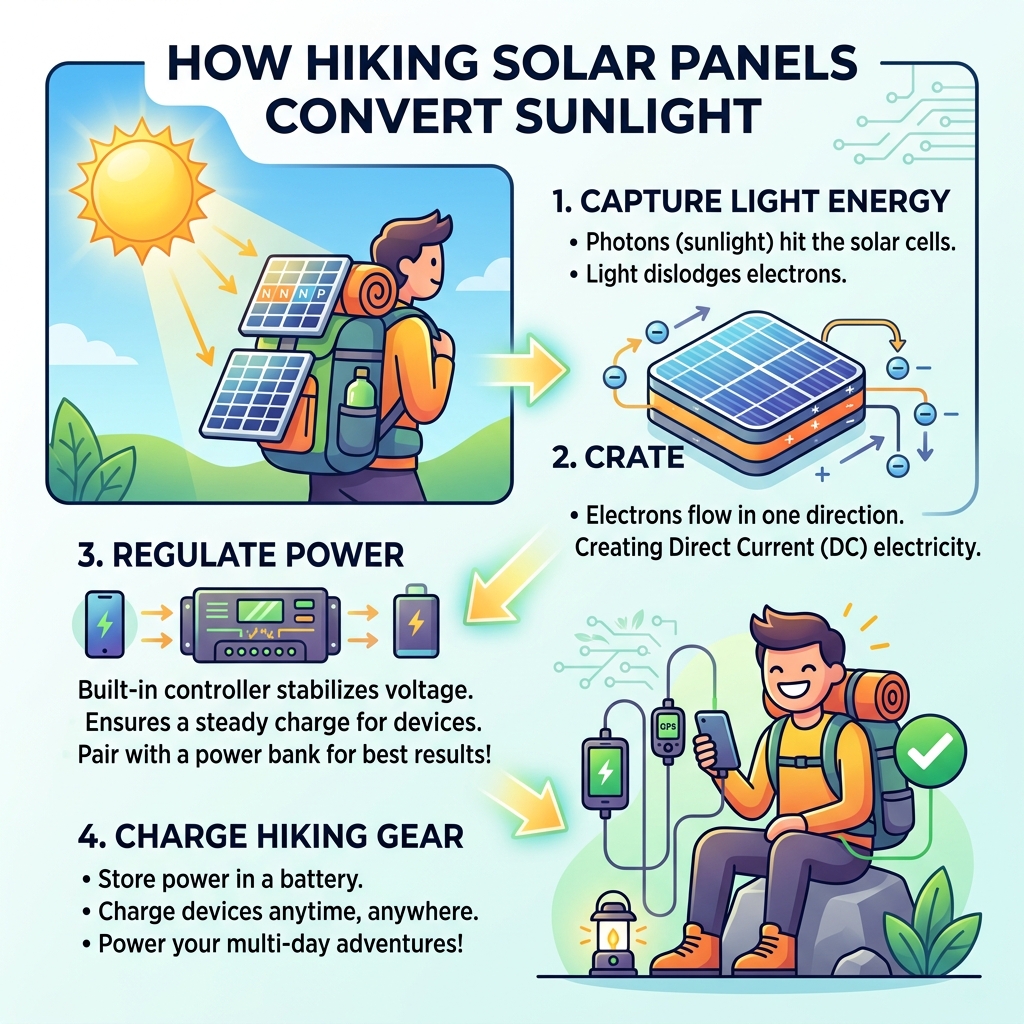
A hiking solar phone charger is one of the smartest pieces of gear you can carry on a multi-day trip. These devices utilize the photovoltaic effect to convert sunlight into electricity. Here are the top options worth considering:
Best hiking solar phone chargers at a glance:
| Model | Weight | Wattage | Best For |
|---|---|---|---|
| High-Output Foldable | 20.9 oz | 28W | Max power output |
| Ultralight Mini | 7.3 oz | 10W | Ultralight backpacking |
| Integrated Battery Panel | Moderate | 10W | Built-in battery storage |
| Versatile Multi-Day Panel | Moderate | 20W | Versatile multi-day trips |
Quick tip: Pair any solar panel with a separate power bank. Direct phone charging from solar is unreliable due to voltage fluctuations — your phone may actually reject the charge entirely.
You’re deep in the backcountry. Your phone hits 8%. The nearest outlet is two days away.
This is the exact situation that pushes hikers toward solar. And the good news is that solar chargers have gotten genuinely useful in recent years — lighter, more efficient, and more affordable than ever before.
But not all of them work the way the marketing suggests. Some take 85 hours to recharge in full sun. Others work great when stationary at camp but produce almost nothing while bouncing around on your pack.
This guide cuts through the noise with real field-tested data so you can pick the right charger for your next trip.
Key Factors in Choosing a Hiking Solar Phone Charger
When we head out into the wilderness, every ounce in our pack needs to earn its keep. Choosing a hiking solar phone charger isn’t just about picking the one with the highest wattage; it’s about finding the “sweet spot” between weight, efficiency, and reliability.
Modern commercial solar cells can convert up to 25% of sunlight into electricity, but most portable panels you’ll find for backpacking sit in the 18-21% efficiency range. While that might sound low, it’s a massive leap from the tech available just a decade ago.
Wattage vs. Weight
As we discuss in our Beginner Guide to Solar Powered Gear, wattage is the “engine size” of your panel. For a solo hiker, a 10W to 15W panel is usually sufficient for keeping a smartphone and a GPS unit topped off. If you are traveling in a group or carrying power-hungry gear like a DSLR camera or a tablet, you’ll want to step up to a 20W or 28W foldable panel.
The weight-to-power ratio is a metric many thru-hikers obsess over. A good benchmark is staying under 25g per Watt. For example, a high-quality 10W Mini weighs only about 205g, giving it an excellent ratio for those counting every gram.
Monocrystalline vs. Polycrystalline
If you see a panel that looks like a solid, dark, almost black sheet, it’s likely monocrystalline. These are the gold standard for hikers. They are more efficient in smaller sizes compared to blue-tinted polycrystalline panels, meaning you get more power for less surface area. Some high-end models even use “back-contact” cells which maximize the surface area exposed to the sun by moving the wiring to the rear of the cell.
Portability and Connectivity
A foldable design is almost mandatory for backpacking. It protects the cells when they are inside your pack and allows for a larger surface area when unfolded at camp. Look for USB-C PD (Power Delivery) compatibility if you want to charge modern devices quickly. Some larger panels even include specialized ports for charging larger power stations or laptops when paired with the right accessories. For more on the technical side, check out Solar Gadget Placement for Best Efficiency.
Hiking Solar Phone Charger Performance in Direct Sun vs. Clouds
The “rated wattage” on the box is often a “best-case scenario” measured in a lab. In the real world, performance varies wildly.
- Direct Sun: A high-performing 28W panel can generate upwards of 2,177 mAh in a single hour of direct, unobstructed sunlight. To put that in perspective, a standard iPhone battery is roughly 3,000 to 4,000 mAh. You could theoretically get a 50% charge in about an hour.
- Cloudy Conditions: This is where small panels struggle. In indirect sun or heavy cloud cover, that same 28W panel might drop to 583 mAh per hour—a 75% decrease in performance. Smaller 5W or 10W panels may stop charging your phone entirely because the output drops below the phone’s minimum charging threshold.
This is why we see “voltage fluctuations.” If a cloud passes over, the power drops. Many smartphones see this drop and stop the charging process to protect the battery. When the sun comes back out, the phone might not automatically resume charging. This is the “trickle charging” trap that frustrates many hikers. The solution? Always charge a power bank first, then use the power bank to charge your phone.
Top-Rated Solar Chargers for Backpacking
We’ve looked at the data and field tests to see which chargers actually deliver on their promises. Here is how the top categories of a hiking solar phone charger stack up:
| Category | Typical Weight | Best Use Case | Real-World Output (Direct Sun) |
|---|---|---|---|
| High-Wattage Foldable | 18–22 oz | Basecamp / Group use | ~2,000 mAh / hour |
| Integrated Battery Units | 10–15 oz | Short weekend trips | ~300–500 mAh / hour |
| Ultralight Mini Panels | 7–10 oz | Thru-hiking / Minimalists | ~1,200 mAh / hour |
High-Wattage Foldable Panels (e.g., 28W Models)
The premium 28W foldable series is a perennial favorite for a reason. In testing, it consistently outperforms other standard models. While a typical 21W panel produced about 733 mAh in an hour of testing, the high-efficiency 28W model managed nearly 950 mAh in similar conditions. These panels are rugged and often feature built-in ammeters so you can see exactly how much juice you’re getting in real-time. This is perfect for those following our Tips for Charging Gadgets Off Grid.
Integrated Panel-Power Bank Units
Units with an integrated battery feature are convenient because they handle the “voltage fluctuation” issue internally. These panels, for instance, often have a 3,200 mAh internal battery—roughly one full charge for an older smartphone. However, be wary of “solar power banks” that are just a battery with a tiny solar strip on top. Those tiny panels often take 50 to 85 hours of full sun to charge the battery completely. They are great for emergencies, but not for daily power needs.
Compact and Lightweight Designs
The 10W Mini is a standout here, weighing just 7.3 oz. Despite its tiny footprint, it generated 1,247 mAh in one hour of direct sun during field tests. For a solo hiker who just needs to keep a phone alive for navigation, this is arguably the best value and weight-saving option on the market.
Why Your Hiking Solar Phone Charger Works Best When Stationary
Marketing photos always show a hiker with a solar panel dangling off their backpack. While it looks cool, it’s often the least efficient way to use the gear.
- The Backpack Mounting Myth: When you walk, you are constantly changing direction. You go from sun to shade under trees, and the panel bounces around. Because solar efficiency relies on a perfect 90-degree angle to the sun, a swinging panel on a backpack might only operate at 10-20% of its potential.
- The 37-Degree Rule: For most of the United States, angling your panel at roughly 37 degrees (stationary) while facing south provides the most consistent energy capture.
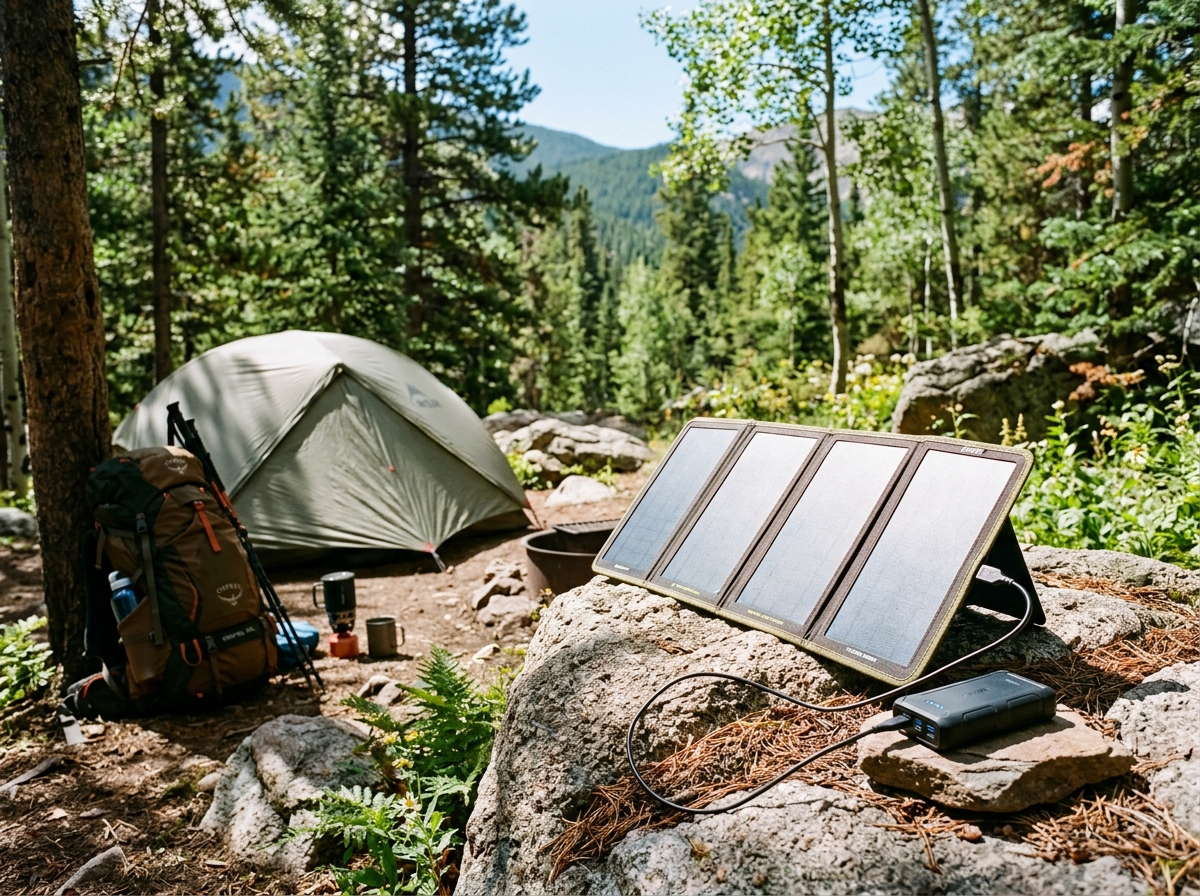
- Heat Management: Solar panels actually become less efficient as they get too hot. Propping a panel up on a rock with a bit of airflow behind it is much better than laying it flat on hot dirt or trapped against a dark backpack.
- Camp Setup: The most effective strategy is to set up your panel as soon as you reach camp or during a long lunch break. Use the grommets to secure it to your tent or a sunny rock, and let it “soak” while you relax.
Durability and Weather Resistance for Rugged Trails
The trail is a violent place for electronics. Dust, rain, and the occasional drop are inevitable.
- IP Ratings: Look for an IP67 rating. This means the device is dust-tight and can survive being submerged in a meter of water for 30 minutes. High-end rugged power banks are famous for this level of durability.
- ETFE Coating: This is a high-strength fluorine-based polymer. It’s more durable and scratch-resistant than the cheaper PET films used on budget panels. ETFE also has better light transmission, which helps with efficiency.
- CIGS Technology: Some newer panels use CIGS (Copper Indium Gallium Selenide) technology. These cells are flexible and almost unbreakable, making them ideal for being stuffed into a crowded backpack.
Maintaining your gear is key to longevity. We recommend reading How to Maximize Solar Battery Life to ensure your investment lasts for years of adventures. Additionally, Setting Up Solar Chargers in the Outdoors provides more tips on keeping your gear safe from the elements.
Frequently Asked Questions about Solar Hiking Gear
Do solar chargers work on cloudy days?
Yes, but with a major caveat. Large panels (20W+) can still “trickle charge” a power bank on a cloudy day, but it will be significantly slower—often 4 to 5 times slower than in direct sun. Small panels may not produce enough voltage to trigger the charging circuit on your devices at all.
How long does it take to charge a phone with a solar panel?
In ideal direct sunlight, a 15W to 28W panel can charge a modern smartphone in 2 to 4 hours. On a partially cloudy day or if the panel is poorly angled, expect that to double or triple. This is why we recommend charging a power bank during the day and your phone at night.
What is the difference between a solar charger and a solar power bank?
A solar charger (or panel) generates electricity in real-time but has no way to store it. A solar power bank is a battery that has a solar panel attached to it. While solar power banks seem like a “two-in-one” win, the panels on them are often too small to be the primary charging source. Think of the solar strip on a power bank as a “backup to the backup.”
Conclusion
A hiking solar phone charger is no longer a “gimmick” for gear nerds; it is a viable power solution for anyone spending more than three days off the grid. While a simple power bank is often better for short weekend trips, solar becomes the clear winner for long-distance treks where you won’t see a wall outlet for a week or more.
Based on our field tests, the most reliable setup is a high-efficiency monocrystalline panel (like a 28W foldable or 10W Mini) paired with a high-quality 10,000 mAh power bank. This combo ensures that you capture every possible photon during the day and have a steady, safe supply of energy for your devices at night.
At Rico Compouco, we believe in gear that empowers your journey rather than complicating it. For more insights on the latest in trail energy, check out Portable Solar Power Banks: The Vanguards of Outdoor Energy or Explore More Outdoor Tech Solutions to find the perfect setup for your next adventure. Happy trails!
