
The Best Solar Backpacks with Battery — Quick Answer
If you want a quick answer, here are the top solar backpacks with integrated batteries worth considering:
| Model Type | Solar Output | Battery Capacity | Best For |
|---|---|---|---|
| High-Capacity Laptop Pack | 9W | 24,000mAh (88.8Wh) | Laptops & heavy users |
| Ultra-Output 30W | 30W | No built-in battery | Max solar output |
| Everyday Off-Grid | 10W | 12,800–19,200mAh | Everyday off-grid use |
| Slim Flexible Pack | CIGS flexible cells | Up to 26,800mAh | Lightweight daily carry |
| Anti-Theft Travel Pack | ~450mAh/hr | 5 phone charges | Travel & anti-theft |
Dead batteries mid-hike. A phone dying right when you need navigation. Scrambling for an outlet in a café.
A solar backpack with battery is one of the smartest ways to solve these problems — especially if you spend serious time outdoors or commuting away from power outlets.
These backpacks do two things at once. They carry your gear and harvest sunlight to keep your devices charged. The built-in battery stores that solar energy so you can use it even after the sun goes down.
Solar panel efficiency has improved a lot in recent years. Modern backpacks use high-efficiency cells — like monocrystalline silicon (up to 20% efficiency) or flexible CIGS cells (around 16.5%) — meaning you get real, usable power from a bag you’d already be wearing anyway.
The best models can charge a smartphone in as little as 2 hours of direct sunlight, and the most powerful options can even top up a laptop battery.
Below, we break down exactly how these backpacks work, what specs matter most, and which models are worth your money.
How a Solar Backpack with Battery Works
At its core, a solar backpack with battery is a mobile power station. But how does a piece of fabric turn sunlight into a TikTok scroll? It all comes down to the layers of technology integrated into the bag’s exterior.
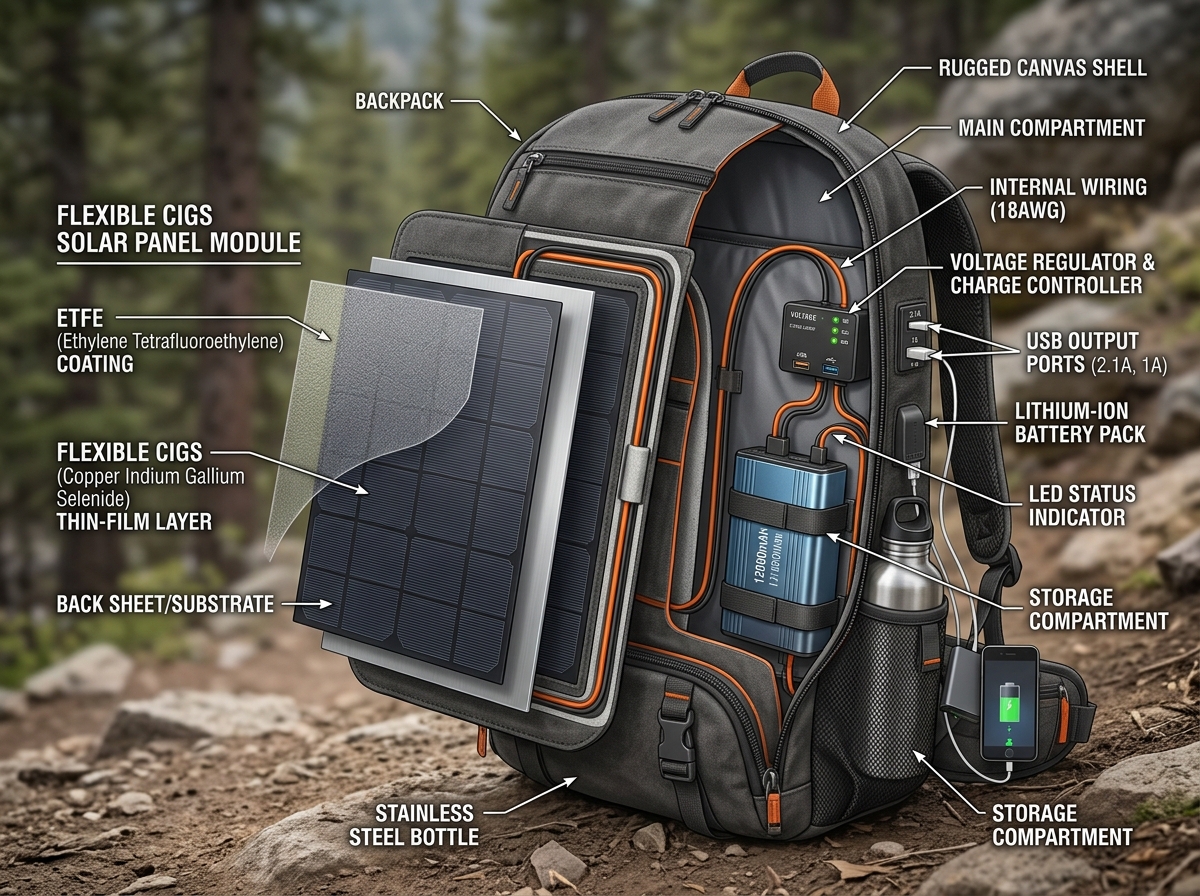
Most high-end solar backpacks utilize monocrystalline solar cells. These are the “gold standard” of solar tech, offering around 20% efficiency. They are rigid but incredibly effective at converting photons into electrons. For those who need something more rugged or lightweight, CIGS (Copper Indium Gallium Selenide) technology is a popular alternative. CIGS cells are flexible and offer the highest power-per-unit weight, making them perfect for sleek, modernist backpacks that don’t look like science projects.
To protect these cells from the elements, manufacturers often apply an ETFE (Ethylene Tetrafluoroethylene) coating. This high-strength polymer is UV-resistant, waterproof, and “self-cleaning,” ensuring that dust and rain don’t block the sun’s rays.
The magic happens in the portable solar power banks tucked inside the bag. The solar panel generates direct current (DC) electricity, which passes through a voltage regulator to ensure a steady flow. This energy is then stored in a lithium-ion battery. Without this battery, your phone would stop charging every time a cloud passed by. The battery acts as a “buffer,” providing a consistent 5V or 20V output to your devices regardless of the sun’s fluctuations.
Key Features to Look for in a Solar Backpack with Battery
Choosing the right pack isn’t just about the coolest-looking solar panel. You need to look at the “math” behind the power.
Wattage and Capacity
- Wattage (W): This determines how fast the panels can generate power. A 4W panel is fine for “topping up” a phone over several hours, while a 10W to 30W setup can actually charge devices in real-time.
- Battery Capacity (mAh or Wh): Look for at least 10,000mAh for phones. If you plan to charge a laptop, you’ll need a battery with at least 20,000mAh (roughly 88Wh) and USB-C PD (Power Delivery) capabilities.
Durability and Design
Since you’ll be using this for sustainable backpacking gear, look for a storage volume between 25L and 35L. Ensure the laptop sleeve fits your specific device (most fit 15-inch models, but some go up to 17 inches).
Sustainability and Travel
Many modern packs are made from recycled PET (old soda bottles). For example, some models use 33 recycled bottles per bag, saving pounds of plastic from entering the ocean. Additionally, check for TSA compliance. Most integrated batteries are under the 100Wh limit, meaning they are safe for carry-on luggage (but never check them in the cargo hold!).
| Feature | Low-End Models | Mid-Range Models | High-End Models |
|---|---|---|---|
| Solar Wattage | 4W – 7W | 9W – 12W | 20W – 30W |
| Battery Capacity | 4,000 – 5,000mAh | 10,000 – 15,000mAh | 24,000mAh+ |
| Weight | 2.5 – 3.0 lbs | 3.5 – 4.0 lbs | 4.5+ lbs |
| Best Use | Emergency backup | Daily commute | Week-long hiking |
Top-Rated Models for Every Activity
Whether you are a digital nomad or a mountain explorer, there is a solar backpack with battery designed for your specific lifestyle. Many of these are considered eco-friendly solar gadgets for backpackers because they reduce reliance on the grid while utilizing recycled materials.
When selecting, consider the “Zones.” Some bags offer “Work Zones” for electronics and “Life Zones” for clothes and snacks, which is a hallmark of top outdoor gadgets for backpacking trips.
High-Performance Options
For those who can’t afford to lose power, high-output models are the way to go.
- The Powerhouse: Some models feature 9W monocrystalline panels paired with a massive 24,000mAh (88.8Wh) battery. This setup is specifically designed for laptops, providing enough juice for a full charge via USB-C PD.
- The Solar King: If solar speed is your priority, look for dual-cell 30W output models. These often feature 35L of storage and are fully waterproof, making them ideal for camping and long-distance trekking where wall outlets are non-existent.
Versatile Daily Carry Options
If you’re just commuting to the office or a local park, you might not need a 30W array.
- The Commuter: Sleek designs using flexible CIGS cells offer around 16.5% efficiency. These are lightweight and often include “anti-theft” features like hidden pockets and integrated locks.
- The Eco-Traveler: Some travel-focused packs generate about 450mAh per hour in ideal sunlight. While that sounds small, it means 4 hours of walking in the sun adds a 25% charge to your phone. These are often made from sustainable fabrics like 100% recycled plastic.
Performance and Maintenance in Real-World Conditions
We’ve all seen the marketing photos of perfectly clear skies, but real life involves clouds, shadows, and dust.
Cloudy Days: Solar panels don’t stop working when a cloud passes, but their output drops significantly. However, high-efficiency cells can still harvest UV light even on overcast days. It won’t be a “fast charge,” but it will keep the battery from draining.
Maintenance: To keep your solar backpack with battery at peak performance, you must keep the panels clean. A layer of dust can reduce efficiency by 10% or more. Use a microfiber cloth and a tiny bit of water to wipe the panels down after a dusty hike. Maintaining solar power banks also involves keeping the battery away from extreme heat (don’t leave the bag inside a baking car in July!).
Temperature: Solar panels actually perform better in cooler temperatures, but the internal lithium batteries hate the cold. If you’re hiking in winter, the solar panel will be fine, but try to keep the battery pack tucked deep inside the bag near the warmth of your gear to maintain its capacity. Check out our guide on top solar chargers for outdoor use for more environmental tips.
Frequently Asked Questions about Solar Backpacks
Can a solar backpack with battery charge a laptop?
Yes, but with caveats. To charge a laptop, you need a solar backpack with battery that supports USB-C PD (Power Delivery) and has a battery capacity of at least 20,000mAh (roughly 70-88Wh). A standard 5V USB port used for phones won’t have enough “push” (voltage) to charge a laptop. High-performance models are specifically built for this, featuring 18V output options to handle power-hungry devices. Using these high-capacity packs is a great way to upgrade your backpacking game if you need to work from the trail.
Are solar backpacks with battery TSA-friendly for air travel?
Generally, yes. The FAA and most international airlines allow lithium-ion batteries in carry-on luggage as long as they are under 100 Watt-hours (Wh). Most solar backpack batteries fall between 45Wh and 90Wh. Crucially, you must never check these bags in the cargo hold. If you are asked to gate-check your bag, you must remove the battery pack and bring it into the cabin with you.
How long does it take to charge a phone via solar?
In direct, peak sunlight, a high-quality 10W panel can charge a standard smartphone in about 2 to 3 hours. However, if you are charging the internal battery first, it may take 4-6 hours of sunlight to store enough energy for a full phone charge. Think of the solar panel as a “trickle charger” that works while you walk, and the battery as the “fast charger” you use when you take a break.
Conclusion
Investing in a solar backpack with battery is about more than just gadgets; it’s about independence and sustainability. By choosing packs made from recycled plastic bottles and powered by the sun, we reduce our environmental footprint while staying connected to the tools we need.
Whether you’re navigating a new city or trekking through a national park, having a reliable, renewable power source on your back changes the way you travel. At Rico Compouco, we believe the best adventures are the ones where you never have to look for a wall outlet.
Ready to find your perfect match? Explore more at Rico Compouco Solar Gadgets and power up your next journey.
