
What a Portable Solar Power Generator Kit Actually Does (And Why It Matters)
A portable solar power generator kit is a complete, self-contained system that captures sunlight and converts it into usable electricity — no gas, no noise, no grid required.
Here’s what you get in a typical kit:
- Solar panels — capture sunlight and convert it to DC electricity
- Power station — stores that electricity in a built-in battery
- Inverter — converts stored power to AC electricity for standard devices
- Charge controller — manages how power flows to protect the battery
- Cables and connectors — everything needed to plug in and go
Quick answers to what most people want to know:
| Question | Short Answer |
|---|---|
| What can it power? | Phones, laptops, fridges, lights, small appliances |
| How does it recharge? | Sun, wall outlet, car port, or all at once |
| How long does it last? | Quality LFP batteries last 4,000+ charge cycles (~10 years) |
| Is it quiet? | Yes — as low as 30dB, quieter than a whisper |
| Is it safe indoors? | Yes — zero emissions, safe for indoor use |
If you’re tired of hauling extra batteries or hunting for outlets on a camping trip, you already understand the problem these kits solve.
Off-grid adventures, emergency home backup, RV road trips — the use cases are real and growing. And with solar panel conversion rates now reaching up to 25% and fast-charging technology cutting recharge times to under two hours, the technology has finally caught up with the need.
This guide breaks down exactly how these kits work, what to look for, and how to get the most out of one.
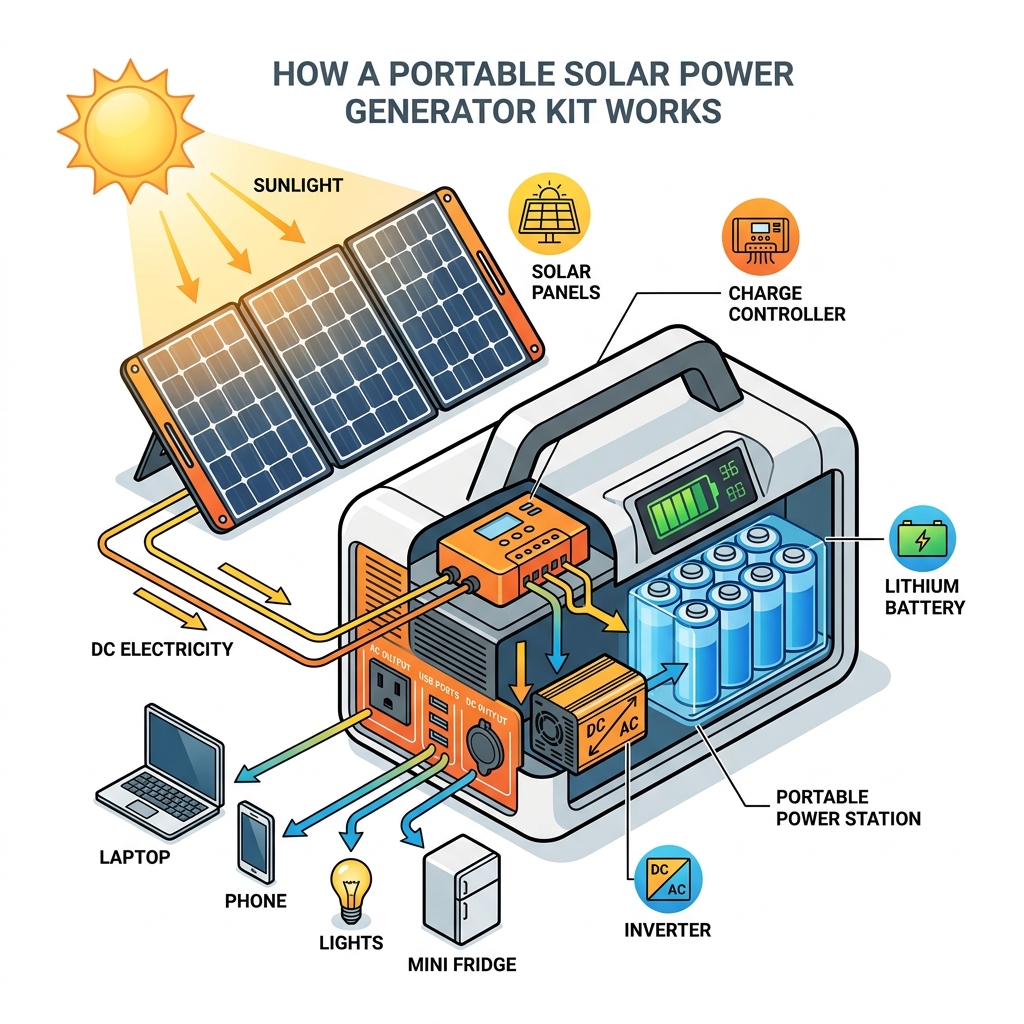
Anatomy of a Portable Solar Power Generator Kit
To understand how a portable solar power generator kit works, we need to look under the hood. While it might look like a simple plastic box, it is actually a sophisticated piece of electrical engineering. We like to think of it as a miniature power plant that you can carry with one hand.
Photovoltaic (PV) Panels
The journey begins with photovoltaic (PV) panels. Most portable kits use monocrystalline silicon panels because they offer the highest efficiency in a small footprint. Modern panels have reached impressive conversion rates of up to 25%, meaning they are better than ever at turning photons into electrons. You will generally find two types: “Nomad” style panels that are foldable and lightweight for hikers, and “Boulder” style panels that are rugged and rigid for semi-permanent setups on an RV or at a cabin.
The Battery: LiFePO4 vs. Standard Lithium-ion
The “heart” of the kit is the battery. In the past, most generators used standard Lithium-ion (NCM) batteries. However, the industry has shifted toward LiFePO4 (Lithium Iron Phosphate or LFP) cells.
Why does this matter to us?
- Longevity: LFP batteries typically offer 3,000 to 4,000 cycles to 80% capacity. That is roughly 10 years of daily use, which is about 25% above the old industry standard.
- Safety: They are much more thermally stable, meaning they are less likely to overheat or catch fire.
- Durability: They handle being left at a high state of charge better than standard lithium.
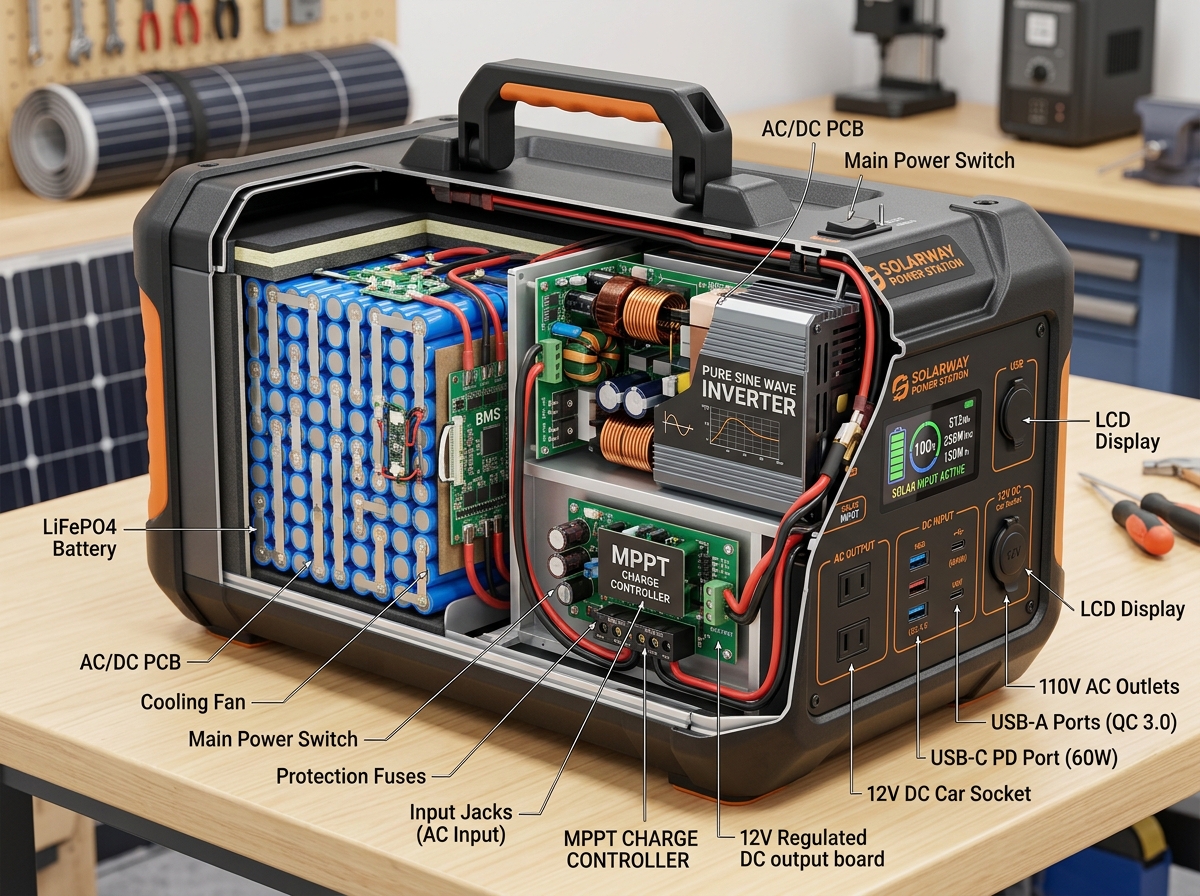
Pure Sine Wave Inverter
Batteries store power as Direct Current (DC), but your toaster and laptop charger need Alternating Current (AC). The inverter does this conversion. We always recommend looking for a Pure Sine Wave inverter. Cheaper “modified” sine wave inverters can produce “dirty” power that might hum, flicker, or even damage sensitive electronics like CPAP machines or high-end laptops.
MPPT Charge Controller
Think of the Maximum Power Point Tracking (MPPT) controller as the “brain.” Solar panel output fluctuates constantly based on cloud cover and the angle of the sun. The MPPT controller ensures that the power station is pulling the maximum possible wattage from the panels at any given moment. High-end kits boast an MPPT efficiency of 99%, ensuring almost no energy is wasted during the transfer.
To make sure your investment lasts as long as possible, it is vital to understand how to maximize solar battery life through proper cycle management and temperature control.
Choosing the Right Capacity and Features
Choosing a portable solar power generator kit can feel like a math test you didn’t study for. You’ll see numbers like 300Wh, 1000W, and 3600W surge. Let’s simplify those terms so we can pick the right gear.
- Watt-hours (Wh): This is the size of your “fuel tank.” A 1000Wh battery can theoretically power a 100W device for 10 hours.
- Continuous AC Output (Watts): This is how much “speed” the generator has. If you want to run a 1500W coffee maker, your generator needs a continuous output of at least 1500W.
- Surge Power: Some devices, like refrigerators or power tools, need a massive burst of energy just to start up. A good kit might have a 1800W continuous rating but a 3600W surge rating to handle those initial “kicks.”
We also look for port variety. A modern kit should have multiple AC outlets, USB-A ports, and at least one 100W USB-C PD (Power Delivery) port for fast-charging laptops without needing a bulky wall brick.
Sizing Your Portable Solar Power Generator Kit for Different Needs
Not everyone needs to power a whole house. Here is how we categorize the kits based on what you actually intend to do with them:
Small Capacity (Under 500Wh) These are the “weekend warriors.” They usually weigh less than 10 pounds and are perfect for charging phones, tablets, and running LED camp lights. If you are a backpacker, these are your best friends. You might pair a 300Wh station with a 50W foldable panel for a setup that recharges in about 7 hours of good sun. Check out our guide on top solar chargers for outdoor use 2026 for more on these lightweight options.
Medium Capacity (500Wh–2kWh) This is the “sweet spot” for most campers and RVers. These units can run a portable fridge for 20-30 hours, power a TV, or run a blender at a tailgate. A 1000Wh unit paired with a 200W solar panel is a classic combination. Some of the latest models in this range can charge from 0% to 80% in just 56 minutes using a wall outlet, or about 2 hours with 500W of solar.
Large Capacity (2kWh+) These are heavy-duty machines meant for home backup or off-grid living. They can weigh 40 to 100 pounds and often come with wheels. We’ve seen units that can be expanded with extra batteries to reach 12kWh or even 60kWh—enough to power a whole house for days. These units often support 240V output for heavy appliances like dryers or well pumps.
Maximizing Efficiency with a Portable Solar Power Generator Kit
Getting the most out of your kit isn’t just about buying the biggest battery; it’s about how fast you can fill it back up.
- Solar Panel Wattage: If you have a 1000Wh battery and a 100W panel, it will take at least 10 hours of perfect sun to charge. If you use a 400W panel, that time drops to under 3 hours.
- The 800W Car Power Factor: Some newer kits allow for incredibly fast charging from your car—up to 800W, which is 8 times faster than the standard cigarette lighter port. This means you can fully charge while driving to your next destination in about 1.3 hours.
- Weather and Placement: Solar panels are sensitive. Even a small shadow from a tree branch across one corner of a panel can drop efficiency by 50%.
For the best results, we recommend setting up solar chargers in the outdoors by angling them directly toward the sun and moving them every few hours as the sun travels across the sky.
Benefits Over Traditional Gas Generators
We often get asked, “Why should I spend more on a solar kit when I can buy a gas generator at the hardware store for half the price?” It’s a fair question, but the benefits of solar go far beyond the initial price tag.
- Silence is Golden: Gas generators are loud (usually 60-70dB). A high-quality portable solar power generator kit operates at an ultra-quiet 30dB when under a moderate load (600W). That is quieter than a library and blends perfectly with natural ambient noise.
- Indoor Safety: Gas generators produce carbon monoxide, meaning they must stay outside, far from windows. Solar generators produce zero emissions. You can keep one right next to your bed to power a CPAP machine or in the kitchen to keep the fridge running during a storm.
- Low Maintenance: Gas engines have spark plugs, oil, air filters, and fuel lines that gum up if not used. A solar generator has no moving parts. You don’t have to worry about storing stabilized gasoline or doing oil changes.
- Cost Savings: While the upfront cost is higher, the “fuel” is free. You can save 50% or more on the lifetime cost of a solar power system compared to buying gas every time the power goes out. Plus, many large kits qualify for the 30% Residential Clean Energy Tax Credit, which can put nearly a thousand dollars back in your pocket.
If you’re ready to make the switch, you can explore portable solar power generator kits that fit your specific power needs.
Maintenance and Long-Term Care
Even though these kits are “low maintenance,” they aren’t “no maintenance.” If you want your LFP battery to actually last those 10 years, follow these expert rules we live by:
- The 60-80% Storage Rule: If you aren’t using your generator, don’t store it at 100% or 0%. Batteries are happiest when they are “resting” at about 60-80% charge. This prevents the chemistry from degrading.
- The 3-Month Recharge Cycle: Even when turned off, batteries slowly lose charge. Set a calendar reminder to pull your kit out every three months, check the level, and top it off if it has dropped below 50%.
- Temperature Control: Most kits are rated for storage between 0°C and 40°C (32-104°F). Storing a generator in a freezing garage or a sweltering attic will significantly shorten the battery’s lifespan.
- Keep it Clean: Dust and pollen on your solar panels can act like a shade, blocking the sun. Wipe the glass down with a damp cloth and a little mild soap. Avoid abrasive cleaners that could scratch the surface.
Frequently Asked Questions
Can I use third-party solar panels?
Yes, in most cases! Most portable solar power generator kits use standard connectors like the Anderson port or MC4 connectors. However, you must check two things:
- Voltage: Ensure the panel’s open-circuit voltage (Voc) is below the generator’s limit (often 60V for small units, up to 150V for large ones).
- Polarity: Use a multimeter to ensure the positive and negative wires match. While third-party panels work, we often suggest staying within the brand’s ecosystem for the best efficiency and plug-and-play simplicity.
How long will it power my fridge?
This depends on the “Duty Cycle” of your fridge. A modern energy-efficient fridge doesn’t run 24/7; it kicks on and off. On average, a full-sized fridge uses about 1kWh to 1.5kWh per day.
- A 1000Wh capacity generator will likely power a fridge for about 15-20 hours.
- A 3000Wh capacity unit can easily keep things cold for 2-3 days without any solar input.
Are solar generators waterproof?
Most power stations are not waterproof. They have cooling fans and vents that allow water to reach the internal electronics. However, the solar panels themselves usually have an IP65 or IP67 rating, meaning they can handle a splash or a light drizzle. If a storm is coming, we always bring the power station inside and cover the panels.
For more technical troubleshooting and deep dives, explore portable solar power generator kits on our main collection page.
Conclusion
The era of relying solely on noisy, smelly gas engines for backup power is coming to a close. Whether you are looking for a way to keep your phone charged while backpacking or you want a reliable way to keep your lights on during a blackout, a portable solar power generator kit offers a clean, quiet, and increasingly affordable solution.
By understanding the “anatomy” of your kit—from the LFP battery cells to the efficiency of the MPPT controller—you can make an informed choice that provides energy independence for a decade or more. At Rico Compouco, we believe the best way to predict the future is to power it yourself.
Ready to cut the cord? Start your solar journey today and find the kit that brings the sun into your box.
